




 Share








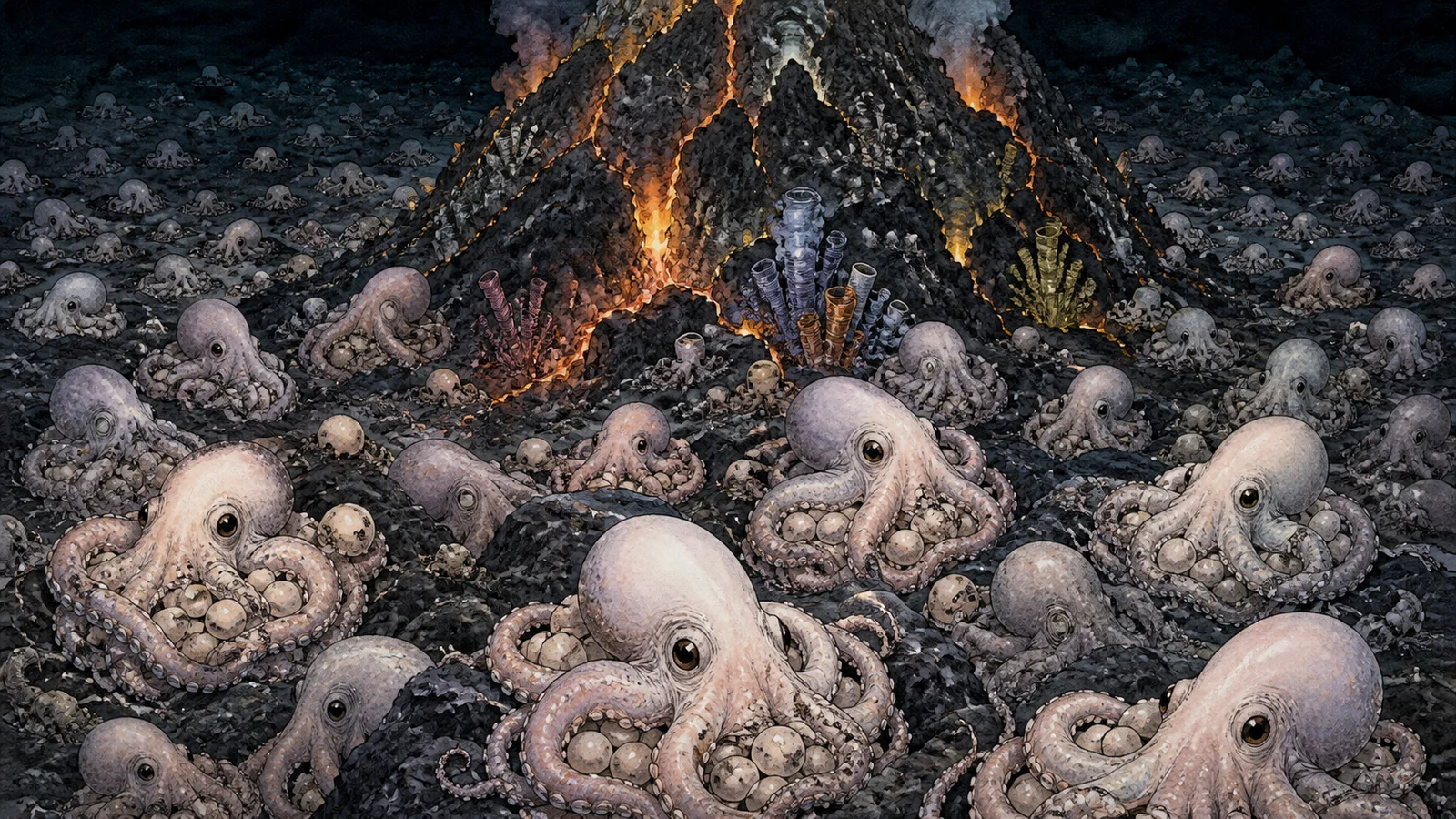
Near the base of Davidson Seamount off central California, a patch of dark seafloor holds the largest known gathering of octopuses on Earth. Thousands of pearl octopuses settle over cracks and crevices, each nesting mother guarding eggs. The site is 3,200 meters below the surface, where ordinary seawater is about 1.6 degrees Celsius. Inside the nesting cracks, thermal springs lift the temperature to nearly 11 degrees.
That modest-looking difference rewrites the nursery's clock. In near-freezing ambient water, researchers projected that the eggs would take five to eight years to develop. At the Octopus Garden, monitored broods hatched in less than two. Warmth increases the metabolism of mothers and embryos, shortening the long period during which a guarded clutch can be damaged or eaten.
MBARI surveys counted nearly 6,000 octopuses in part of the site and estimated that the full nursery could hold more than 20,000. Water percolating beneath the seafloor picks up heat before seeping through volcanic rock, sometimes visible only as a shimmer. The under-two-year hatching time is observed; five to eight years is a cold-water projection. This is not an octopus city built around comfort. It is a nursery gathered around time.

The Octopus Garden sits on a small hill near the base of Davidson Seamount, an inactive undersea volcano about 130 kilometers southwest of Monterey. Its depth—roughly 3,200 meters—places it in an environment of darkness, high pressure, and water just above freezing. Researchers from NOAA and Nautilus Live encountered the vast nesting aggregation, and MBARI teams returned with remotely operated vehicles, cameras, temperature sensors, and mapping tools to ask the obvious question: why here?
The animals are pearl octopuses, Muusoctopus robustus. They migrate to the site to mate and nest. A female settles over a clutch attached among rocks and guards the developing eggs. Deep-sea incubation is usually a punishingly slow commitment because cold water slows metabolism. The mother remains with the eggs rather than leaving to resume ordinary feeding, so every added year stretches a period of exposure for both parent and brood.
Temperature revealed the site's advantage. Water away from the springs measured about 1.6 degrees Celsius, close to 35 degrees Fahrenheit. Within cracks occupied by nesting octopuses, it approached 11 degrees Celsius, about 51 degrees Fahrenheit. That is not a tropical bath, but biologically it is an enormous change. The warmer pocket accelerates metabolism in the embryos and the brooding females, moving development forward far faster than the surrounding abyss would.
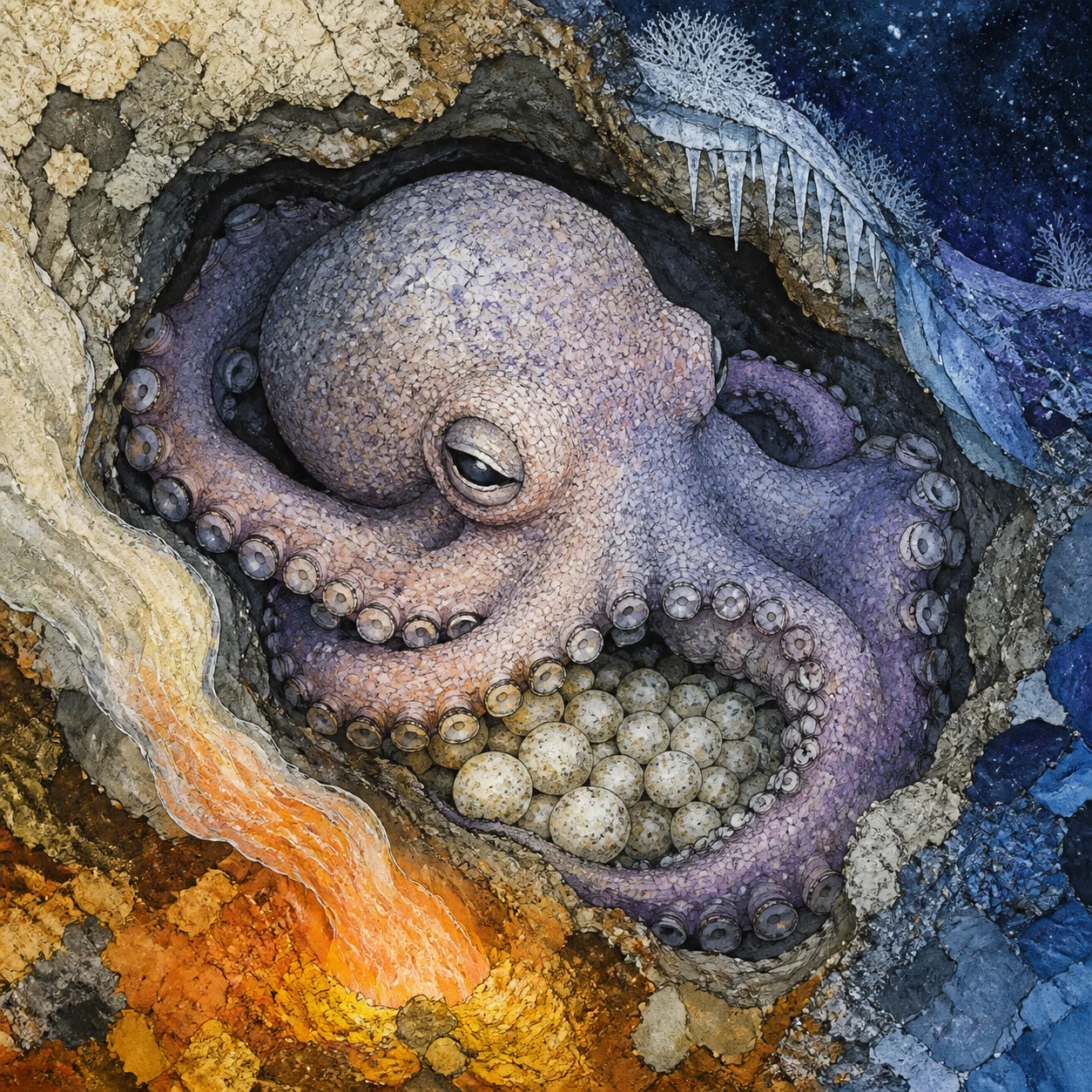
The comparison must be stated carefully. Based on development in near-freezing conditions, researchers projected a five-to-eight-year incubation, perhaps longer. At the warm nursery, observed eggs hatched in less than two years. The shorter number came from monitoring the actual site; the longer number is a cold-water projection. Keeping that distinction visible makes the result stronger, because the thermal benefit is measured without pretending scientists watched an identical cold-water clutch for eight years.
A shorter brood period changes risk. Eggs attached to the seafloor can be injured or eaten, and a guarding mother must remain through the development. Warmth cannot guarantee every embryo survives, but it reduces the time the brood spends in that vulnerable state. In evolutionary terms, the spring does not need to feel comfortable to an octopus. It needs to move the reproductive clock enough that nesting there produces a better chance of successful young.
The count is almost as startling as the mechanism. A detailed survey found nearly 6,000 nesting octopuses in the central area. From the mapped habitat, researchers estimated that the nursery could contain more than 20,000 animals or nests in total. That makes it the largest known octopus aggregation. “Known” matters: it describes what exploration has documented, not a claim that every deep ridge on Earth has been searched.
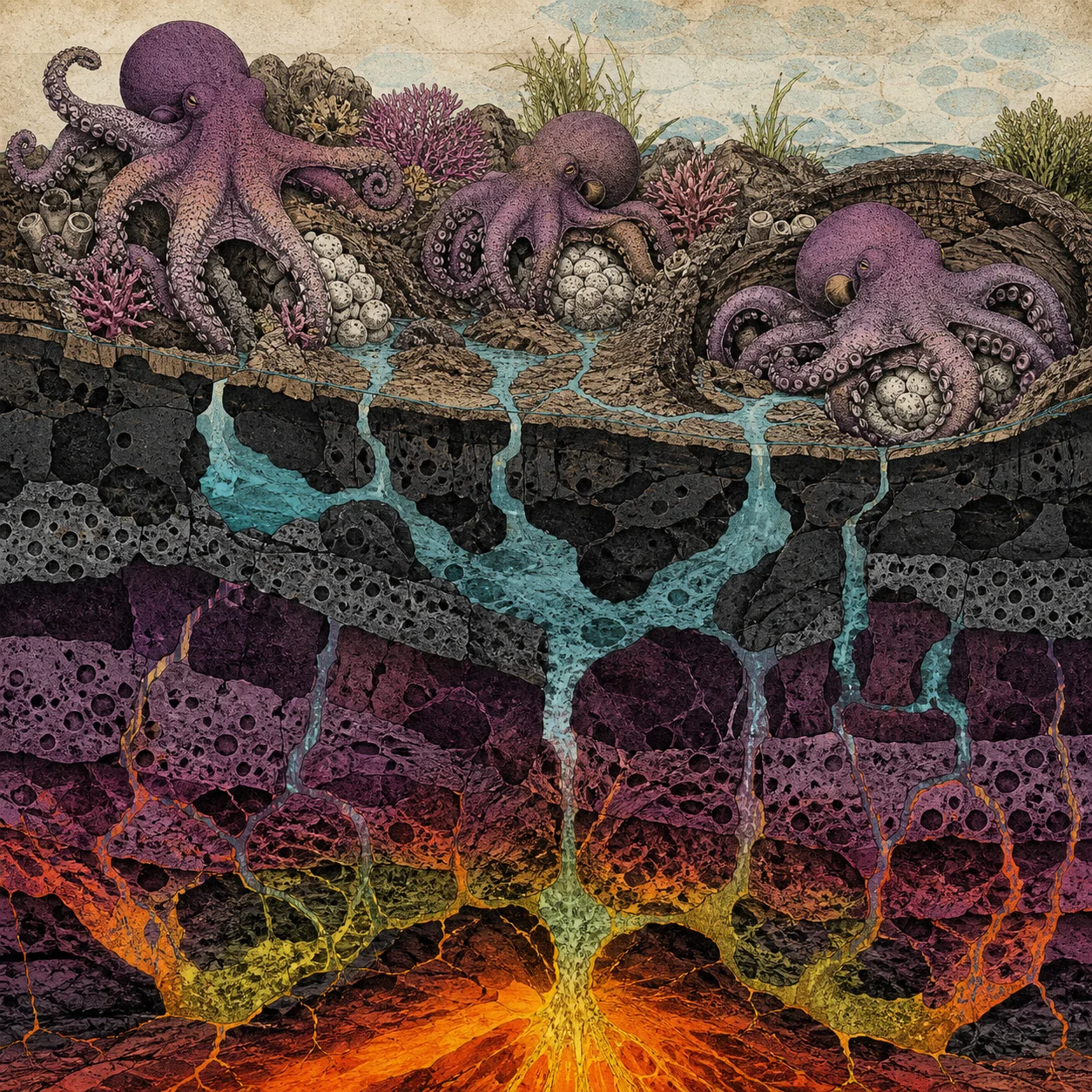
The heat source is a ridge-flank hydrothermal system. Seawater moves beneath the seafloor, warms as it circulates through the crust, and returns through volcanic rock. Unlike spectacular black-smoker vents that announce themselves with tall plumes, these springs can be cryptic. Their warmth dissipates only a short distance above the bottom, and a slight distortion in the water may be the clearest visible clue. The nursery marks a hidden flow with thousands of pale bodies.
Long monitoring suggests the spring environment can remain stable, potentially releasing warm fluid for very long spans. It also supports other life around the nesting grounds. Similar octopus nurseries near hydrothermal springs elsewhere in the eastern Pacific suggest that these quiet flows may create biological hotspots more often than scientists once recognized, though each site still needs its own observation rather than being folded into one universal rule.
Davidson Seamount and the nursery are protected within Monterey Bay National Marine Sanctuary. That protection matters because the story depends on repeated access: one dive can reveal a crowd, but time-series measurements reveal temperatures, hatching intervals, and persistence. The Octopus Garden became understandable when cameras and sensors stayed long enough to see eggs change, mothers brood, and the warm cracks keep flowing.
The visual spectacle is thousands of octopuses. The deeper discovery is a relationship between geology and development: heat carried through rock alters the biological cost of waiting. A small temperature refuge on a cold seafloor concentrates reproduction at a scale visible from a robot, turning an otherwise hidden hydrothermal system into a living map.
Sources