Share
Share







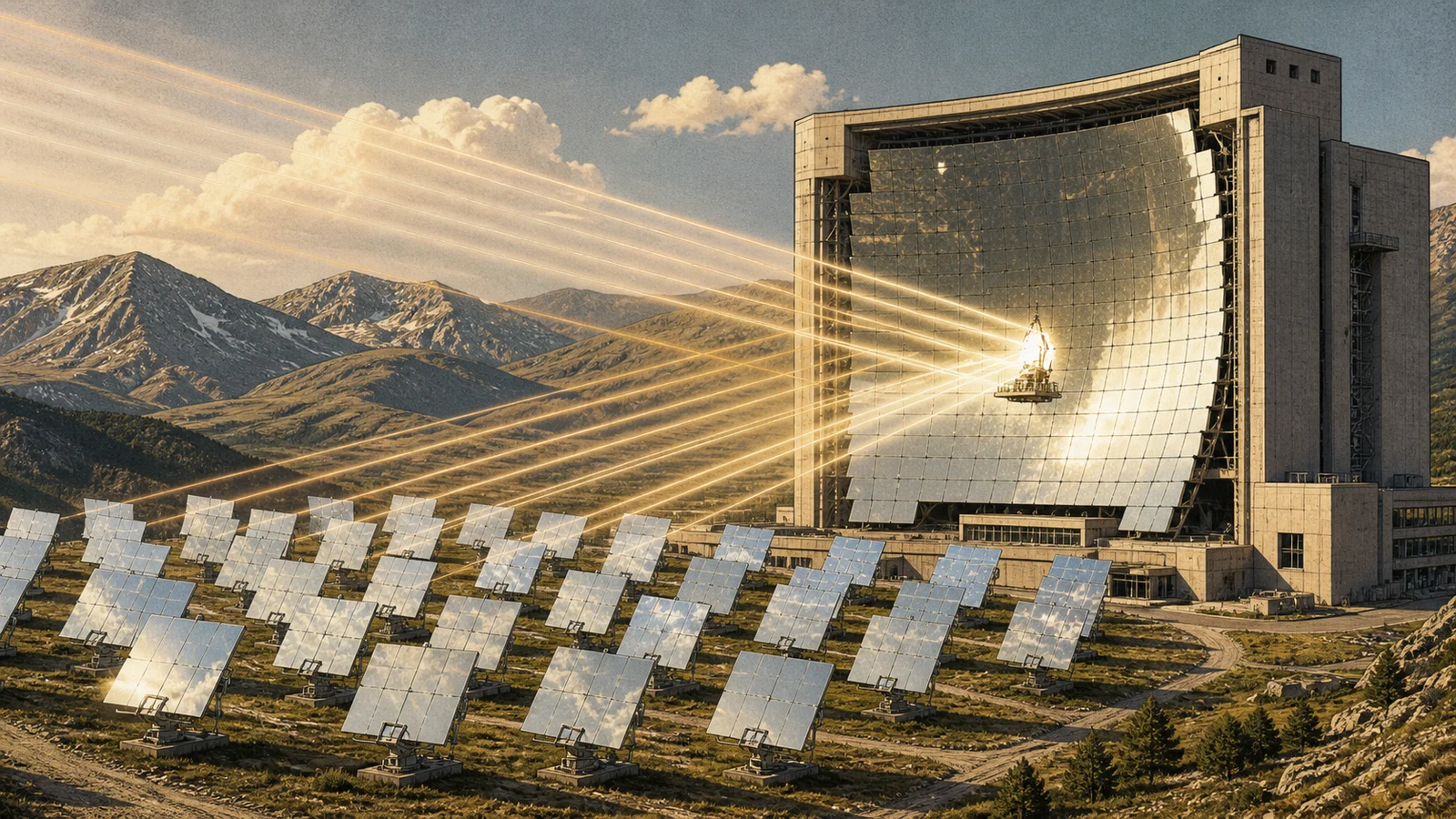
From a distance, the solar furnace at Odeillo looks as though someone tiled the side of a building with a single enormous eye. Its curved reflector is forty meters high and fifty-four meters wide, a grid of mirror panels facing a field in the French Pyrenees. The building does not generate light. It waits for sixty-three other mirrors to deliver it.
Those smaller mirrors are heliostats. Each follows the sun across the sky and adjusts its angle so the reflected rays keep landing on the same giant parabolic surface. The parabola gathers that spread-out light and redirects it again toward a focal zone. By the time the rays arrive, roughly one megawatt of solar power has been concentrated into an area small enough for high-temperature research. PROMES, the CNRS laboratory operating the furnace, states that the system can exceed 3,000 degrees Celsius.
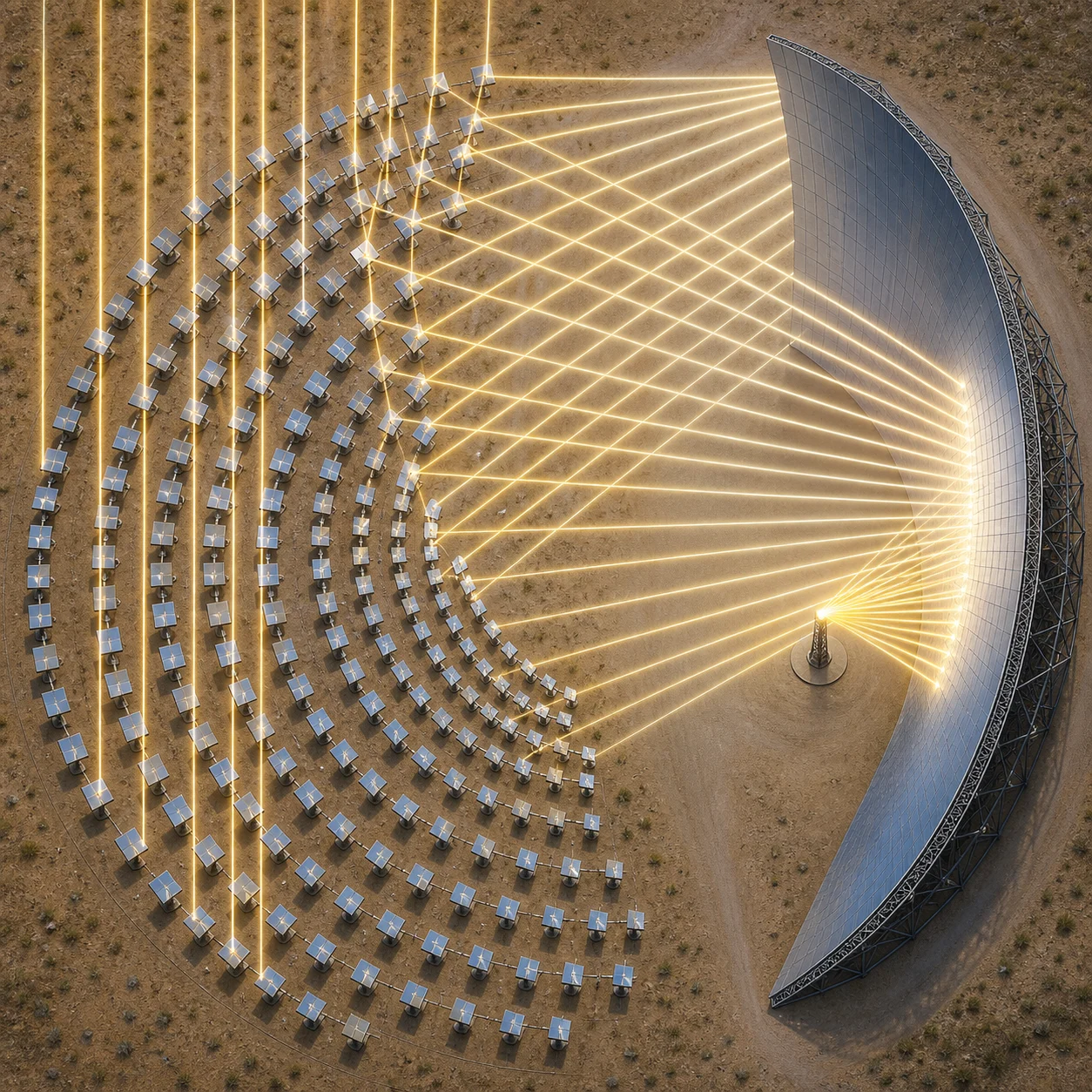
The path explains the facility's strange architecture. A parabolic mirror normally focuses light arriving along its axis. The sun moves, but the huge reflector does not need to rotate with it because the heliostat field turns wandering sunlight into a controlled incoming beam. The first mirrors aim; the second mirror concentrates. The target sits at the optical focus in front of the mirrored facade, inside experimental equipment built to handle an extreme flux of energy.
Calling the machine a furnace is accurate, but it can suggest a chamber full of burning fuel. Odeillo creates heat without combustion at the focal point. That matters for experiments because a flame introduces its own hot gases and chemical products. Concentrated sunlight can heat a specimen rapidly while leaving researchers more control over the surrounding atmosphere and the material being tested. The energy source is bright enough to see and clean enough, in principle, to separate the heat from a burner.
One megawatt describes a rate of incoming solar power, not a reservoir stored in the building or a claim that every target absorbs all of it. Mirrors have optical losses, the focal distribution has shape, and experimental equipment intercepts the beam according to its design. Temperature is not power translated through one universal formula; it emerges from flux, material properties, heat loss, geometry, and time. That is why the facility's instrumentation and controls matter as much as the mirror dimensions.
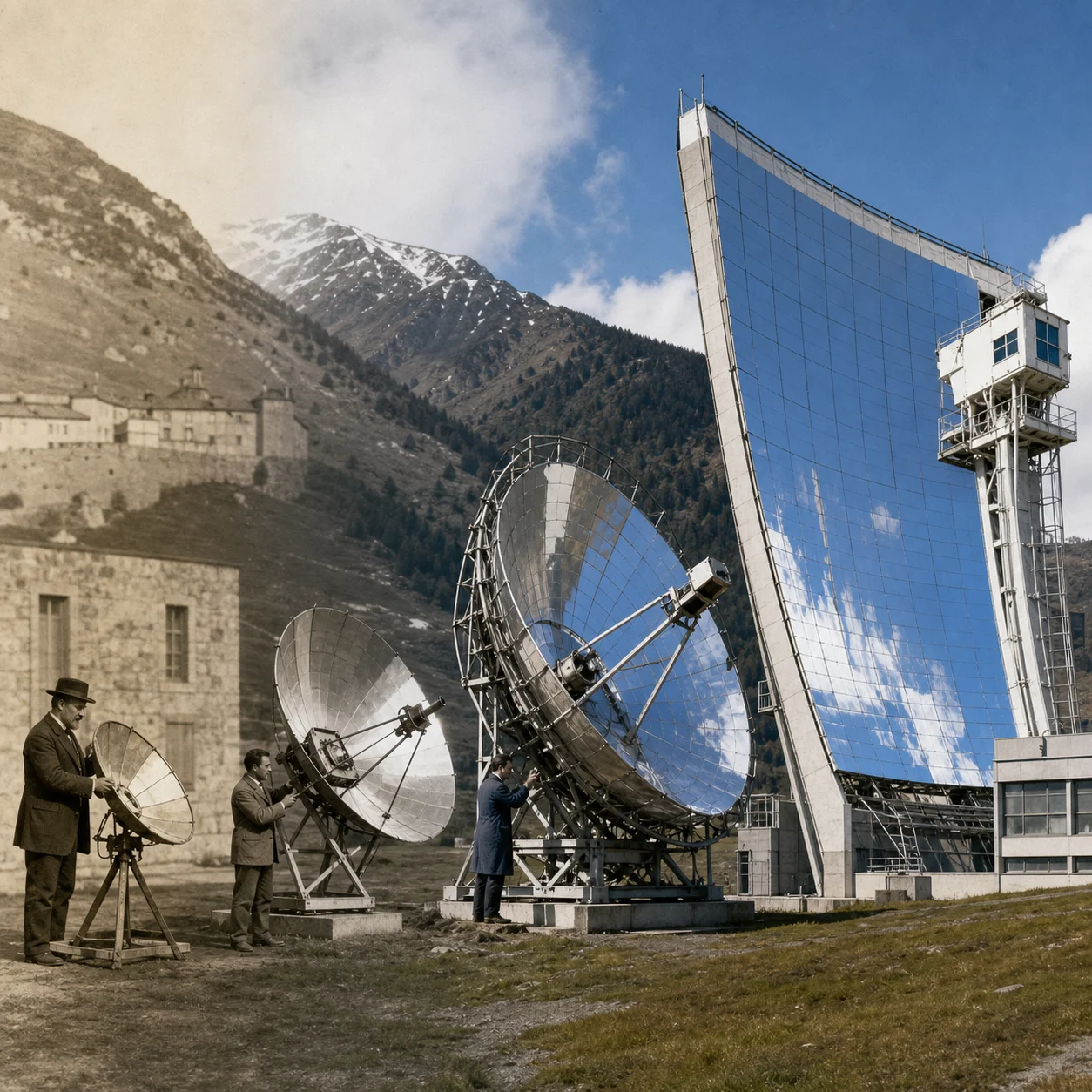
The furnace grew from a longer French program of solar concentration. In the late 1940s, engineer Félix Trombe and colleagues revived experiments in obtaining high temperatures from solar radiation. A two-kilowatt setup led to a fifty-kilowatt furnace at Mont-Louis, which became a model for the much larger Odeillo facility. CNRS laboratories moved to Odeillo in 1968, and the thousand-kilowatt furnace entered a period of growing research use in the 1970s.
Its assignments changed with scientific and energy priorities. Early work emphasized chemistry, metallurgy, and materials at high temperature. The oil crisis renewed interest in solar power systems, including boilers and energy storage. Later research returned strongly to testing materials, including those intended for space applications. PROMES also describes programs involving high-temperature solar processes, hydrogen and other energy carriers, innovative materials, and new generations of concentrated solar power. The mirrors are one instrument that can serve many questions.
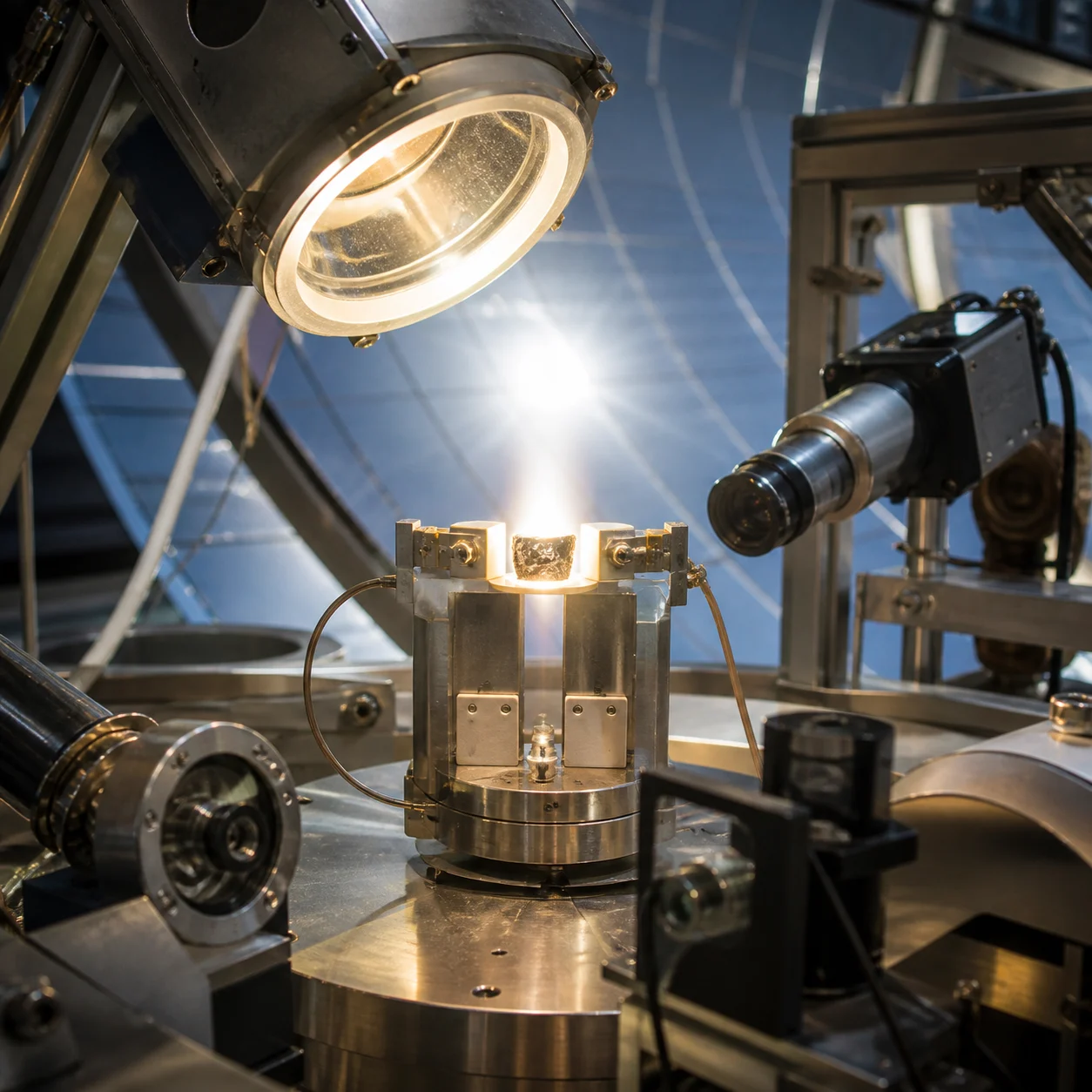
An experiment does not simply place an object in the focus and hope. Researchers control how much reflected light reaches the target and for how long. Depending on the setup, shutters or groups of heliostats can regulate the input. Instruments monitor temperature, energy, material response, and reaction products. The useful achievement is not merely making something spectacularly hot; it is producing an intense, controllable thermal condition that can be repeated and measured.
The headline temperature differs between the two cited sources. PROMES currently states temperatures above 3,000°C, while an older CNRS film cites a maximum up to 3,400°C. Those are source-specific maximum capabilities, not the temperature maintained during every experiment or across the entire focal apparatus. The actual condition depends on the target, alignment, solar input, controls, and research goal. A solar furnace is not one fixed thermostat.
Weather imposes the most obvious limit. The system requires direct sunlight for the heliostats to collect and deliver. Odeillo's high, clear Pyrenean setting is part of the engineering context, but even a mountain sky varies. Unlike a fuel-fired furnace, the primary energy arrives on nature's schedule. The elaborate mirror field exists to make that variable source useful when it is available.
At full concentration, the visual metaphor becomes unavoidable: the building gathers a broad patch of daylight and folds it into a point. Yet nothing supernatural happens between field and focus. Every stage obeys familiar optics. Flat mirrors maintain direction; a parabola brings parallel rays together; absorption turns radiation into heat. Scale is what makes the result feel impossible. Sixty-three reflections become one reflection, one reflection becomes a focal spot, and mountain sunshine becomes an experimental furnace hotter than three thousand degrees.