





 Share







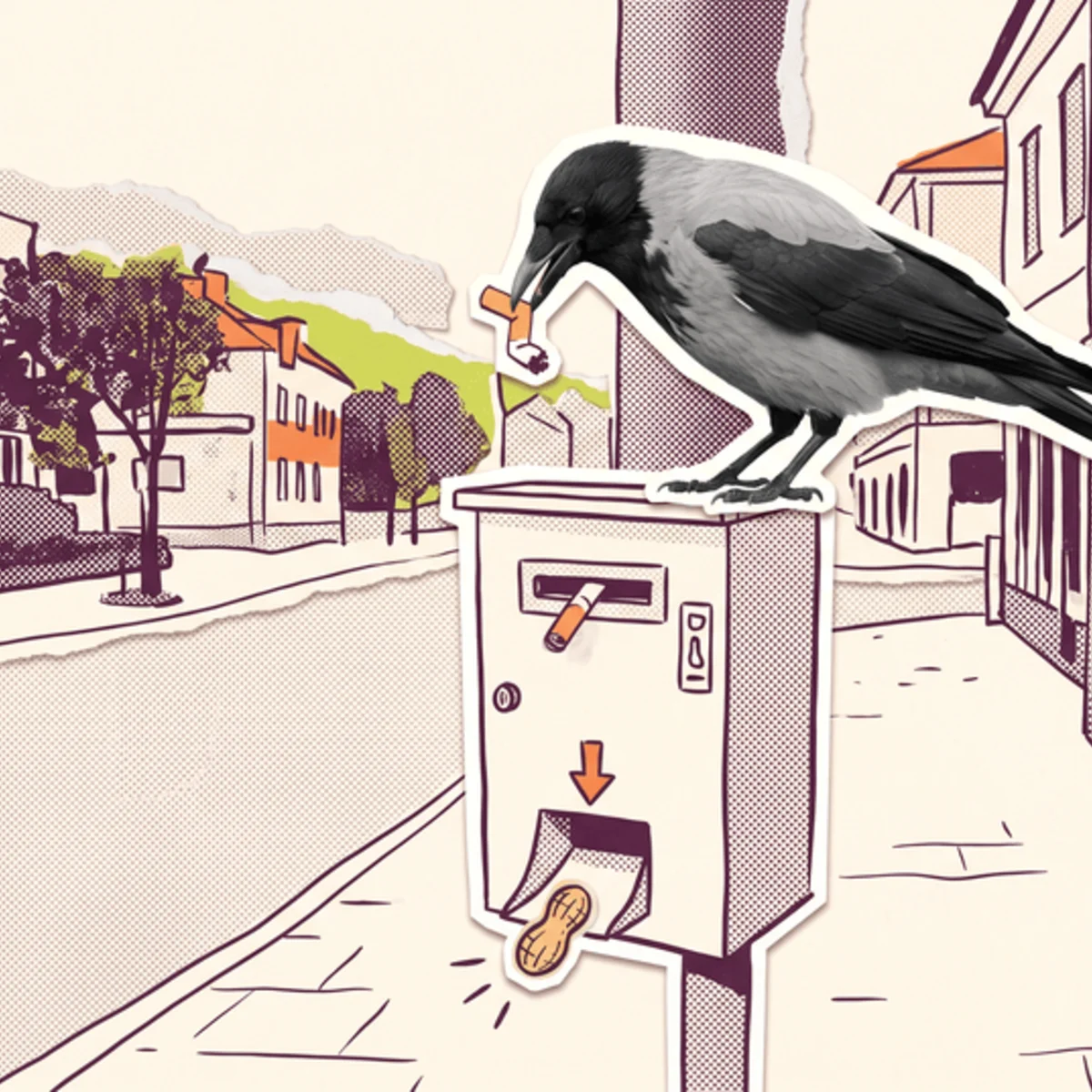
The most famous crow cleanup crew in Sweden never reported for work. Online retellings often describe wild hooded crows patrolling Södertälje, collecting cigarette butts, and feeding them into a machine for peanuts. Corvid Cleaning did develop that machine and conduct company-led training experiments. The citywide workforce, however, was a proposal that became a finished fact as it traveled across the internet.
The problem behind the idea was real. Swedish anti-litter organization Håll Sverige Rent has estimated that roughly one billion cigarette butts are discarded in Sweden each year. The widely repeated claim that butts make up 62 percent of Swedish litter comes from the organization's 2020 national litter measurement; it is a measurement result, not a permanent percentage for every street and every year. Filters are small, easy to drop, and labor-intensive to remove individually.
Christian Günther-Hanssen began exploring whether corvids could help in 2013 while studying at Lund University. According to a later published case study, he ran early behavior tests that year, built another prototype in 2019, and tested at a recycling center in Täby. The experiments did not begin with cigarettes. Training progressed in stages, allowing hooded crows to become familiar with a food dispenser and then rewarding them for interacting with tokens or sticks. The case study reports that several birds had reached an advanced training stage by 2021.
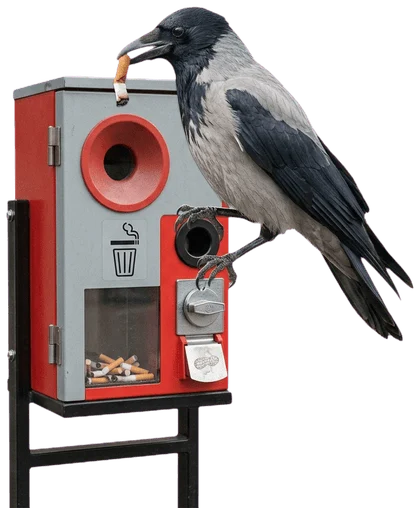
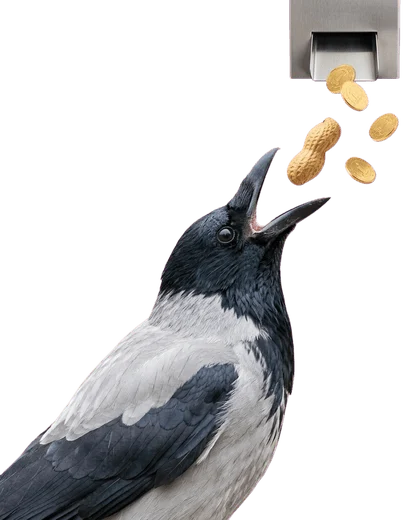
The proposed end point was simple enough to fit in one sentence: deposit a cigarette butt, receive food. A specially designed bird bin would recognize an acceptable object and release a reward, often described as a peanut. Because the birds were wild, participation was meant to be voluntary. The company argued that trained birds might also influence others through observation, reducing how much direct human training the system required. Those ideas came from prototype work and plans; they were not measurements from a municipal street-cleaning service.
In January 2022, Södertälje Science Park announced that a pilot was being planned with the municipality and would be discussed during Science Week. The wording was prospective: a pilot project was planned, with the hope that it might eventually become a permanent solution. News coverage compressed that future tense. Headlines said a Swedish firm was deploying crows, and descriptions of the proposed exchange were repeated beside photographs and illustrations that made the operation feel complete.
The later record remained cautious. A case study first published online in November 2024 described Günther-Hanssen as being on the verge of launching a pilot. Elsewhere it said the project had yet to be implemented, was still in testing, and was not accessible. It also identified unresolved questions: the possible effects of tobacco waste on bird health, the need for ethical permits and approval, how much litter birds would actually collect, and how far they would travel to do it. Its recommendations began with conducting the pilot—not expanding a pilot that had already produced results.
The final correction came from the municipality itself. In a response reported by fact-checkers, Södertälje said Günther-Hanssen had presented the pilot during Science Week in 2022, but the municipality did not proceed with any collaboration or project beyond that presentation. The accurate timeline is therefore narrower than the viral version: private experiments and prototype training, a publicly announced municipal proposal, extensive coverage, and no launched city program.
The economics belong in the same conditional frame. Södertälje was reported to spend about 20 million Swedish kronor per year on street cleaning overall. Günther-Hanssen estimated that using crows could reduce certain cigarette-butt collection costs by as much as 75 percent. That figure was a founder's projection, not a saving measured after deployment. Without a municipal pilot, there was no operational dataset showing cost per butt, collection volume, reliability, or effects on the birds.
Street deployment would also have tested whether the reward system worked outside a controlled setup. A bird bin would need to reject stones and leaves, dispense food consistently, survive public weather and interference, and avoid encouraging contact with harmful cigarette residue. Those are not reasons the concept could never work. They are the ordinary engineering and animal-welfare questions that turn an impressive training result into a public service.
None of this makes the mechanism imaginary. Corvids can learn reward-based tasks, and the case study documents progressive training experiments with hooded crows. A machine that exchanges selected objects for food is plausible enough to build and test. The error was moving from plausible to operational without stopping at the difficult middle: permits, animal-welfare research, municipal procurement, field trials, maintenance, public space, and evidence.
The corrected story is more useful than the myth. It shows how a vivid prototype can outrun its own status, especially when the idea arrives prepackaged with smart animals, dirty streets, and a perfect one-butt-one-peanut mechanism. Corvid Cleaning did not prove that crows could clean a Swedish city cheaply. It proved that a planned crow-cleaning machine could become global news before the city decided whether to switch it on.