Share
Share







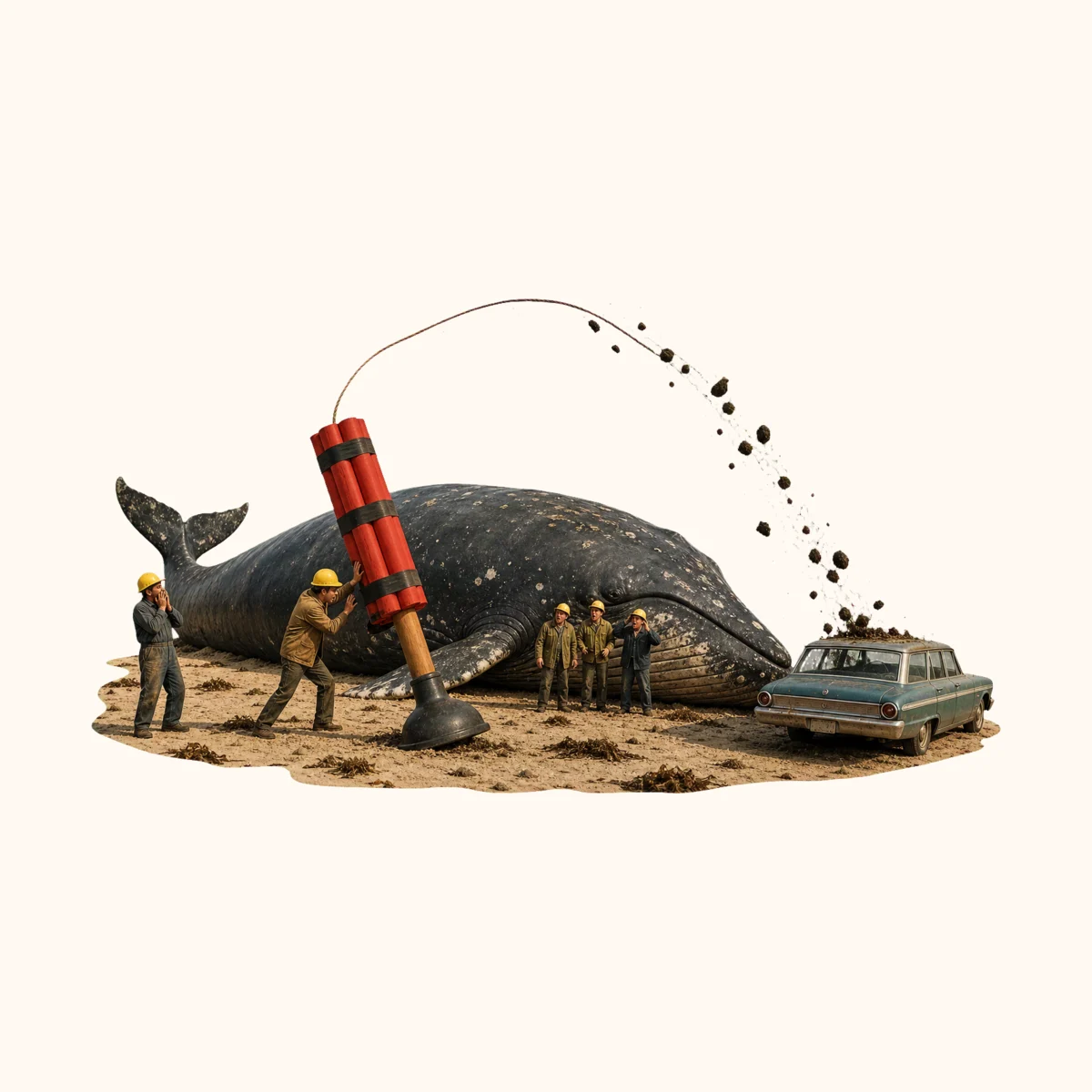
On November 12, 1970, Oregon highway officials decided that the best way to dispose of a 45-foot, 8-ton sperm whale carcass was with half a ton of dynamite. The whale had washed ashore near Florence, Oregon, and posed a significant problem. After consulting with munitions experts, the Oregon State Highway Division, now known as the Oregon Department of Transportation, treated the carcass like a boulder that needed blasting.
The explosion was captured by KATU-TV reporter Paul Linnman and cameraman Doug Brazil, using 16 mm color reversal film. As the dynamite detonated, the beach erupted in a shower of sand, blubber, and whale flesh. Spectators watched in awe as chunks of the whale, some as large as coffee tables, soared through the air. One such piece landed on a parked Oldsmobile, flattening its roof.
The aftermath was chaotic. Whale fragments rained down on the crowd, sending people scurrying for cover. Despite the spectacle, no one was injured, though the beach was left littered with whale debris. The event was intended to solve a problem but instead created a viral sensation long before the internet age.
The footage has since been viewed over 350 million times, becoming one of Oregon's most infamous moments. The legacy of the exploding whale lives on, commemorated by the community of Florence with the aptly named "Exploding Whale Memorial Park." In the end, the incident taught us that sometimes, the simplest solutions are the best—like burying the problem rather than blowing it up.