




 Share








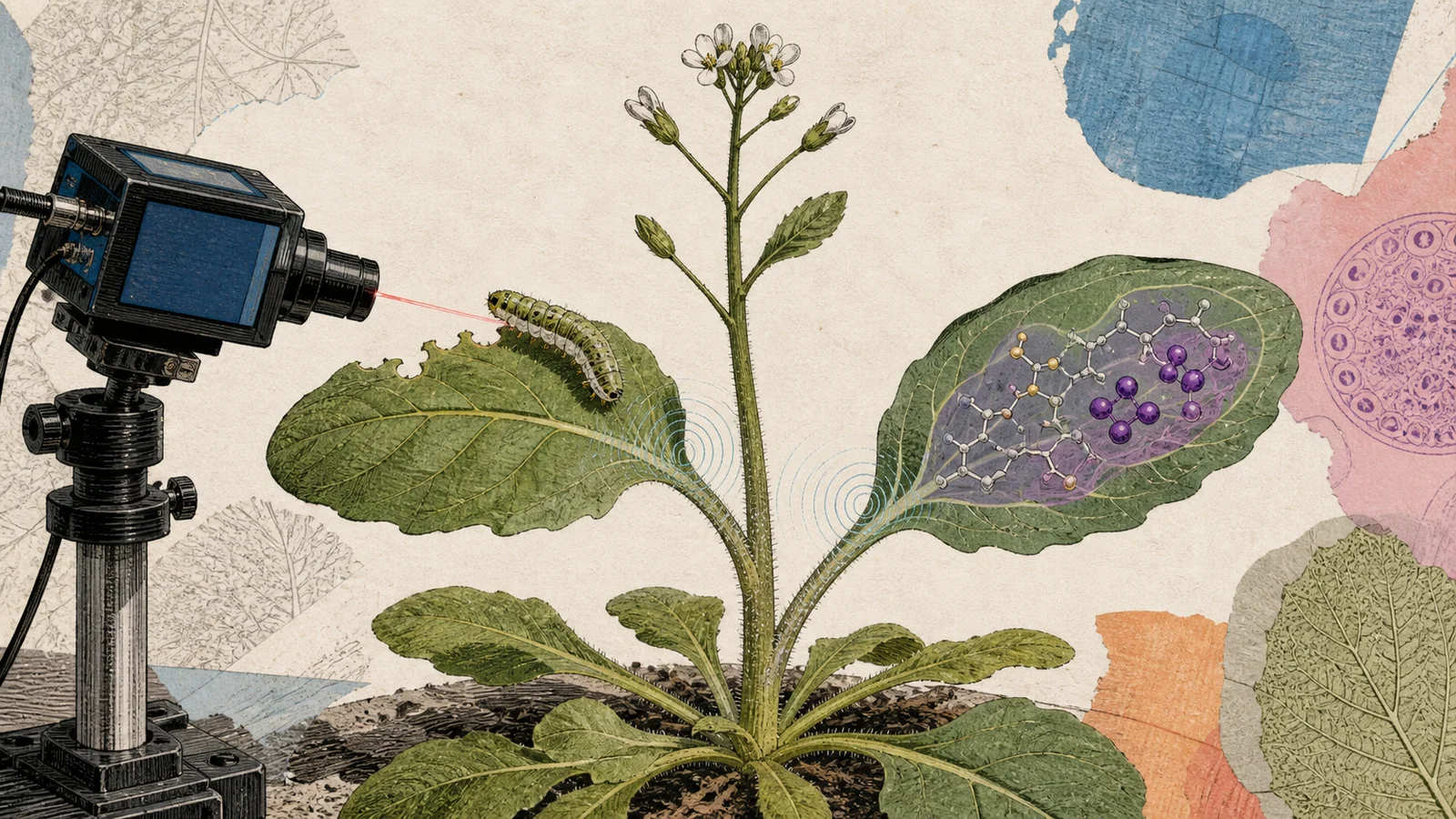
A caterpillar’s lunch begins as a mechanical signal. As mandibles tear a leaf, vibrations travel through the blade and stem. University of Missouri researchers recorded those movements from Arabidopsis leaves with a laser vibrometer, then used small piezoelectric actuators to replay the chewing pattern into untouched plants.
The playback was extremely subtle—leaf motion on the order of one ten-thousandth of an inch—and lasted about as long as a typical two-hour feeding session. Other plants received silence, wind vibration, or the sounds of an unrelated insect with some similar frequencies. Afterward, caterpillars were allowed to feed. Plants primed with chewing vibration produced higher levels of defensive chemicals, including glucosinolates and anthocyanins, than the comparison groups.
That separation matters. The plants did not simply treat every shake as an attack; the feeding pattern triggered a stronger chemical response than wind or insect song. Yet “hearing danger” remains a metaphor. Arabidopsis has no ears, nervous system, fear, or conscious picture of a caterpillar. Its cells detect mechanical disturbance and change metabolism. The experiment reveals a finely tuned plant defense without turning the leaf into a tiny anxious animal.
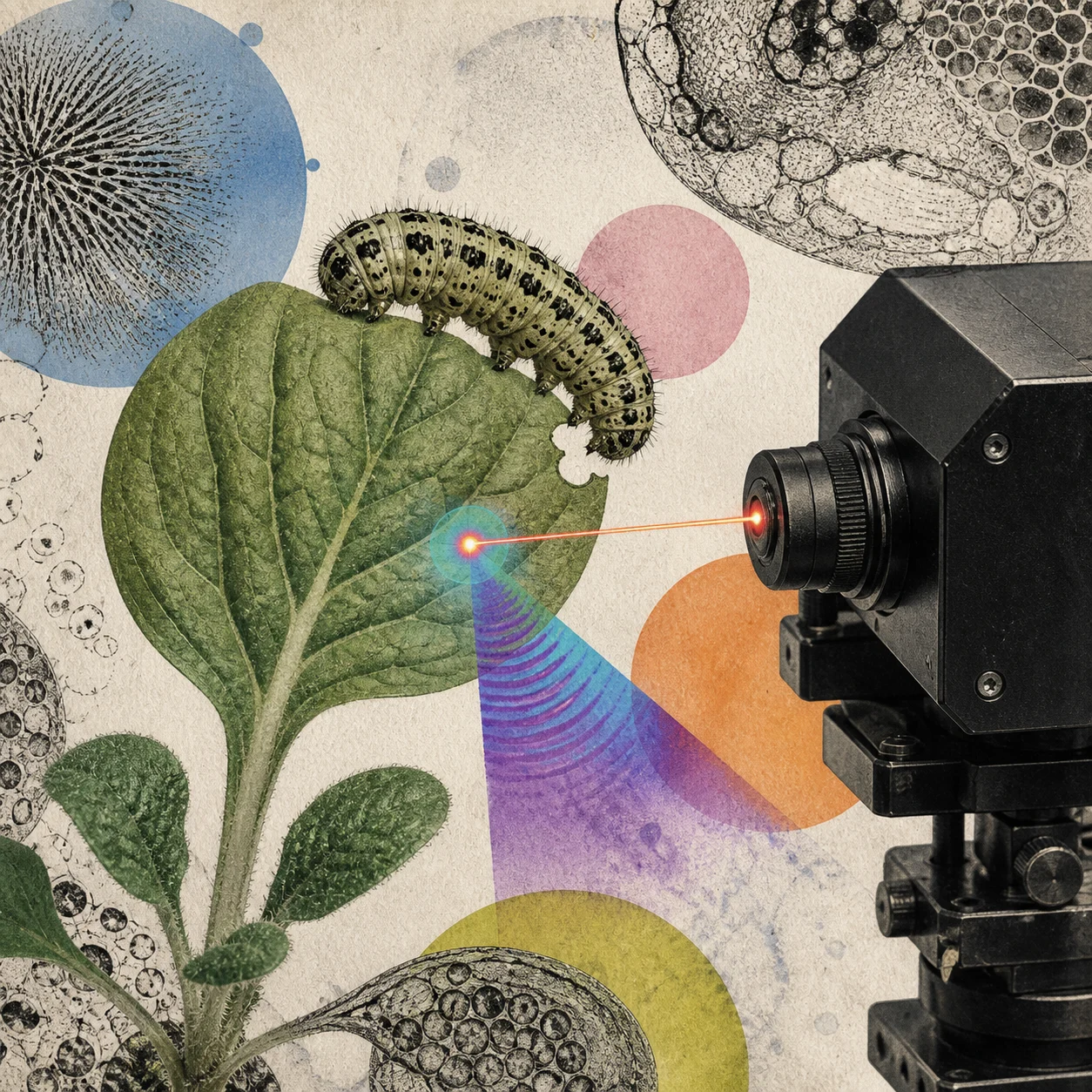
Plants cannot leave when an herbivore arrives, so defense depends on recognizing damage quickly and changing the value of the remaining tissue. They already respond to light, touch, gravity, chemicals, and mechanical stress. Caterpillar chewing adds a distinctive vibration pattern that can move beyond the exact patch being bitten and potentially warn connected tissue before damage spreads.
The team used Arabidopsis thaliana, the small mustard-family plant that serves as a major laboratory model. Cabbage butterfly caterpillars fed on leaves while reflective material helped a laser vibrometer measure minute surface motion without pressing a sensor onto the blade. That preserved the vibration itself as the experimental signal.
Recording was only half the design. Piezoelectric actuators were attached to new leaves with wax and converted the saved signal back into movement. For about two hours, the actuator drove the leaf through displacement measured at roughly one ten-thousandth of an inch. The plants were exposed to motion, not to caterpillar saliva, odors, or actual wounds.
Controls tested specificity. Some plants received no playback. Others experienced vibration caused by wind or by a leafhopper’s mating song, which overlapped parts of the chewing signal’s frequency range. If any repeated shaking activated the same defenses, those groups should have responded like the chewing group. They did not.
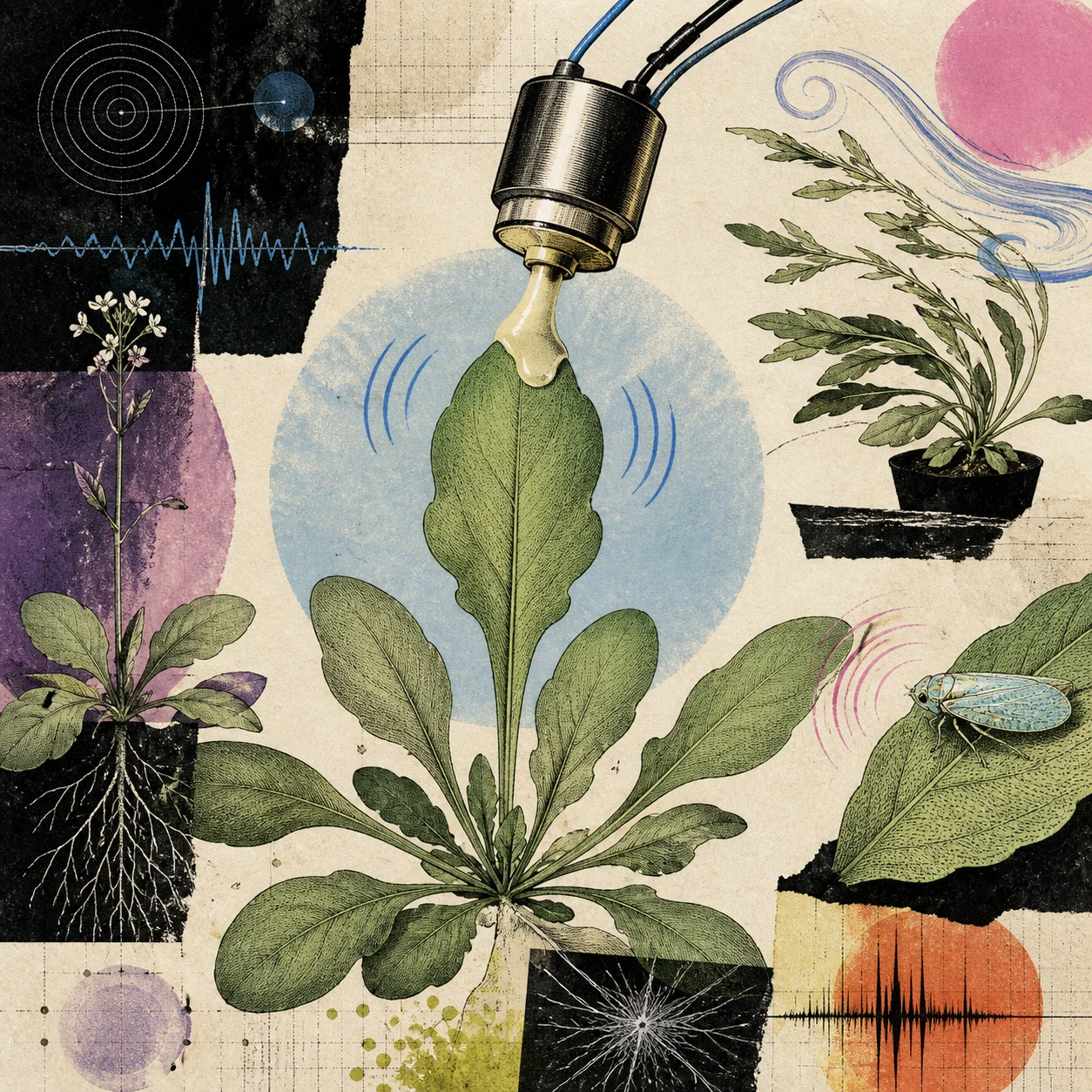
After the playback period, caterpillars ate approximately one-third of three leaves on each plant. Researchers then measured defensive chemistry in the remaining tissue. Chewing-vibration plants showed increased glucosinolate and anthocyanin levels relative to controls. These compounds can influence herbivore feeding and stress response, though one laboratory assay does not describe every consequence in a field.
The experiment is a form of priming. No caterpillar had yet damaged the playback plant, but a cue associated with feeding shifted its later chemical response. Priming lets an organism prepare before a larger attack while avoiding the full cost of keeping every defense maximized continuously. Whether that balance works the same way amid rain, insects, neighboring plants, and fluctuating wind needs ecological testing.
Mechanical signals can be informative because living actions produce patterns. A gust flexes much of a leaf. Chewing creates repeated bursts at a local point. An insect’s courtship vibration has another temporal structure. Frequency matters, but the discrimination need not come from one pitch; amplitude, rhythm, duration, and transmission through tissue can together form a recognizable input.

Nothing in the result requires consciousness. Plant cells contain mechanosensitive systems capable of converting deformation into biochemical change. “Detect” describes that conversion accurately. “Hear” can be a vivid shortcut if its limits travel with it. The plant does not imagine teeth. Its tissues respond differently to one physical pattern than to other tested patterns.
The study also keeps cause and consequence separate. Playback changed defensive chemistry after later feeding; it did not make the plant invulnerable or prove that caterpillars always avoid primed leaves. Chemical concentration is one piece of defense. Growth, reproduction, attacker behavior, and interactions with beneficial insects determine what the response means outside the chamber.
A stationary organism is not a passive one. Its information arrives through pressure, strain, dissolved molecules, light, temperature, and damage. In this case, a laser first made the hidden movement measurable and an actuator delivered it back. The plant supplied the final interpretation through chemistry, distinguishing an imitation of eating from the weather around it.
The comparison with leafhopper song is especially useful because it resists a simple frequency story. Some of the insect signal occupied a similar acoustic range, yet the defensive response differed. The plant may be integrating several features of the vibration at once. Identifying those features will require further experiments that vary rhythm, amplitude, duration, and where the motion enters the plant rather than replaying whole natural recordings.
Sources