




 Share








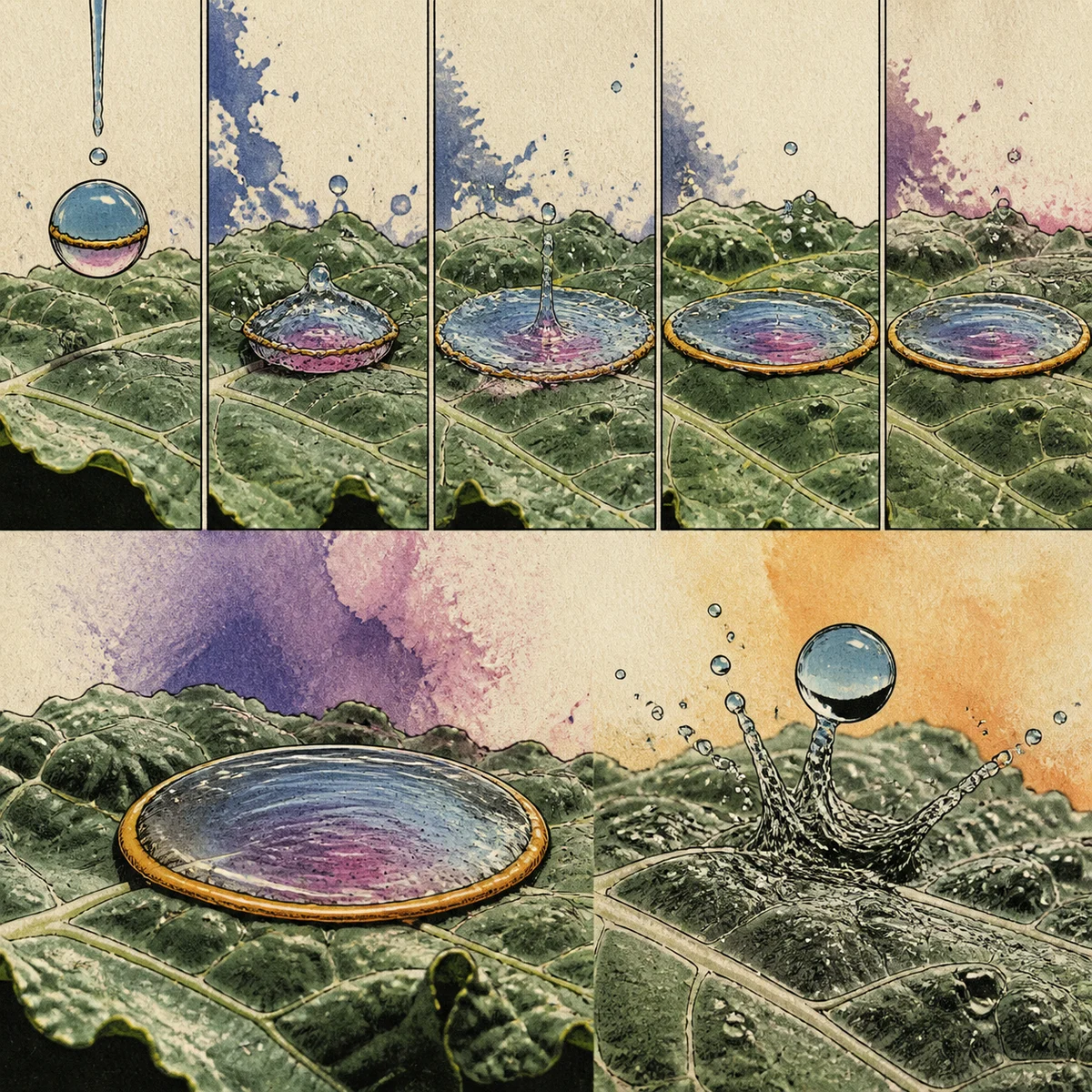
Many leaves repel water so effectively that a sprayed droplet hits, flattens, and rebounds before much pesticide stays behind. MIT engineers changed the interface instead of making the liquid simply thicker. They coated each water-based spray drop with a vanishingly thin layer of oil or familiar agricultural adjuvant, using less than one percent of the formulation.
On impact, the coating moved toward the spreading edge and formed an oily ring. That ring pinned the contact line to the water-repellent surface, dissipating motion that would otherwise launch the drop back into the air. In laboratory tests on leaf-like surfaces, the method increased measured stickiness by as much as one hundred times. Tests with common nozzles and crops such as kale and soybeans showed that the approach could work with ordinary spraying equipment.
The hundredfold figure belongs to laboratory adhesion tests, not every farm, chemical, crop, or weather condition. The researchers see possible reductions in wasted pesticide and runoff, but field performance, formulation safety, regulation, and application practices still decide those outcomes. The proven mechanism is a tiny cloak reorganizing itself into a brake at the instant a drop tries to bounce.
Sources