Share
Share








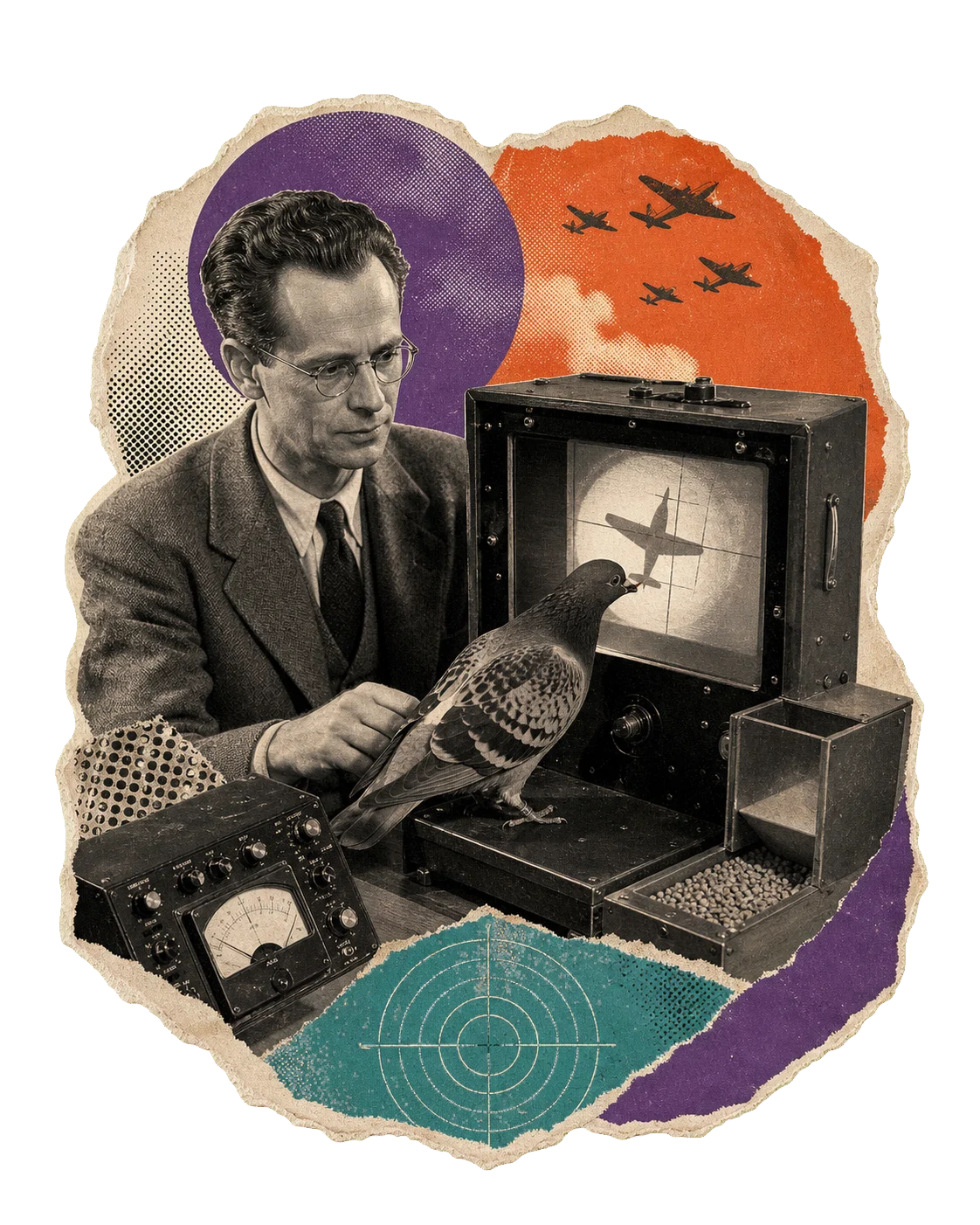
During World War II, the problem was not simply how to build a bomb that could fly. The harder problem was persuading it to keep flying toward the right thing. Electronic guidance was developing, but the available systems were costly, complicated, and limited. Psychologist B. F. Skinner looked at the problem and proposed a control component that already came with sharp vision, fast reactions, and a talent for repeating a learned action: a pigeon.
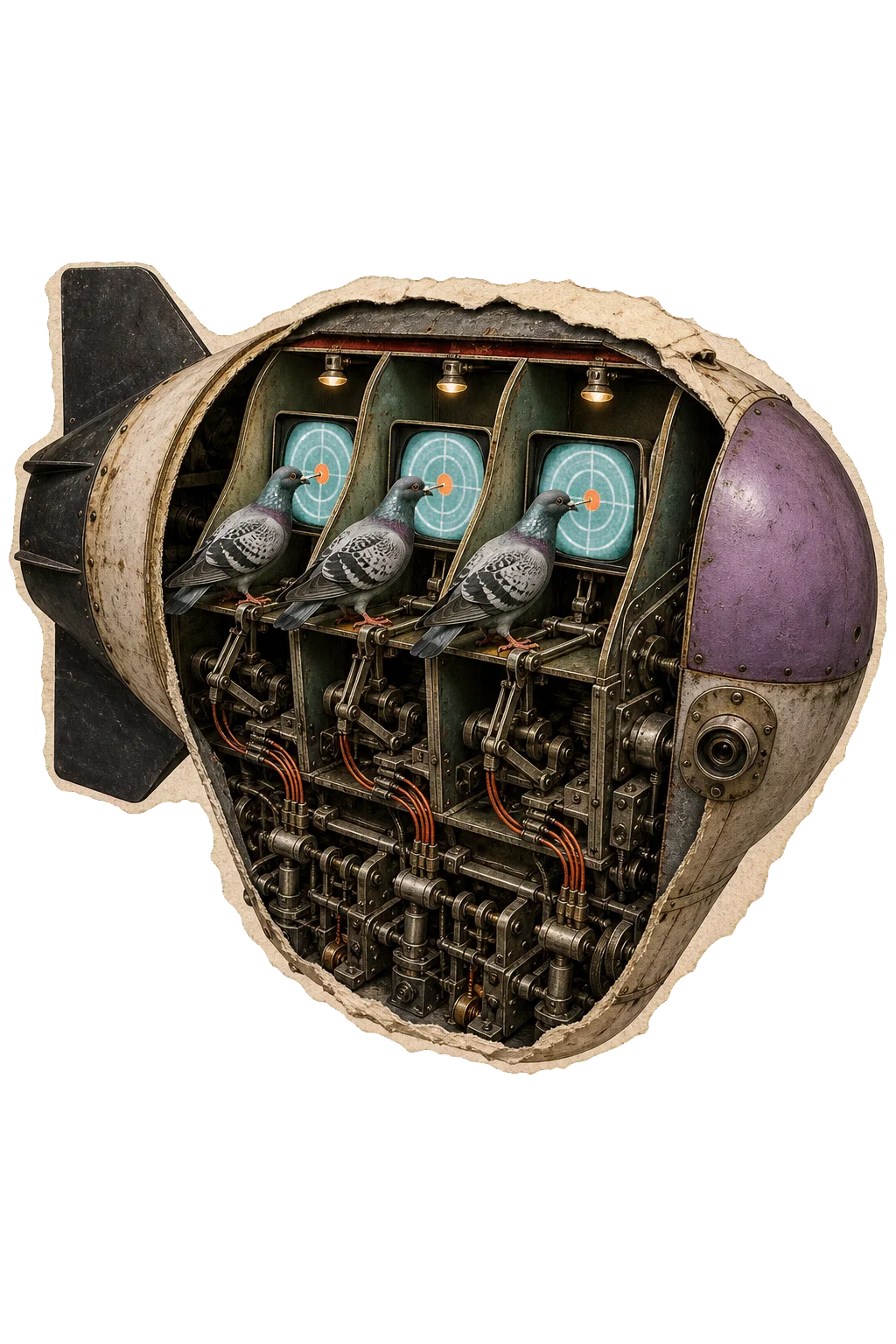
Skinner’s idea became Project Pigeon. Its core was behavioral conditioning rather than avian intuition. A bird would be trained to recognize an image of a target and peck at it. Inside the proposed missile nose cone, optics would project the target onto a screen in front of the bird. If the image drifted away from the center, the pigeon would follow it with its beak. Those off-center pecks could be translated into corrections that steered the weapon back toward the target.
The full design used three pigeons, each in its own compartment with its own screen. This was not a bird perched on a joystick. The animals supplied rapid visual tracking while the surrounding mechanism converted the location of their pecks into guidance signals. Skinner was effectively separating the problem into two parts: use a trained nervous system to decide where the target had moved, then let a machine turn that decision into motion.
That division of labor is the key to understanding the proposal. The pigeon was not expected to understand a map, a mission, or the consequence of reaching the image. It had one narrow job: notice a familiar visual pattern and keep responding to its movement. The mechanism did not need the bird to comprehend guidance. It needed a stream of quick, consistent choices about where the important shape appeared on a small screen.
The choice of pigeon was less whimsical than it sounds. Pigeons can distinguish visual patterns, respond quickly, and repeat a rewarded behavior with extraordinary persistence. Skinner’s experiments emphasized that reliability. Smithsonian’s history of his animal research records one bird pecking more than 10,000 times during a 45-minute test. A human operator would call that monotonous. For the proposed guidance system, monotony was the specification.
Training converted the projected target into the most important object in the bird’s tiny world. Peck the correct area and receive food; lose the target and the reward disappears. Over repeated trials, the birds learned to keep their beaks working at the moving image. Skinner had already built a career around the idea that behavior could be shaped by its consequences. Project Pigeon took that laboratory principle and placed it inside the most severe engineering proposal imaginable.
The apparatus also forced engineers to confront an uncomfortable gap between “strange” and “nonfunctional.” Military observers could watch the pigeons perform. According to the NIST history of the project, observers at technical institutions agreed that the controlled demonstrations worked. The birds did what they had been trained to do. What remained doubtful was whether the entire biological-mechanical package belonged in a practical weapon. Reliability in a demonstration room was not the same as deployability under wartime conditions.
That distinction helped doom the project. Electronic guidance systems kept advancing, and they offered a development path that military planners found more scalable and familiar. Project Pigeon was cancelled before becoming an operational weapon. The birds had not failed their assigned task; the larger system lost a competition over what the future of guidance should look like. Electronics promised machines that did not need feeding, training, housing, or an explanation that began with three live animals in a nose cone.

The comparison also reveals how quickly a technology can move from plausible to obsolete. Project Pigeon addressed a genuine capability gap with materials already available: optics, mechanical controls, and trainable animals. Once electronics improved, those advantages changed. A living sensor that had seemed adaptable now looked difficult to standardize. The same demonstration could remain impressive while the strategic case for building it disappeared.
It is easy to tell the story as comic relief from wartime research, but the joke obscures why it got as far as it did. Skinner was proposing a hybrid computer before that language was ordinary: living visual processors coupled to mechanical controls. The pigeon’s peck was an input signal. The screen supplied feedback. Reinforcement created a repeatable response. In modern terms, the design combined sensing, classification, and closed-loop correction, using feathers where later engineers would use electronics.
Project Pigeon therefore sits in an odd but revealing corner of technological history. It was neither a practical missile system nor a random stunt. It was a serious attempt to borrow a capability from an animal while engineered alternatives were still immature. The pigeons could track the image with impressive discipline. The surrounding world simply chose a different kind of intelligence to put inside its machines.