Share
Share







At Alto Patache, on the northern coast of Chile, a cloud can erase the landscape without producing a single raindrop. Pacific air pushes inland, cools against the coastal mountains, and becomes camanchaca: a low, wet fog thick enough to hide buildings only a few metres away. In a region where annual rainfall averages about 0.2 millimetres, that moving wall of grey carries something extraordinarily valuable. It carries water.
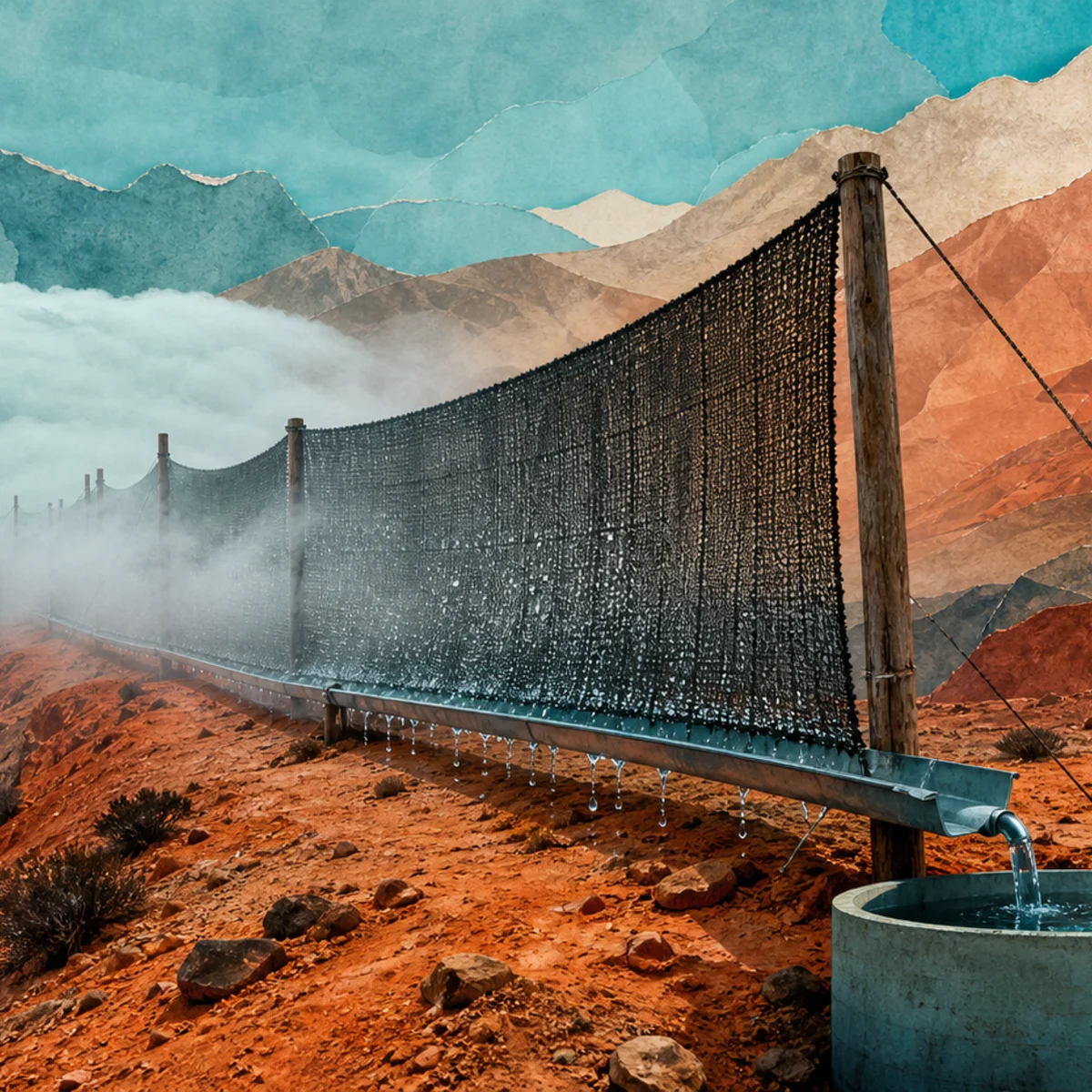
The machines waiting for it do not look much like machines. A typical collector is a taut rectangle of black Raschel mesh stretched between posts. Wind drives microscopic droplets into the plastic fibres. The droplets cling, collide and merge until gravity pulls them downward. A gutter catches the trickle and guides it through a pipe to a tank. There are no pumps in that sequence, no condenser coils and no electricity bill. The atmosphere arrives; the net combs it.
At the UC Chile Atacama Station, about 70 kilometres south of Iquique, one 32-square-metre installation averages roughly 224 litres a day. That figure belongs to the collector as a whole, not to each square metre, and output changes with wind, season, location and mesh condition. Even with those caveats, the scene is wonderfully counterintuitive: a piece of shade cloth can fill containers in a desert famous for almost never seeing rain.
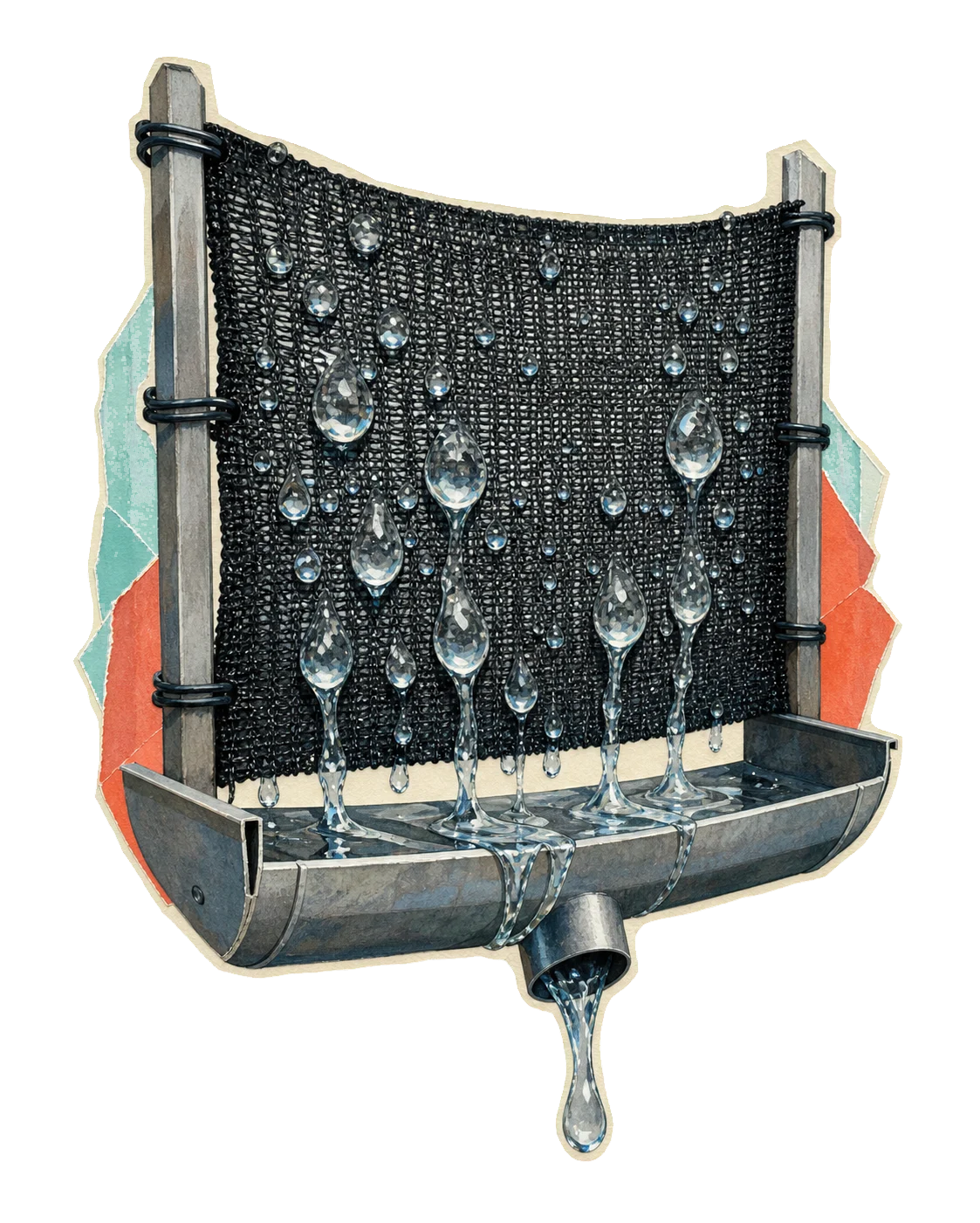
Fog collection works because fog and rain are physically different deliveries of the same basic material. Rain arrives as drops large enough to fall. Fog is a cloud at ground level, its water suspended in droplets so small that air currents keep them aloft. A collector does not manufacture water. It interrupts those droplets while they are already passing through. The design challenge is to catch enough of them without blocking the wind that carries the next supply.
That balance explains the open mesh. A solid wall would force much of the air around it. Fine fibres create many collision points while leaving room for flow. Once wet, however, a collector needs drainage paths that resist clogging and keep water from being blown away again. Tension matters. Cleanliness matters. So do placement, orientation and the shape of the terrain. A net on the wrong hillside can spend its life staring at clear air.
Alto Patache is especially useful to researchers because it sits inside a fog oasis, one of the coastal pockets where topography concentrates moisture. UC Chile has maintained fog measurements there since 1997. Its network watches how events change by hour, season, elevation and location, alongside weather instruments and ecological studies. The work treats fog not as a novelty but as a climate system: variable, mapped and capable of carrying both nutrients and pollutants from ocean to land.
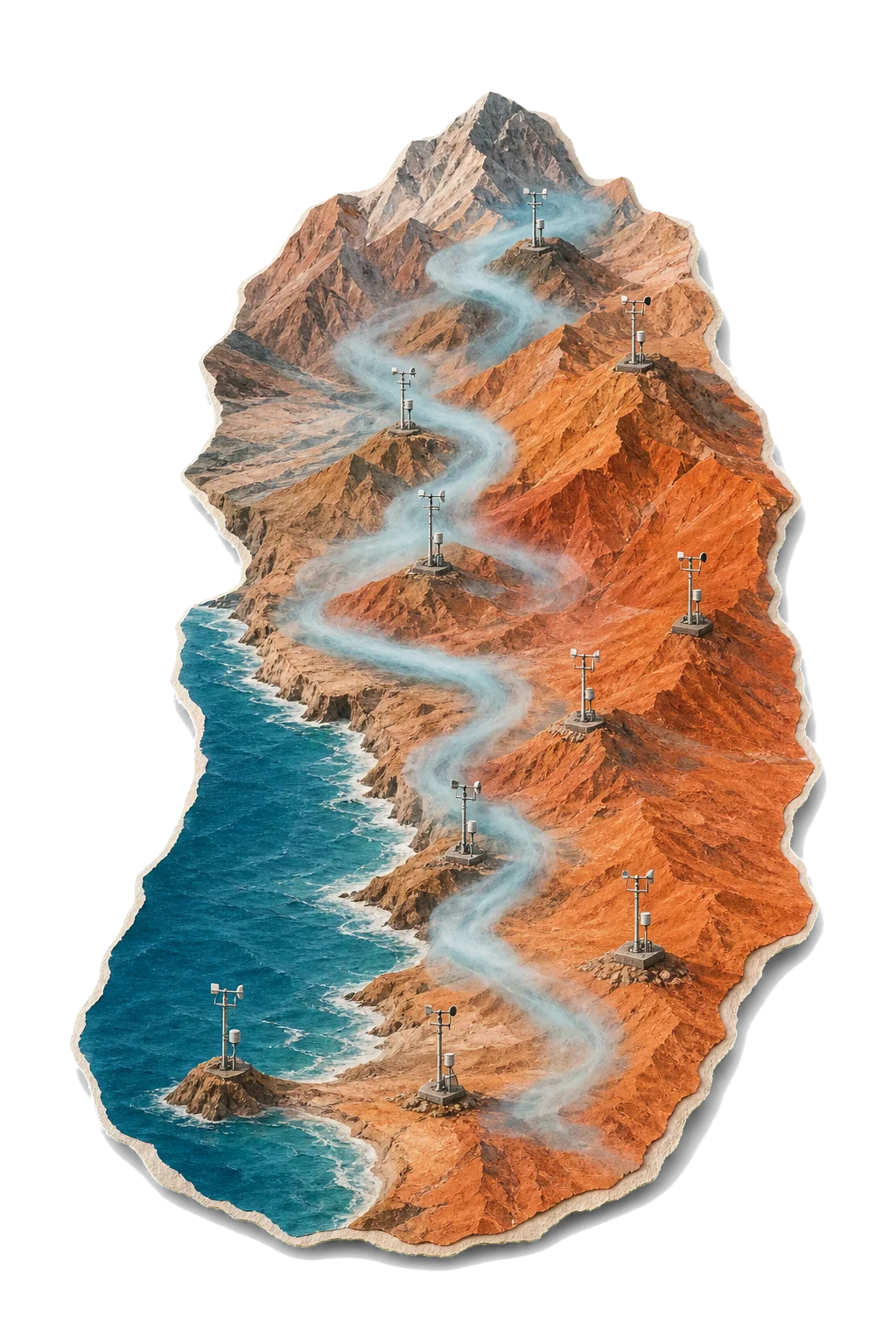
The water also supports a biological world that looks impossible from the surrounding desert. Lichens, small organisms and endemic plants persist where coastal relief repeatedly intercepts mist. Experiments at the station compare fog-exposed ground with dry control areas to measure what that moisture does. Researchers have found that fog can deliver more than water; it may also bring nitrogen, phosphorus, iodine, metals and other materials. That makes chemical testing and appropriate treatment important when collected water is intended for people.
A fog collector is therefore not a magic substitute for a municipal water system. Yield is weather-dependent. Tanks, pipes, maintenance and water-quality controls still cost money. Communities need land where useful fog actually occurs, and collection must be designed around local conditions. A number that sounds spectacular at one station cannot simply be copied into another landscape. The technology is most honest when described as a local water source—sometimes a powerful one—rather than a universal cure for drought.
Its simplicity is precisely what makes it travel. Fog-harvesting projects have been developed in Chile and in dry, fog-prone regions of Morocco, Peru, Guatemala, Nepal and elsewhere. The mesh can supply drinking water after treatment, irrigate small plantings or help establish vegetation where conventional infrastructure is difficult. Because the collection step is passive, the system can work far from an electrical grid. The people operating it still do the essential work: cleaning, repairing, storing, testing and deciding how the water is shared.
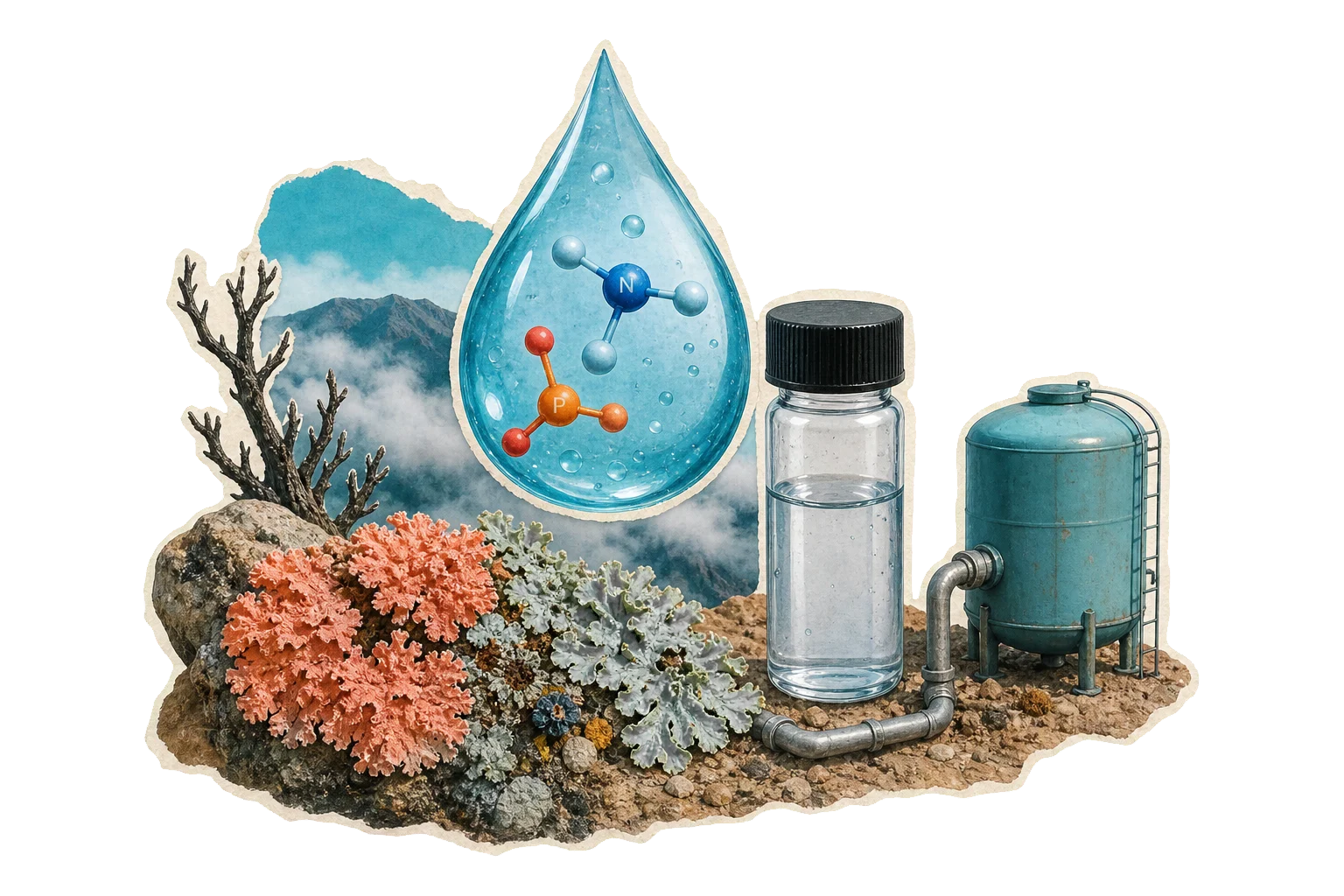
Chile's researchers have also been turning decades of measurements into maps. Instead of asking whether a whole coastline is foggy, they can identify particular elevations and slopes where harvestable droplets appear often enough to matter. That changes fog from a weather anecdote into a planning resource. A community considering a collector can begin with evidence rather than a hopeful rectangle of mesh.
The great visual trick of Alto Patache is that the hardware remains almost disappointingly plain. There is no chrome machine humming against the desert. There are posts, netting, gutter and tank. Yet each part sits at the end of careful decisions about fluid motion, fibre geometry, terrain, chemistry and climate. The collector succeeds by being less dramatic than the thing it catches.
Rain announces itself. Fog merely occupies the air. At Alto Patache, researchers learned to measure that quiet occupation, and a net learned to turn it into a downward line of water. The desert does not stop being a desert. The cloud does not become a lake. But for a few hundred litres at a time, the boundary between air and drinking water becomes as thin as a piece of mesh.