Share
Share







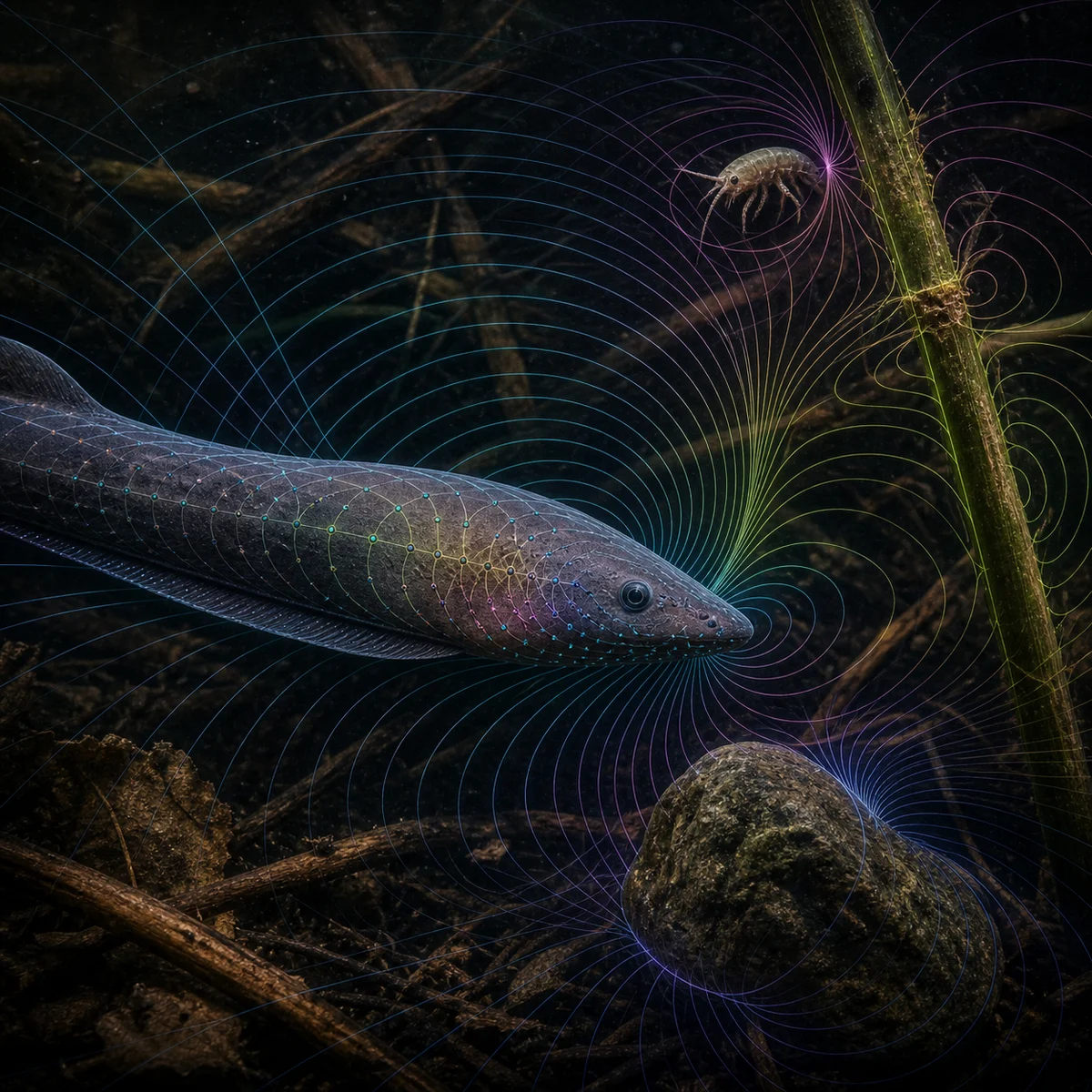
In dark or cluttered water, a weakly electric fish can sense without waiting for light. Specialized organs emit a modest electrical field around the body. Objects with different electrical properties distort that field, and receptors distributed across the skin detect the changing pattern. A nearby animal, plant, or obstacle becomes a spatial signal wrapped across the fish itself.
This is active electrolocation: the animal generates the probing energy and reads the return indirectly through field distortion. Because receptors cover much of the body, sensing is not confined to a forward-facing pair of eyes. The fish can maneuver while continuously updating an electrical picture of its surroundings, even where vision is limited. Engineers have studied that relationship for field-inspired sensing and movement systems.
The word “electric” can pull the story toward the wrong animal. These fish use weak fields for perception and communication, not the powerful defensive or predatory discharge associated with electric eels. The field is useful precisely because subtle changes remain readable. The fish does not illuminate dark water with visible electricity; it creates an invisible envelope, then detects how the world bends it.