Share
Share







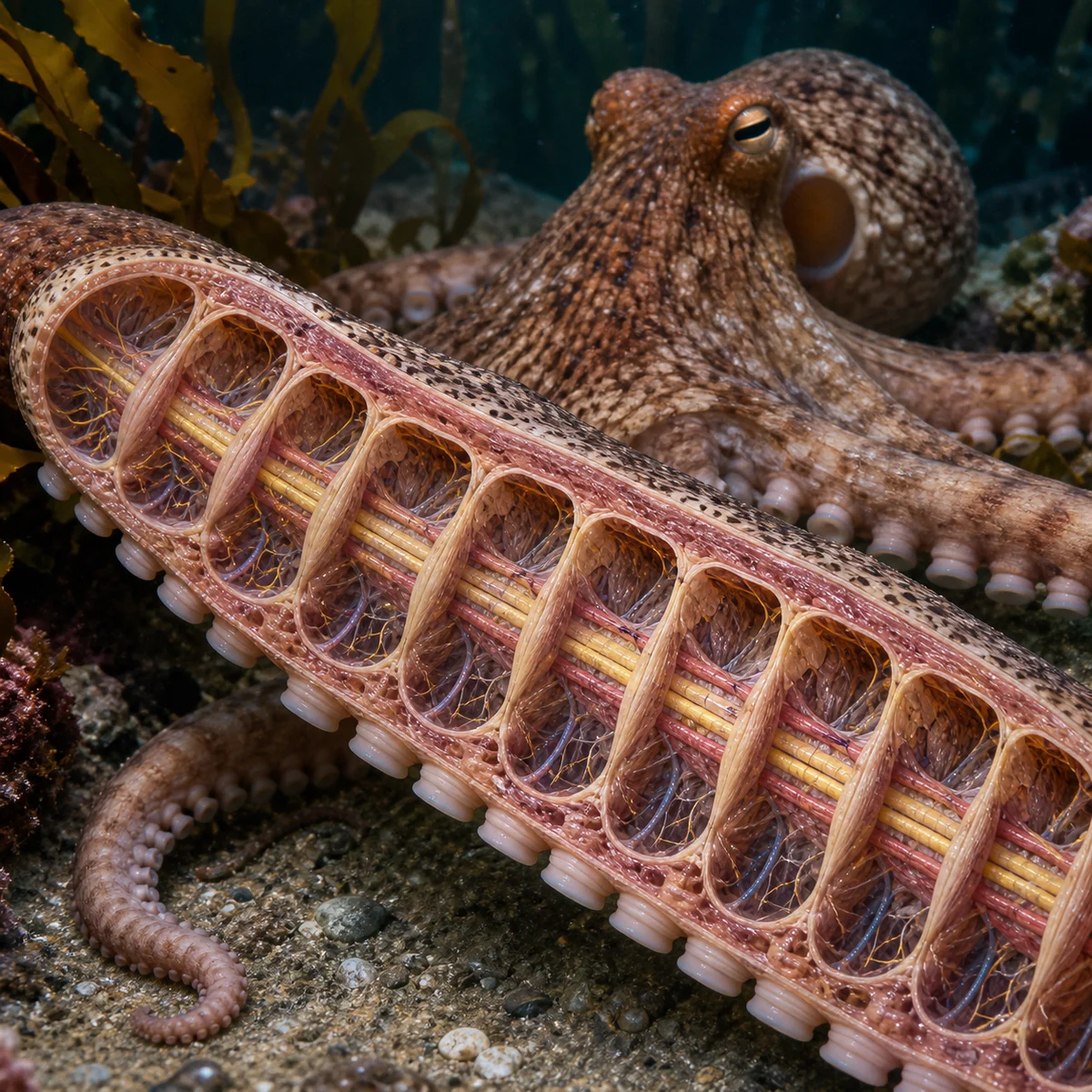
An octopus arm has no bones and almost no fixed joints, yet it can bend, twist, curl, taste, grasp, and reshape its suckers with extraordinary control. Researchers studying the California two-spot octopus found an orderly architecture inside that apparent freedom. The arm's axial nerve cord bends back and forth, forming enlargements near the suckers. Neuronal cell bodies sit in repeating columns divided into segments by gaps called septa.
Nerves and blood vessels leave through those septa for nearby muscles. Sucker nerves also connect in a systematic spatial map, which the researchers dubbed “suckeroptopy.” A comparison strengthened the connection: squid tentacle stalks without suckers lacked the segmentation, while their sucker-covered clubs had it. The pattern may help coordinate flexible, sensory appendages by breaking an enormous control problem into cooperating local sections.
That anatomy does not prove each arm has a separate mind. Segmentation describes organized circuitry and connections, not independent thought. The discovery makes octopus movement less mysterious without making it less astonishing: hundreds of suckers are served by a repeating neural map running through an arm that can move almost anywhere.
Sources