Share
Share







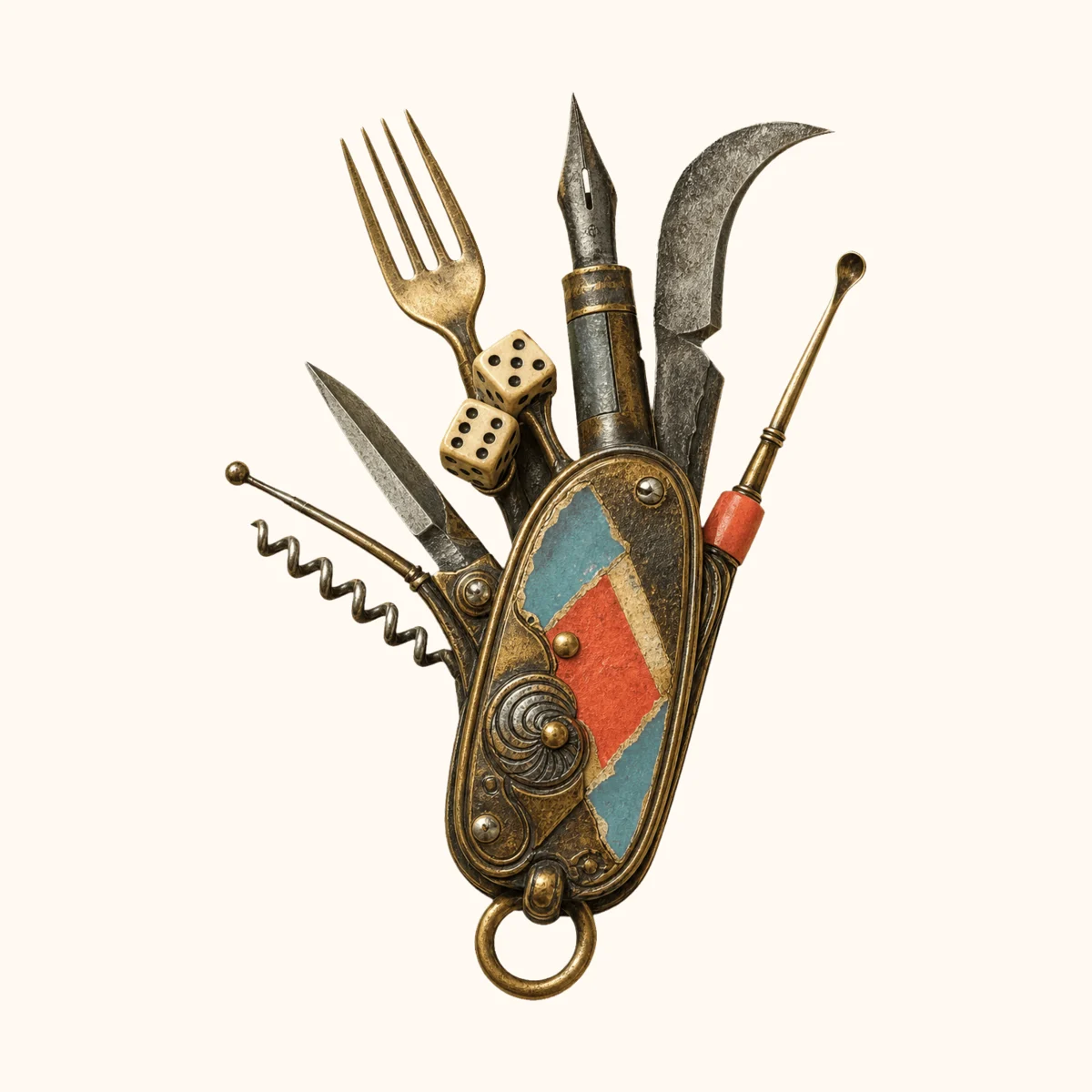
A folding implement in the British Museum tries to solve nearly every small problem a traveler might encounter. Its silver body opens into a spoon and fork. A garnet-set sliding collar secures the hinge, which is decorated with a pelican on one side and swimming ducks on the other.
The upper finial is a pierced sphere. Unscrew it and two tiny silver dice come out, converting dinner equipment into a pocket game. Another section releases a silver pen; inside that tube are a hinged toothpick and ear pick. Eating, writing, gambling, dental care, and grooming occupy the same highly ornamented object.
The museum now considers its origin uncertain but probably German, from the second half of the nineteenth century. An older description placed it much earlier, which helps explain why its decoration imitates the dense ingenuity of Renaissance curiosities. The practical pieces are real, but practicality is not the whole point. Every function requires another hinge, collar, cavity, or flourish. It is less a compact tool than a tiny cabinet of decisions—an object designed for someone who wanted to carry a dining table, desk, washstand, and pair of dice in one jeweled hand.