




 Share








The sound that reorganized the supermarket is barely a sound at all. A cashier passes a box over glass, a machine chirps, and another physical object becomes a line of data. That ordinary beep traces back to a problem overheard at Drexel Institute of Technology, four fingers dragged through Miami Beach sand, and a pack of chewing gum small enough to make engineers nervous.
In 1948, graduate student Bernard Silver heard a supermarket executive ask a Drexel dean for a way to encode product information so checkout could move faster and stores could keep better track of inventory. The dean was not interested. Silver was. He brought the challenge to Norman Joseph Woodland, a fellow graduate student who had worked on the Manhattan Project and already liked inventing things. Woodland became convinced enough to leave graduate school and work on the problem in Miami, where his grandfather owned an apartment.
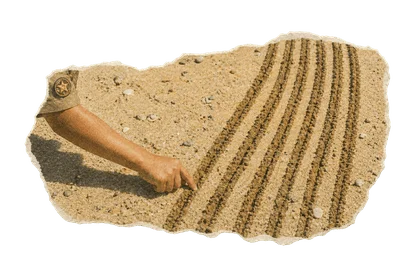
Woodland carried one useful childhood skill with him: Morse code, learned as a Boy Scout. On the beach, he pressed four fingers into the sand and pulled them toward himself. The marks suggested that Morse's dots and dashes could become wide and narrow lines. A machine would not need to understand a word or a picture; it could read variation in the marks. Woodland then swept the lines into a circle. The circular arrangement became the bull's-eye symbol he and Silver pursued because a scanner could approach it from any direction.
They filed for a patent in 1949. The patent, granted in October 1952, described a classifying apparatus and method built around machine-readable patterns. The idea was sound, but the available equipment was not graceful. An early prototype reportedly relied on a 500-watt incandescent bulb, a light-sensing tube, and an oscilloscope, producing a reader roughly the size of a desk. It could demonstrate the principle without offering a practical grocery lane. Woodland and Silver sold the patent for $15,000.
The delay was not simply a matter of nobody appreciating a clever drawing. A useful checkout system needed bright, tightly controlled light; reliable printing; compact computing; a common code; and enough products carrying that code to justify expensive scanners. The laser arrived in 1960. Computing costs fell. By 1970, grocery companies and manufacturers had formed a committee to choose a uniform machine-readable symbol rather than let every chain invent its own private language.
The bull's-eye returned as a serious candidate, but printing exposed its weakness. A small smear could distort the concentric rings in multiple directions. At IBM, engineer George Laurer pushed for a rectangular alternative made from vertical bars. His design used differences in line width and spacing to encode manufacturer and product information while remaining compact and readable at speed. Woodland, then working at IBM, supported the proposal. The industry selected the linear symbol in 1973, turning Woodland's sand-line insight into the Universal Product Code while leaving the circular patent shape behind.
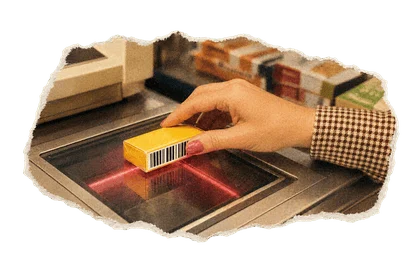
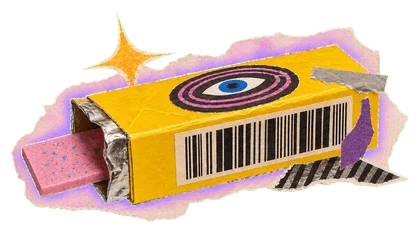
Then came the gum. On the morning of June 26, 1974, a Marsh Supermarket in Troy, Ohio, opened a checkout equipped to read UPCs. Marsh research director Clyde Dawson acted as the first shopper, and cashier Sharon Buchanan handled the first transaction. Dawson selected a multipack of Wrigley's Juicy Fruit. The choice was deliberate: printing a workable symbol on such a small package had been a challenge. At just after 8 a.m., the scanner read it. IBM records the price as 67 cents.
The moment looks modest because it was. There was no dramatic machine revealing a new law of nature, only gum moving across a counter. Yet the scan joined several ideas that had spent decades waiting for one another: Silver's overheard request, Woodland's Morse-code lines, the bull's-eye patent, the laser, Laurer's printable symbol, and an industry willing to agree on a standard. The beep announced that all of those parts finally worked as one system.
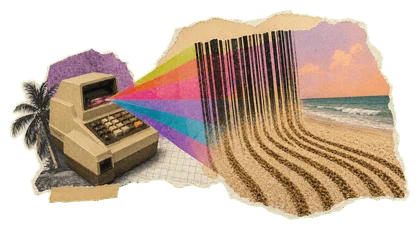
Adoption still took time. Stores worried about the price of scanners and whether enough manufacturers would print the code. Shoppers questioned whether an invisible database would charge them accurately. Labor groups worried about jobs. As the system spread, however, checkout became faster and retailers gained something the cash register alone could not provide: a continuing record of which exact products moved, when they moved, and how much remained. IBM says checkout lines moved 40 percent faster, while the same basic identification system expanded into factories, libraries, hospitals, logistics, and travel.
The familiar barcode is therefore not quite Woodland's original invention and not quite a replacement for it. It is a relay race. Woodland and Silver established that printed variations could identify products automatically. Their circular design proved the concept but met the limits of printing and mid-century electronics. Laurer and the IBM team produced the standardized linear UPC that stores could actually deploy. A gum wrapper supplied the first public proof.
Today the barcode hides in plain sight, designed to be noticed by machines and ignored by everyone else. Its origin is the opposite: a human hand making oversized marks in sand, trying to see whether a childhood code could solve an adult commercial problem. Twenty-five years later, the beach drawing finally made a sound.
Sources