Share
Share








The Flowbee begins with a thought most people would have while sweeping up after a haircut, then immediately dismiss: if a vacuum is already collecting the clippings, why not let the suction help cut the hair too? The resulting machine looks like a hose attachment that has swallowed a small electric clipper. It lifts hair, sets its distance from the scalp, cuts it, and sends the loose pieces down the vacuum line in one continuous operation.
That sequence is important because the vacuum does more than clean. Suction draws the hair into the cutting chamber and helps hold strands in a consistent position. The blade assembly sits recessed inside the head rather than exposed at its edge. Hair enters the airflow, reaches the moving blades, and is clipped before the vacuum carries the fragments away. The same force that removes the mess also presents the material to the cutter.
Length comes from plastic spacers attached between the cutting head and the scalp. Each spacer fixes the distance at which hair reaches the recessed blades. Stack or select them, and the machine changes the length it leaves behind without asking its user to judge that distance freehand. The current manufacturer describes standard settings from one-half inch to six inches in quarter-inch steps, with an even shorter guard available separately.
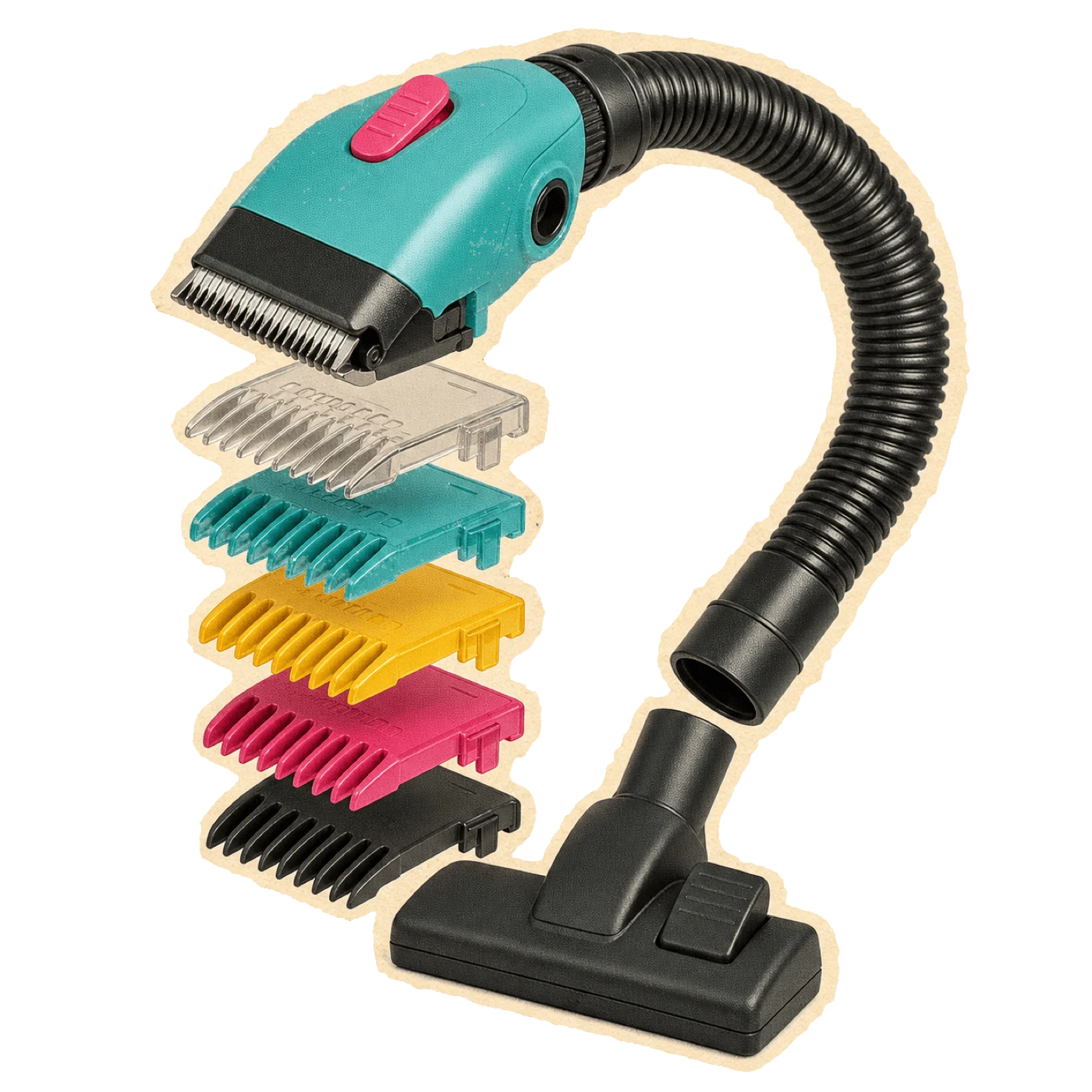
The patent explains why this is not merely a pair of scissors taped to a vacuum hose. U.S. Patent 4,679,322 describes two slotted plates sliding against one another. Their slots cross as the plates oscillate in opposite phases, creating many small shearing edges while keeping airflow through the chamber comparatively steady. Detachable extensions establish a selected spacing from the scalp. The geometry tries to solve two problems at once: cut evenly and keep the suction path open.
Rick E. Hunts developed the device after working as a carpenter in San Diego. In the company’s account, the first version was called the Vacuut. The idea took years of trial and error: use the vacuum to pull hair straight while a compact cutter trims it at a uniform distance. The later name came from the machine’s buzzing sound, which suggested a bee operating somewhere inside the airflow.
The patent was filed in 1986 and granted in July 1987. By 1988, Hunts was presenting the Flowbee through an infomercial, a format perfectly matched to an object that seems unbelievable until it is shown touching a real head. The demonstration did not need an elaborate promise. A hose approached the hair, the spacer held the cutter away from the scalp, and trimmed pieces disappeared instead of falling onto the floor.

Its strangeness comes from combining household systems that normally remain separate. A vacuum cleaner handles debris after an activity. A clipper shapes hair during it. The Flowbee makes debris collection part of the shaping mechanism itself. Remove the suction and the device loses both its way of aligning strands and its way of evacuating them. Remove the blades and the vacuum merely produces an aggressively styled breeze.
The user also performs a different gesture from a conventional haircut. Scissors work section by section, guided by fingers or a comb. Ordinary clippers travel directly against guards near the scalp. The Flowbee’s head hovers at the end of a hose while spacers establish the target length. Instead of lifting and cutting a lock manually, the user moves an intake over the hair and lets airflow do the lifting.
That makes the machine a very specific kind of automation. It does not decide what haircut would suit someone, map a head, or replace every judgment involved in styling. It mechanizes one repetitive measurement: hold hair at this distance, then cut anything that reaches the blade plane. The spacer is the rule; the vacuum keeps feeding hair into that rule.
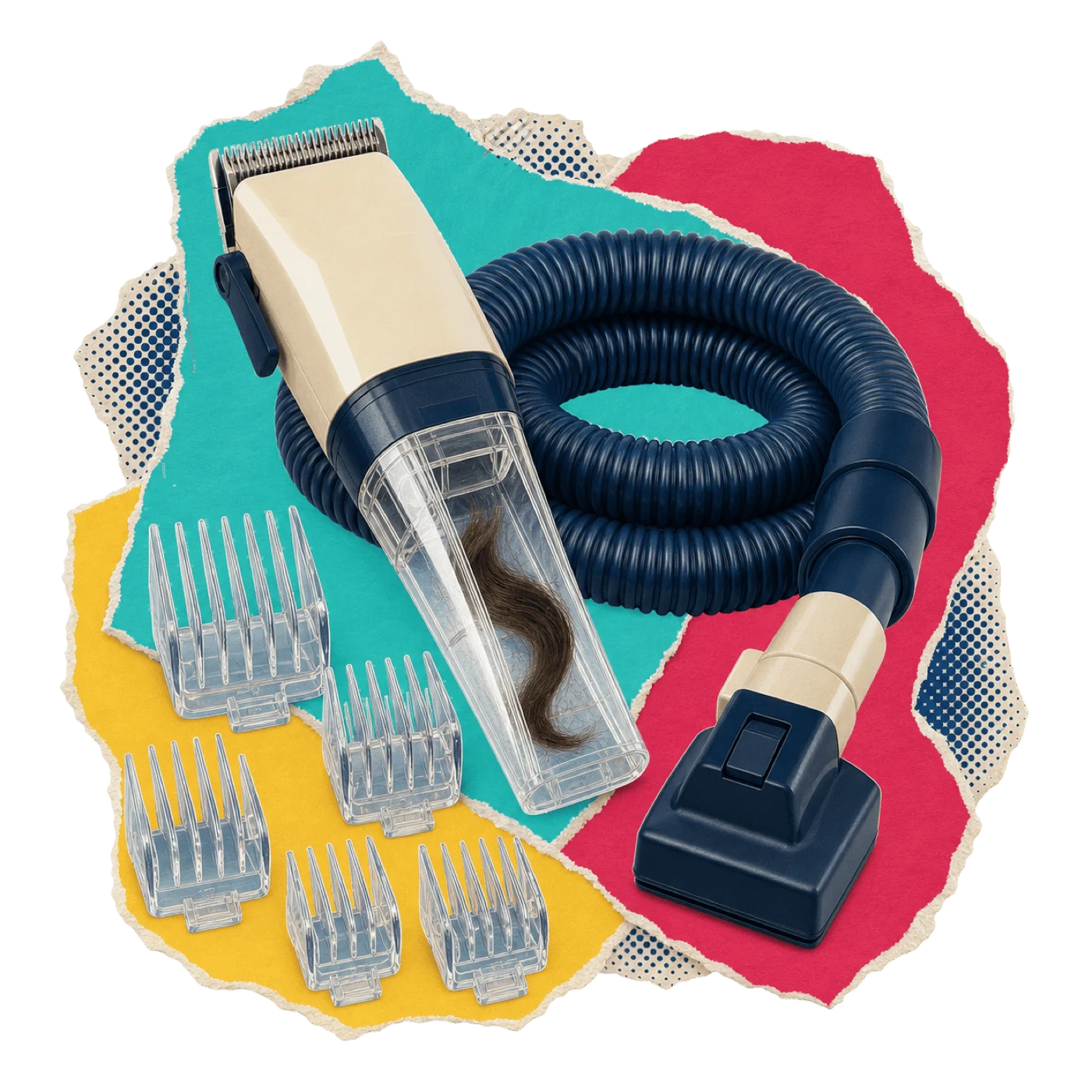
The design also separates the power jobs. An electric motor drives the cutters, while the attached vacuum supplies the airflow. The hose therefore carries no cutting force by itself; it is the route that makes the strands behave. One machine moves metal, the other moves air, and the cutting head forces those two motions to meet at a narrow opening beside the hair.
The design has remained legible across decades because the problem it solves has not changed. Hair must be held, measured, cut, and cleaned up. The Flowbee compresses those steps into a single noisy loop using equipment already present in many homes. Its continued existence is less a triumph of futuristic beauty than of stubborn mechanical logic.
Most improbable products become easier to understand after their hidden technology is explained. The Flowbee does the opposite. Its mechanism is straightforward enough to describe in a sentence—vacuum lifts, spacer measures, blades cut—and that clarity makes the object feel stranger. Nothing about it is magic. Someone simply looked at a vacuum hose, imagined it ending in a haircut, and kept building until the air itself became part of the barber’s tool.