Share
Share







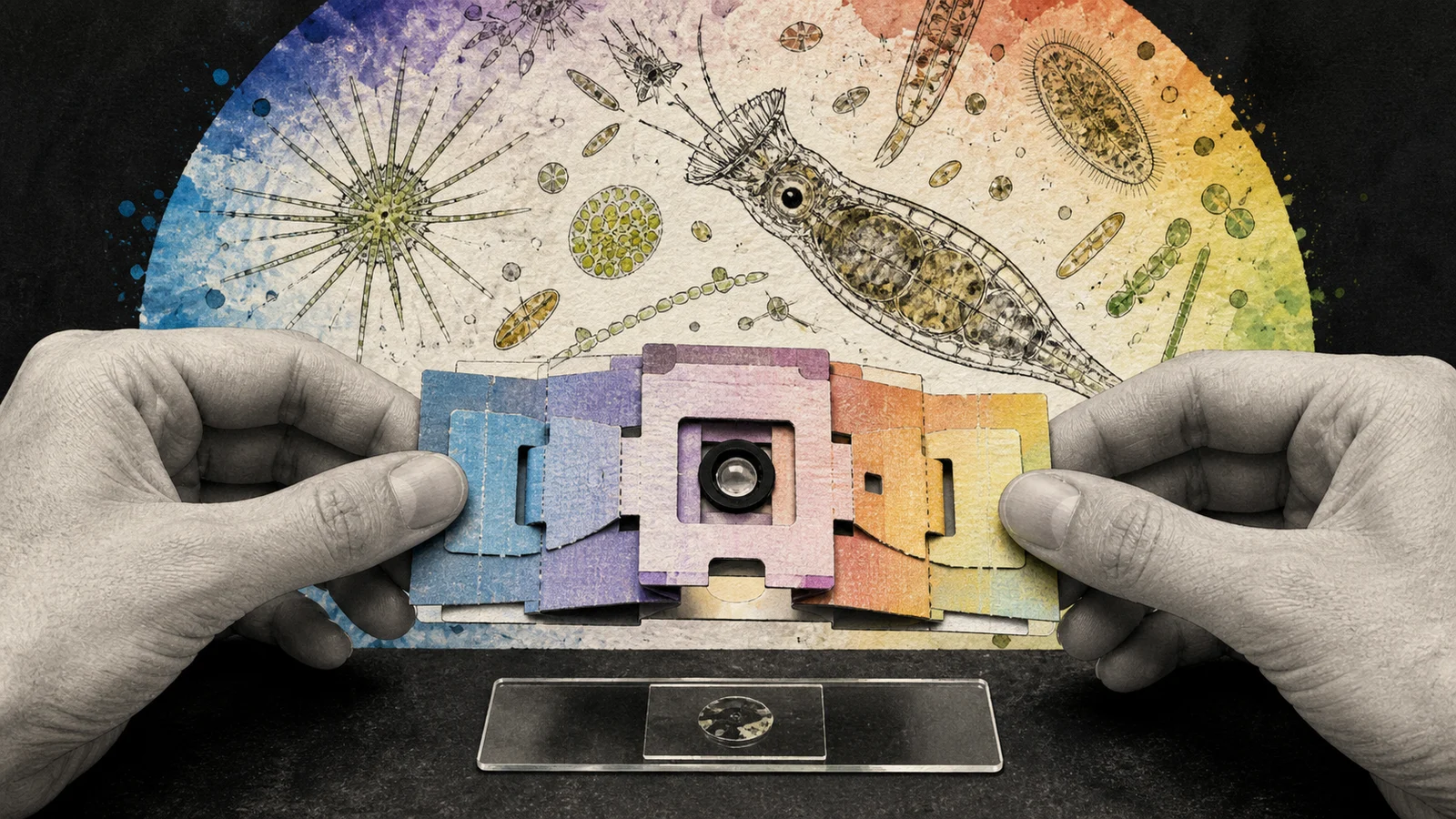
A conventional microscope is a monument to rigidity. Its frame holds the lens, specimen, and illumination in a precise relationship; its knobs move those parts by tiny amounts; its weight helps everything stay put. Foldscope begins with the same optical problem and asks an impolite engineering question: how much of that monument is actually necessary?
The answer published by Stanford researchers James Cybulski, James Clements, and Manu Prakash in 2014 was an origami-based microscope made largely from paper. The original research prototype weighed 8.8 grams, folded nearly flat, required no external power, and carried a parts cost below one dollar. A brightfield version demonstrated submicron resolution. Those figures sound like a novelty until the instrument is unfolded and the paper reveals itself as part of the mechanism.
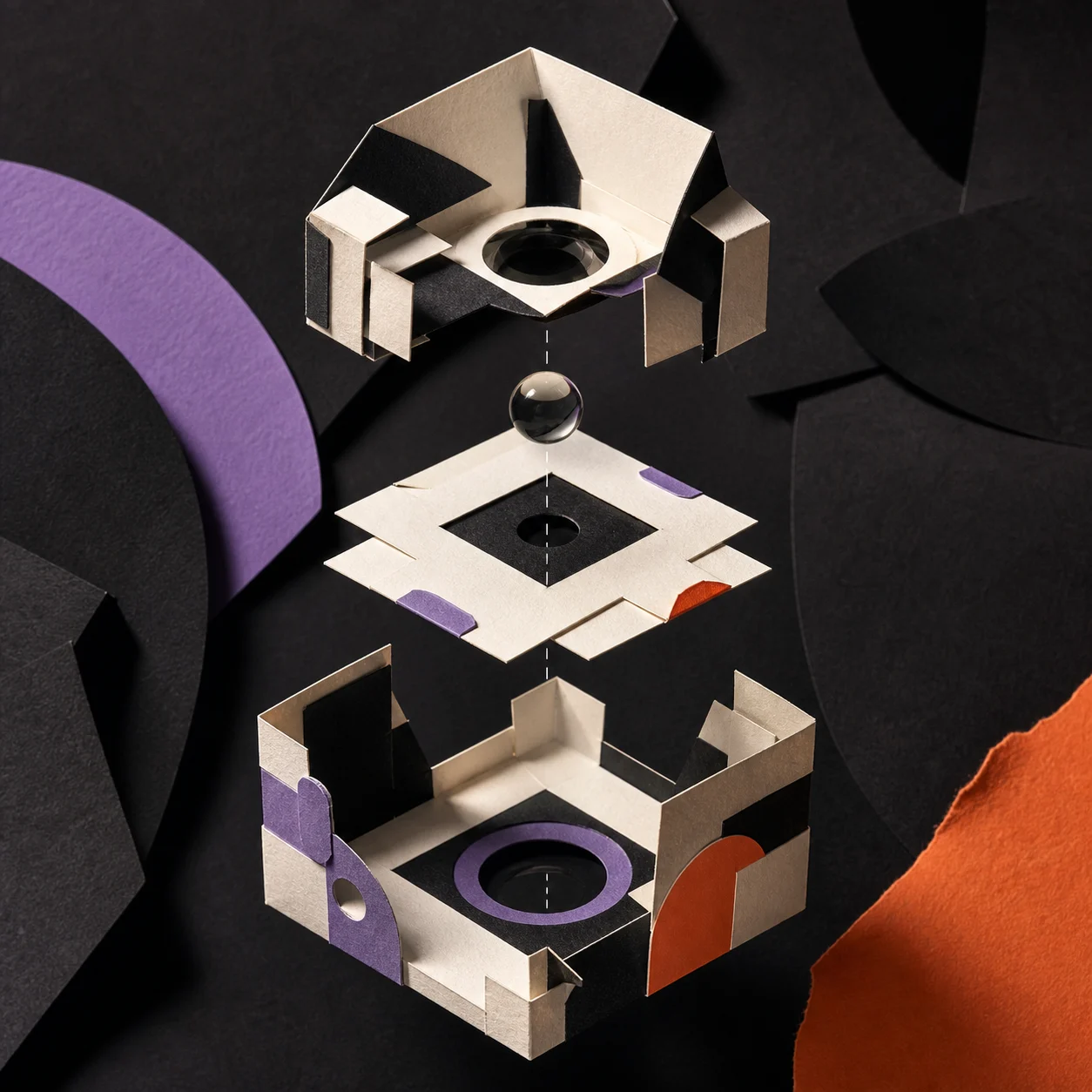
Foldscope is built from three paper stages for illumination, the specimen, and the optics. Folding weaves those stages into a constrained structure. Closed loops in the paper help align a tiny lens with the light source, while flexing the sheet provides the small changes in distance required for focus. Instead of turning a metal knob, a user holds the microscope in both hands. Moving the thumbs together pans across a slide; pulling them apart or pushing them together bends the optical stage and changes focus. The eyebrow-close viewing position is unusual, but the operations are recognizably those of microscopy: place the sample, illuminate it, scan it, and sharpen the image.
The tiny lens does much of the optical work. The research platform accommodated ball lenses and other micro-lenses at different magnifications. It also supported several ways of making contrast visible, including brightfield, darkfield, and fluorescence configurations. An array of lenses could give separate views across a sample. These arrangements were application-specific rather than a promise that one paper instrument would replace every laboratory microscope. That limitation was part of the cost strategy: keep only the functions a particular job needs, then manufacture the flat components at scale.
Small optics bring real tradeoffs. In the high-resolution brightfield configuration, the sharpest detail occupied a reduced optimal field of view because a spherical ball lens develops more optical error toward the edge. The paper described magnifications from below 100 times to above 2,000 times depending on lens choice, rather than one fixed performance number. Illumination could be built around a small LED, diffuser, filters, and a button cell, or removed for low-magnification work facing another light source. Each version was a deliberate arrangement of compromises, not a paper duplicate of every knob and objective on a bench microscope.
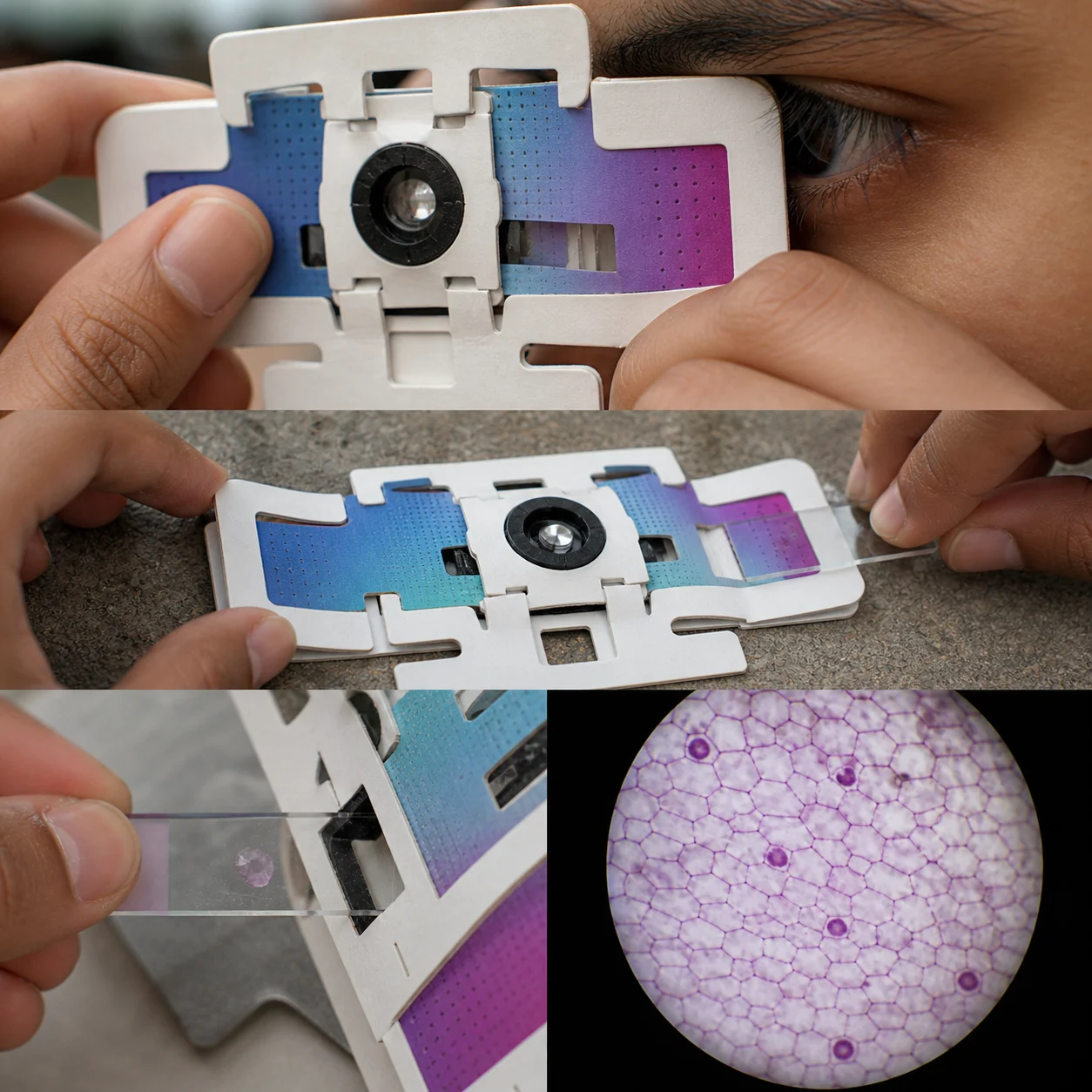
The manufacturing logic was equally important. Features cut into a two-dimensional sheet could be produced in quantity, shipped flat, then folded into a working optical path. Tiny filters could add fluorescence capability; multiple independent lenses could scan separate areas of a blood smear. The research team treated the instrument as a platform whose paper pattern could change with the question. Cheapness came partly from refusing to make every unit universal.
Paper also solves a distribution problem. A flat instrument is light to ship, inexpensive to replace, and less intimidating to handle in a classroom or outdoors. The 2014 paper reported that the assembled microscope could survive being stepped on or dropped from a three-story building. The Prakash Lab describes the project as “frugal science,” an attempt to make scientific observation available where the usual tool is too costly, too fragile, or simply locked away. The idea reportedly began after Prakash encountered a microscope kept in a locked room at a rabies clinic while a patient waited outside.

Once Foldscopes moved beyond the lab, their uses multiplied. The project describes community work involving agricultural pest eggs, soil arthropods, pollen, water samples, counterfeit currency and medicine, and other subjects. A pilot program distributed more than 70,000 instruments across more than 135 countries; the lab now reports more than two million distributed in over 160 countries. Those numbers describe a growing community as much as a product. People could carry a microscope to the specimen, share what they saw, and teach someone else to assemble another one.
Those celebrated numbers belong to one specific research prototype. The under-one-dollar parts cost, 8.8-gram weight, and quoted optical performance describe the original research prototype and its tested configurations. They are not a universal price list or specification sheet for every Foldscope sold today. Current kits can include other materials, accessories, packaging, and capabilities.
The invention's most satisfying fact is not its price. It is that the apparent cheapness comes from real engineering. The folds align components. The flexures focus them. The flat pattern supports manufacturing and transport. Foldscope did not make a microscope by pretending paper was metal; it designed a microscope around what paper does well. A crease became a hinge, a closed loop became an alignment system, and a pocket-size sheet became permission to look closer.