Share
Share







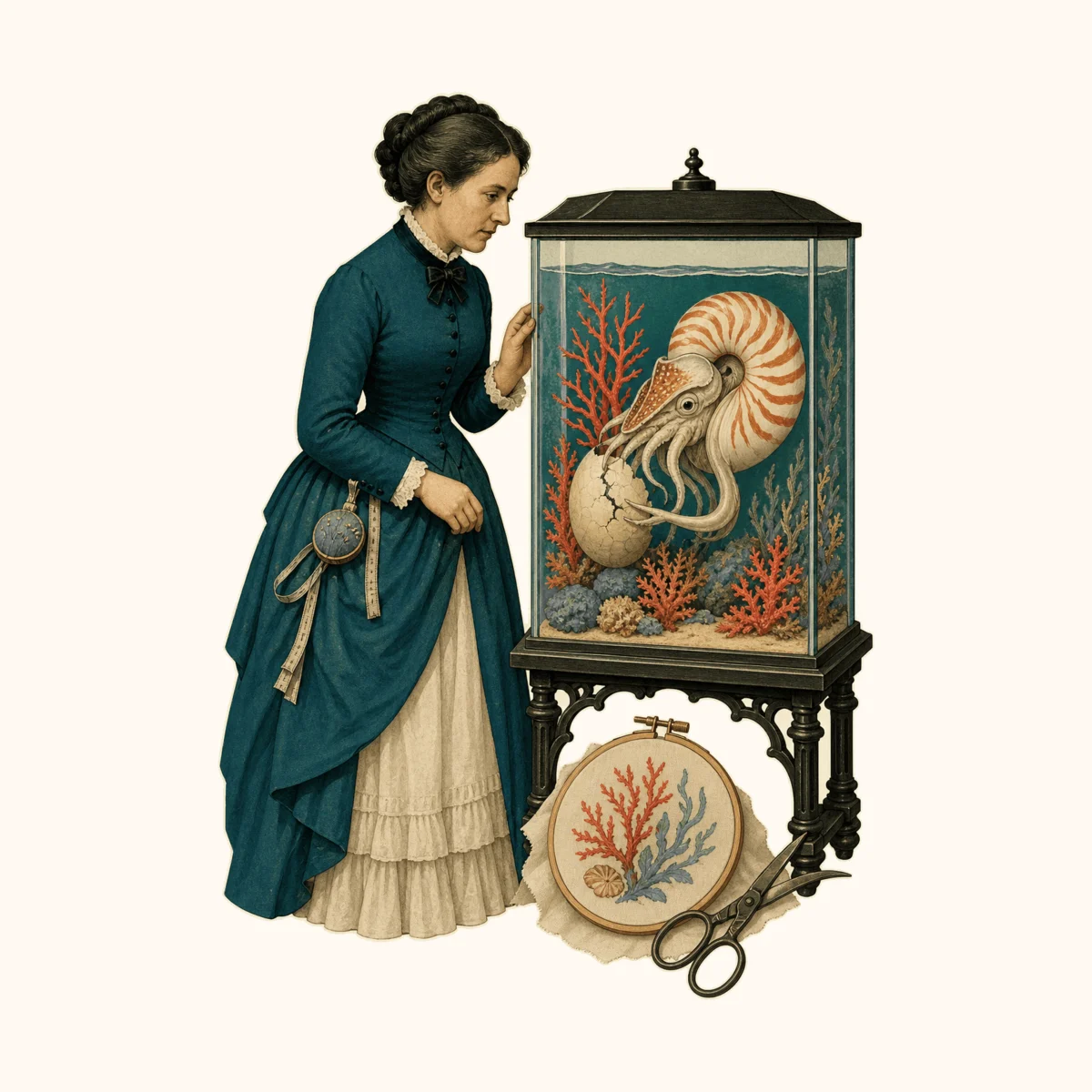
Before Jeanne Villepreux-Power studied living octopuses, she worked with fabric. Her skill as an embroiderer in Paris earned her a commission connected to royal wedding dresses. After marriage took her to Messina, Sicily, she turned the same patient eye toward the island’s natural history, building a collection and securing specimens from local fishers.
Dead specimens could not answer her question about the paper nautilus. Did the female argonaut make its delicate case, or simply move into a shell made by something else? Villepreux-Power built glass enclosures that kept marine animals alive and visible. In experiments during the 1830s, she fractured argonaut egg cases and watched the animals repair the damage. The observation showed that the females secreted their own structures.
Her conclusion met resistance, but Richard Owen presented the work favorably at London’s Zoological Society in 1839. The aquaria remain the essential invention: not decoration, but transparent laboratories that let behavior become evidence. Keeping the animal alive changed the available proof: repair could be observed as an action instead of inferred from a shell left behind. A dressmaker accustomed to constructing form made a new kind of room—one in which the sea could be watched without its occupants first being removed from it.