




 Share







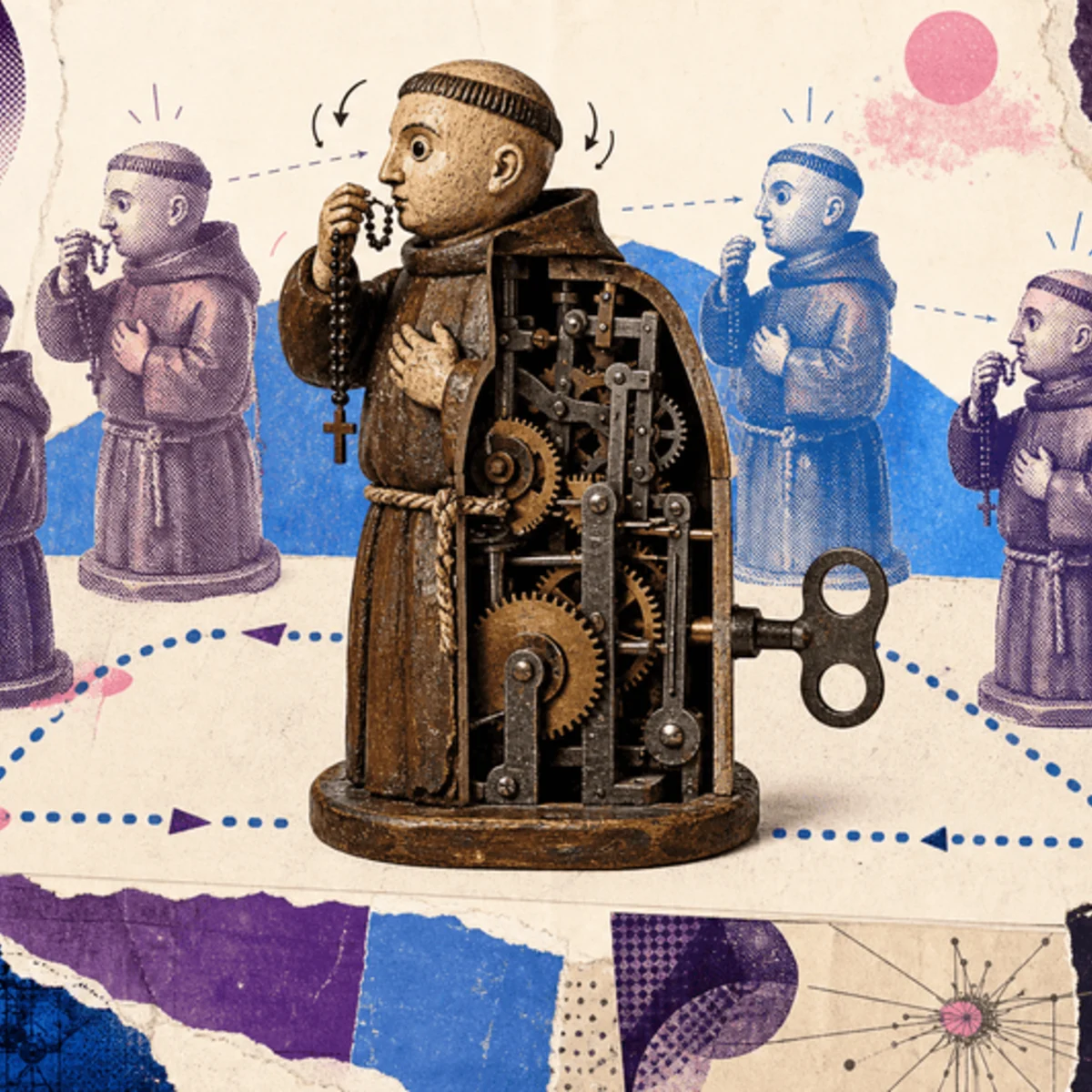
The friar is barely taller than a bowling pin. He wears a rough brown habit, carries a rosary, and keeps the grave expression of someone who has been asked to repeat the same apology for centuries. Wind the key hidden in his wooden body, place him on a table, and a 16th-century performance begins.
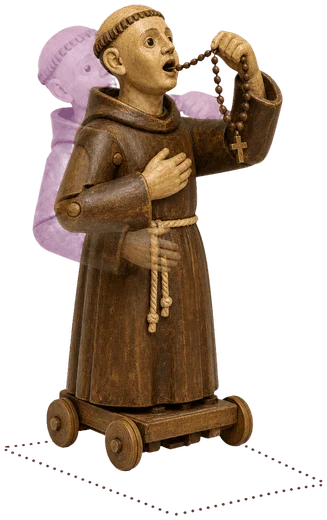
Concealed wheels start to turn. The small figure moves forward, changes direction, and traces a trapezoidal route across the surface. His eyes slide from side to side. His head pivots. His mouth opens and closes. His right arm swings inward to strike his chest, the mechanical equivalent of the penitential mea culpa. His left arm raises a rosary toward his lips, then lowers it so the sequence can begin again.
The Smithsonian's National Museum of American History, which holds the object, describes it as a wooden friar animated by a key-wound iron clockwork. The machine is about 16 inches high and fully operational. Calling it a robot is convenient, but it is worth noticing what that word can hide. There are no sensors, processors, or decisions inside. Its maker stored behavior directly in metal: gears set the pace, cams translate rotation into gestures, linkages distribute motion, and wheels carry the whole body along its prescribed path. It is choreography made physical.
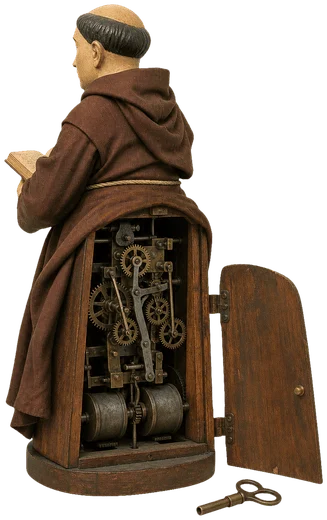
The scale makes that choreography feel intimate. A monumental clock can hide its machinery in a tower and announce itself across a square. This mechanism fits inside a small carved body and performs at the distance of a person seated across a table. Its engineering is directed toward tiny, readable details: a glance, a moving jaw, a hand meeting cloth, a strand of beads approaching the mouth. The machine does not need to resemble a living friar in every respect. It needs to hold attention long enough for separate motions to become one character.
Automata were not merely novelties in Renaissance Europe. They appeared in clocks, princely collections, churches, and courtly displays where mechanical ingenuity could suggest power over nature, mastery of time, or even a tantalizing imitation of life. A moving devotional figure joined technical wonder to religious practice. The result was not a machine that prayed for itself, but a machine that made prayer visible as a sequence of precise, repeatable acts.
The friar's gestures are unusually coordinated. A simpler toy might roll forward or wave one arm. This figure walks while its upper body performs several actions at once. The shifting eyes and moving mouth create the impression of attention and speech. The head turn changes the direction of that attention. The chest strike and raised rosary make the movement legible as penance. The maker did not reproduce a human body so much as select the few motions an audience needed to recognize a complete ritual.
Repetition supplies the final illusion. On a first pass, the viewer studies individual movements and hunts for their causes. On the next, the motions begin to read as intention: the friar seems to look, speak, regret, and pray. Nothing inside has changed. The viewer has assembled meaning from the sequence. That is the same basic bargain made by puppetry and animation, achieved here with iron components turning beneath a robe.
That audience, however, is difficult to identify. The automaton is surrounded by a famous origin story. According to the legend, Spain's King Philip II commissioned a mechanical friar after his son, Don Carlos, recovered from a serious illness. The figure is sometimes connected to the Franciscan Diego de Alcalá, whose intercession was credited with the recovery, and it has often been attributed to Juanelo Turriano, the celebrated engineer and clockmaker who worked for the Spanish court.
It is a satisfying story: royal crisis, miraculous cure, ingenious vow fulfilled in miniature. It is also not established provenance. The Smithsonian explicitly describes the Philip II narrative as legend and says the attribution to Turriano is unsubstantiated. No secure chain of documents currently takes the object from a named workshop to a royal commission and then into the museum. The neat version survives because neat versions travel well. The responsible version leaves the question open.
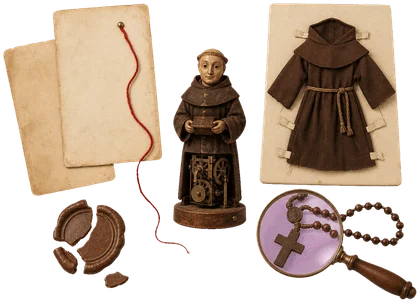
The visible figure also contains more than one moment in time. Its wooden body and iron mechanism date to the second half of the 1500s, but the brown habit seen today was made by the museum in the 1970s. The rosary may be older or newer; its date is unknown. Those additions do not make the automaton false. They show how museum objects accumulate repairs, replacements, interpretations, and stories while the core mechanism continues to carry its original motions.
That core is what makes the friar so affecting. The machine has no inner life, yet its performance is built from signs of inwardness: remorse, concentration, speech, touch, and prayer. Its face looks around as though noticing a room it cannot perceive. Its mouth shapes words it cannot understand. Its hand returns to its chest with tireless conviction. The contradiction was likely part of the fascination from the beginning.
Modern robots often impress us by changing their behavior. The friar impresses by refusing to change. Each turn of the key releases the same path and the same gestures, an instruction set preserved not as code but as shaped metal. We may never know exactly who commissioned it, who built it, or which room first watched it walk. We do know what its maker asked it to remember. For roughly four and a half centuries, the little machine has carried one carefully composed act of devotion inside its gears.