Share
Share







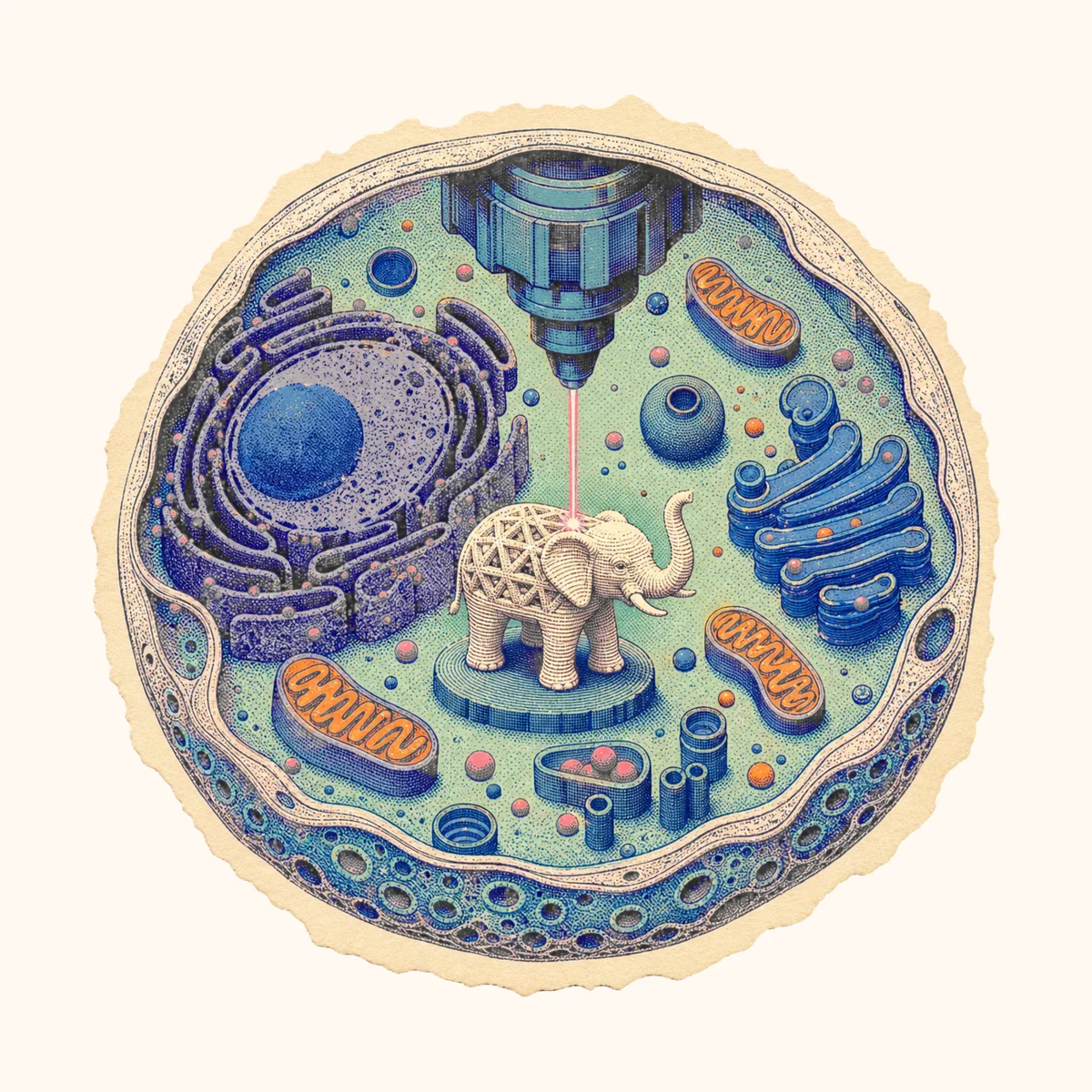
In a groundbreaking feat of science, researchers have 3D-printed a microscopic elephant inside a living cell. This pint-sized pachyderm, measuring just 10 micrometers from trunk to tail, was crafted using a femtosecond 780 nm laser and two-photon polymerization (2PP) technology. The team, led by Maruša Mur and colleagues at the Jožef Stefan Institute, injected a biocompatible photoresist into HeLa cells, allowing them to create free-standing 3D shapes with sub-micron precision.
The tiny elephant was not just a static decoration. The cell containing this miniature marvel survived and even divided, passing the elephant to one of its daughter cells. This demonstrates the potential for subcellular engineering, where custom microstructures could be used to track cells or study cellular forces.
However, the process is not without its challenges. Some cells did not survive the procedure, often due to mechanical disruption from the injection or polymerization. The printed structures, made from IP-S resin, remain stable within the cell, boasting a Young’s modulus of approximately 2.1 GPa, which is significantly stiffer than typical cellular components.
This achievement marks a new frontier in intracellular manipulation, opening doors to novel applications in biology and medicine. As the saying goes, sometimes the biggest breakthroughs come in the smallest packages.