Share
Share







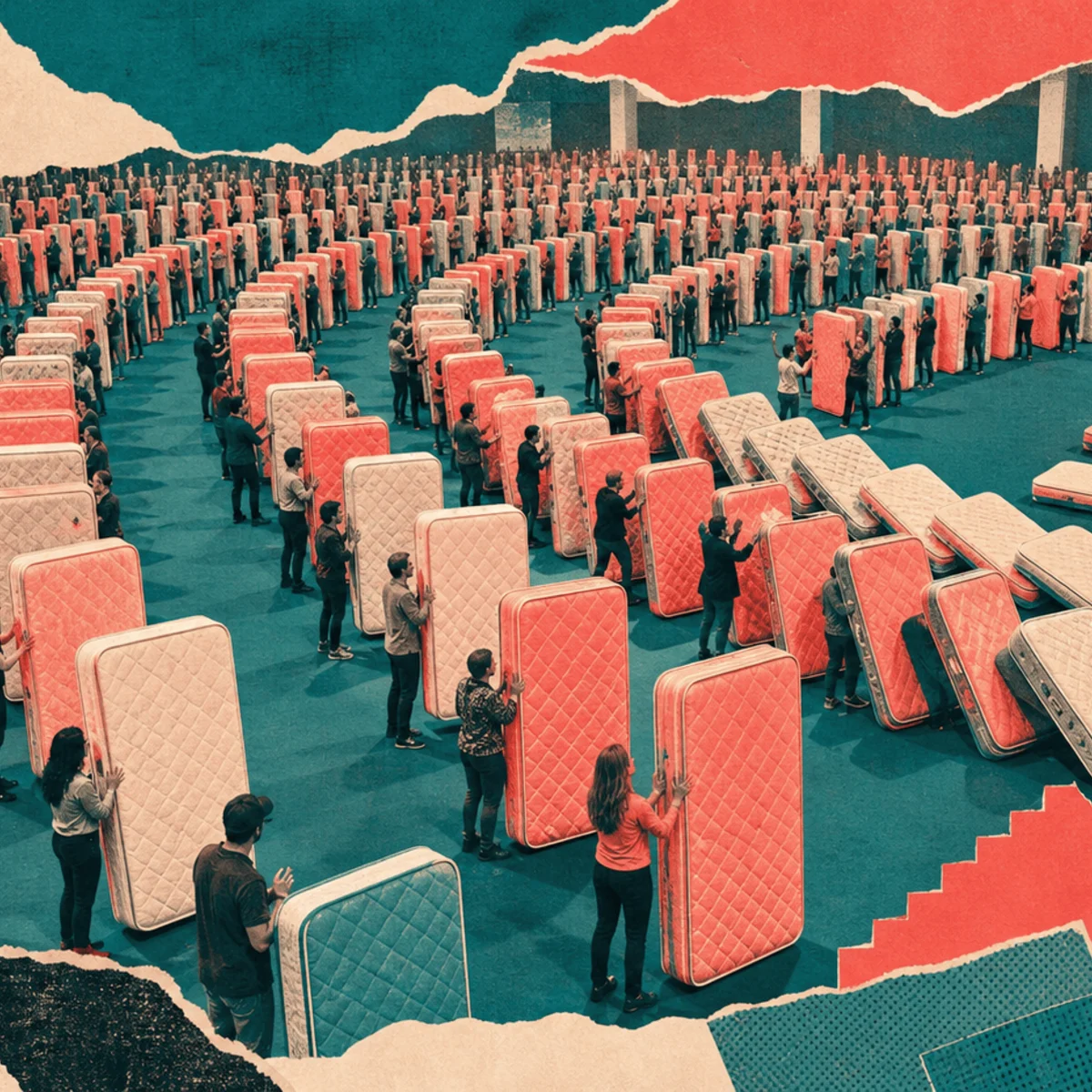
A normal domino chain asks each piece to do one thing: fall into the next. The human mattress version makes the pieces much larger and gives every one of them a person. Participants line up with mattresses, wait for the wave to reach them, then tip in sequence until an entire hall has folded into a soft, slow-motion cascade. It is part record attempt, part choreography, and part demonstration of how much floor space ordinary bedroom furniture can occupy when arranged as a machine.
The largest version currently published by Guinness World Records involved 2,355 people. Mattress maker Uratex staged the attempt at the SMX Convention Center in Pasay, Metro Manila, on October 22, 2023. The event marked the company’s fifty-fifth anniversary and included employees, partners, and representatives of fifty-five charities. After the last fall, the mattresses were donated to those organizations. The equipment required to make the record was also the thing given away.
Human mattress dominoes are easy to understand from a distance and difficult to organize up close. Every participant is both a person and a moving part. A conventional domino is identical to its neighbors, sits on a rigid surface, and falls predictably when struck at the right angle. A person holding a mattress has balance, timing, nerves, and a strong temptation to look around. Scale adds more opportunities for gaps, mistimed falls, and rows that fail to hand the motion forward.
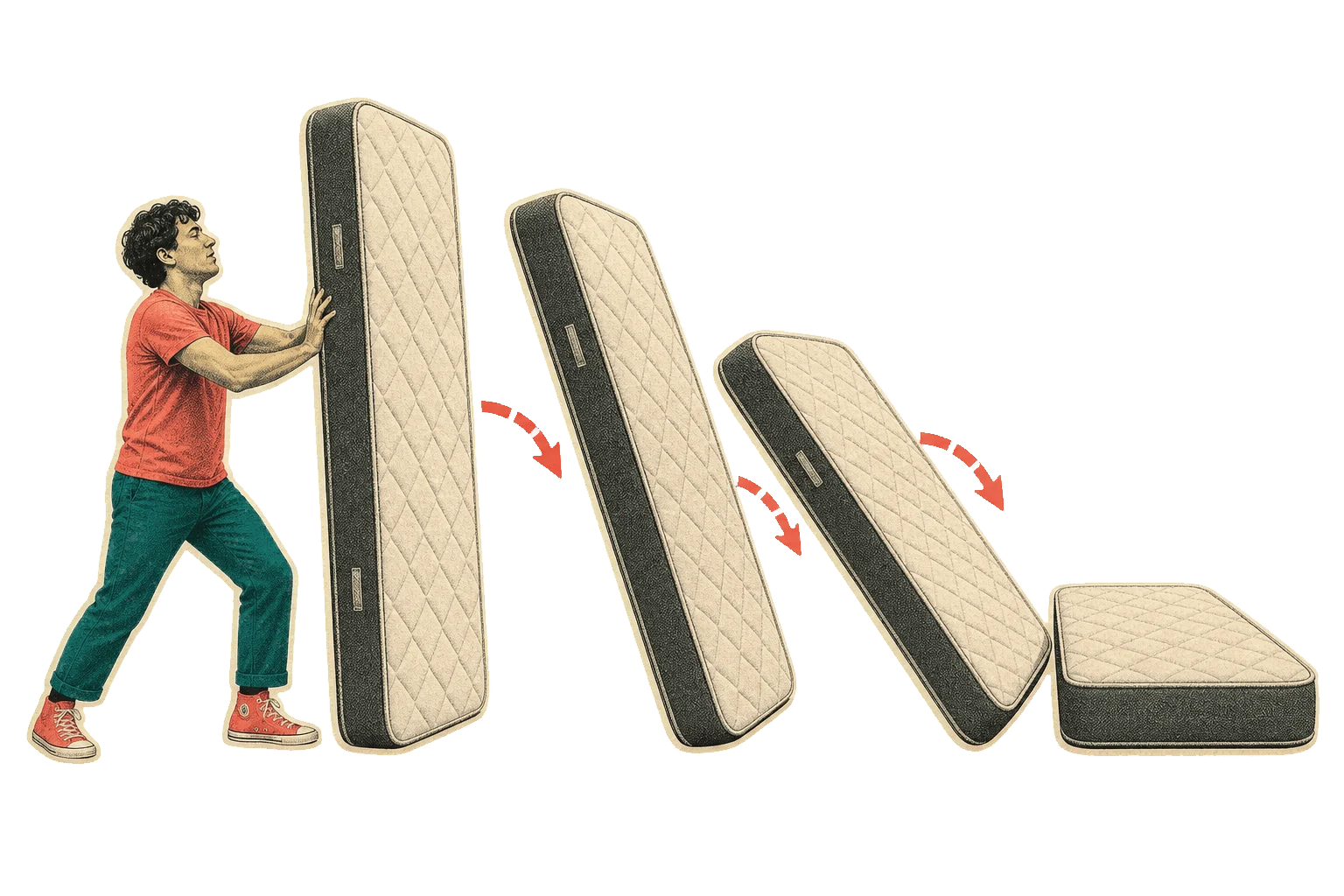
A documented 2016 attempt shows how much planning the joke requires. Aaron’s Inc. assembled 1,200 participants inside two exhibit halls at the Gaylord National Resort and Conference Center in Maryland. The setup covered 70,000 square feet and divided the mattresses into thirty-four rows. A domino specialist helped arrange the field. When the company’s chief executive pushed the first mattress, the chain completed successfully on its first attempt.
That 2016 fall took thirteen minutes and thirty-eight seconds. The number reveals the main visual difference from tabletop dominoes. Small tiles can chatter down a line almost faster than the eye can follow. Mattresses move at body speed. Each transfer includes a person receiving the previous fall, yielding backward, and passing the motion along. Multiply that gesture by 1,200 and the chain becomes a procession rather than a snap. The audience can watch the cause travel.
The 2016 event broke a record of 1,150 participants set by a German furniture company in 2012. Guinness traces the record category back to an eighty-person attempt at Channel Nine studios in Sydney in 2009. In seven years, the field grew by a factor of fifteen. By the published 2023 mark, the original eighty-person chain would fit inside the new total more than twenty-nine times. The idea did not change; organizers simply kept extending the line.

That growth produces a peculiar form of suspense. A record attempt can fail because one athlete misses a mark or one machine breaks. Here, thousands of very simple individual actions must connect. No participant performs an impressive feat alone. The achievement exists only in the handoff from one position to the next. A mattress that falls beautifully but fails to trigger its neighbor is not a successful domino. Coordination matters more than style.
The mattress also solves the problem it creates. Human dominoes need people to fall, but a record built around people hitting a hard floor would quickly stop being whimsical. The same object that enlarges the spectacle provides the landing surface. Each participant carries the cushion that makes their own fall possible, then uses it to transfer the motion. The prop is simultaneously domino face, safety equipment, and eventually a bed.
Both the 2016 and 2023 events attached the temporary spectacle to donations. In Maryland, the 1,200 mattresses were designated for charitable groups and youth shelters in the Washington area. In the Philippines, the 2,355 mattresses went to the fifty-five participating charities. That second life changes the logistical absurdity of gathering thousands of mattresses in one hall. The record uses the objects for minutes; recipients use them for their intended purpose afterward.

There is something pleasingly literal about the category’s name. These are human mattress dominoes—not people pretending to be dominoes, and not mattresses falling empty. Each unit works only because the person and object stay together. The person supplies timing and controlled movement. The mattress supplies scale, a broad surface, and a safer landing. Remove either half and the chain becomes a different record.
The current Guinness listing is a snapshot rather than a promise that 2,355 will remain the maximum. The category has already moved from a television studio to furniture-company gatherings and convention centers, climbing through eighty, 1,150, 1,200, and then more than two thousand participants. Any future challenger must solve the same expanding puzzle: find more people, more mattresses, more floor, and a path that lets one deliberately clumsy fall travel all the way to the end.
That is why the finished cascade is so satisfying. The individual movement is ordinary—lean back onto a mattress—but the system turns it into an event visible across a vast room. Thousands of people wait inside a diagram, each holding the next step of a wave. Then one mattress tips, gravity receives the signal, and a temporary machine made of beds and bodies begins to compute its way across the floor.