Share
Share







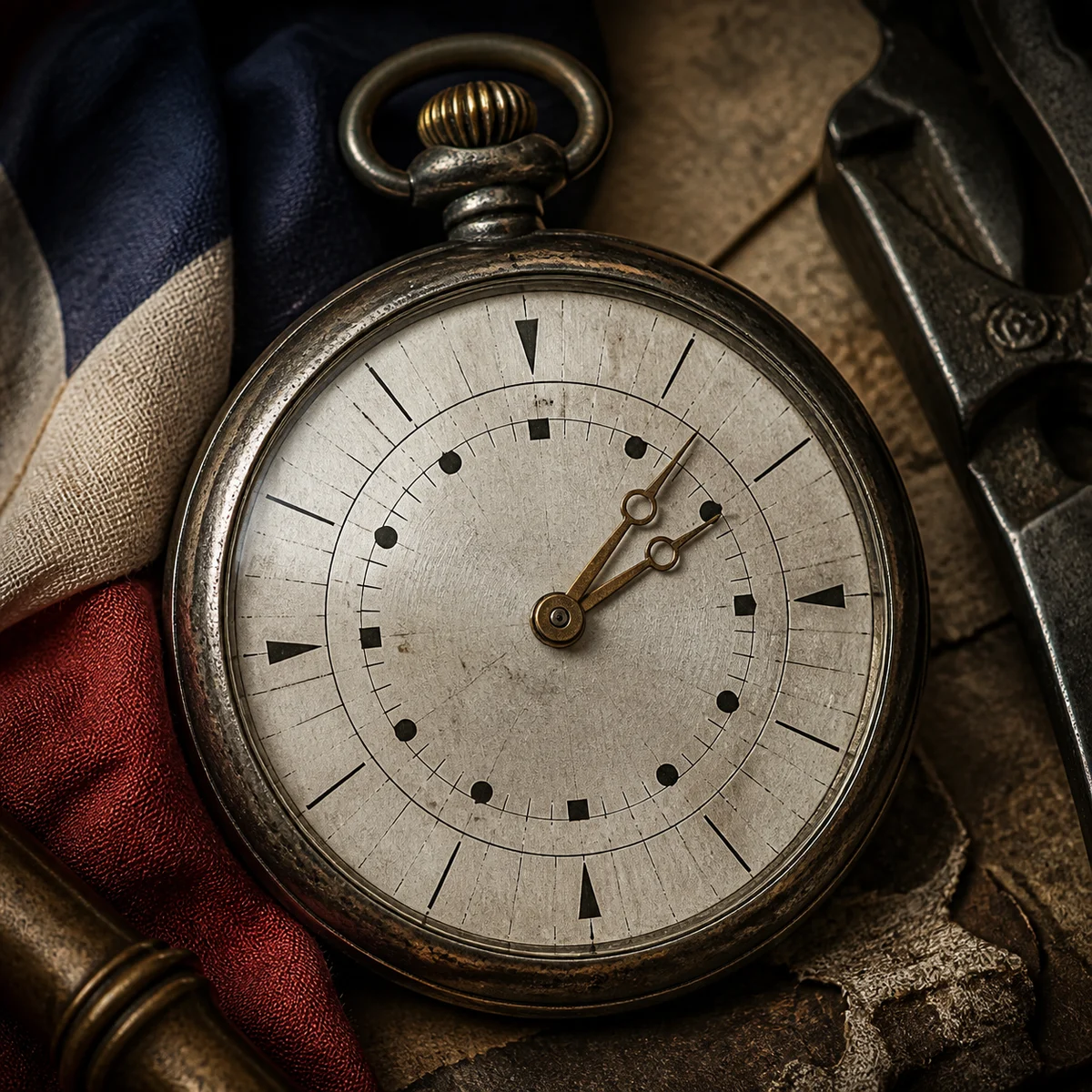
French Revolutionary decimal time tried to make the day behave like the new metric world. Instead of twenty-four hours, a full day held ten. Each decimal hour contained one hundred minutes, and each minute contained one hundred seconds. Midday therefore arrived at 5:00, while midnight marked either 0 or 10.
The reform changed unit size as well as the numbers on a dial. A decimal hour lasted 2.4 conventional hours; a decimal minute lasted 86.4 conventional seconds; a decimal second passed slightly faster than the familiar one. Surviving watches show how difficult a cultural conversion can be. Some carry two scales at once, letting the owner read both ordinary and decimal time while daily life straddled systems. One British Museum example, made in Paris by Jean Chambon around 1800, uses three gold hands: one hour hand reads both scales, while separate minute hands serve conventional and decimal time. Its mechanism makes two numerical systems coexist on a single white enamel dial.
The British Museum preserves examples whose paired rings make the experiment visible. One dial can announce that the same instant is, for example, five decimal hours and twelve conventional hours without either hand being wrong. Decimal time promised orderly arithmetic—tenths, hundredths, thousandths of a day. The clock on the wall had to negotiate with habit. France did not merely rename the hours. It briefly asked everyone to feel a different length of minute.
Sources