




 Share








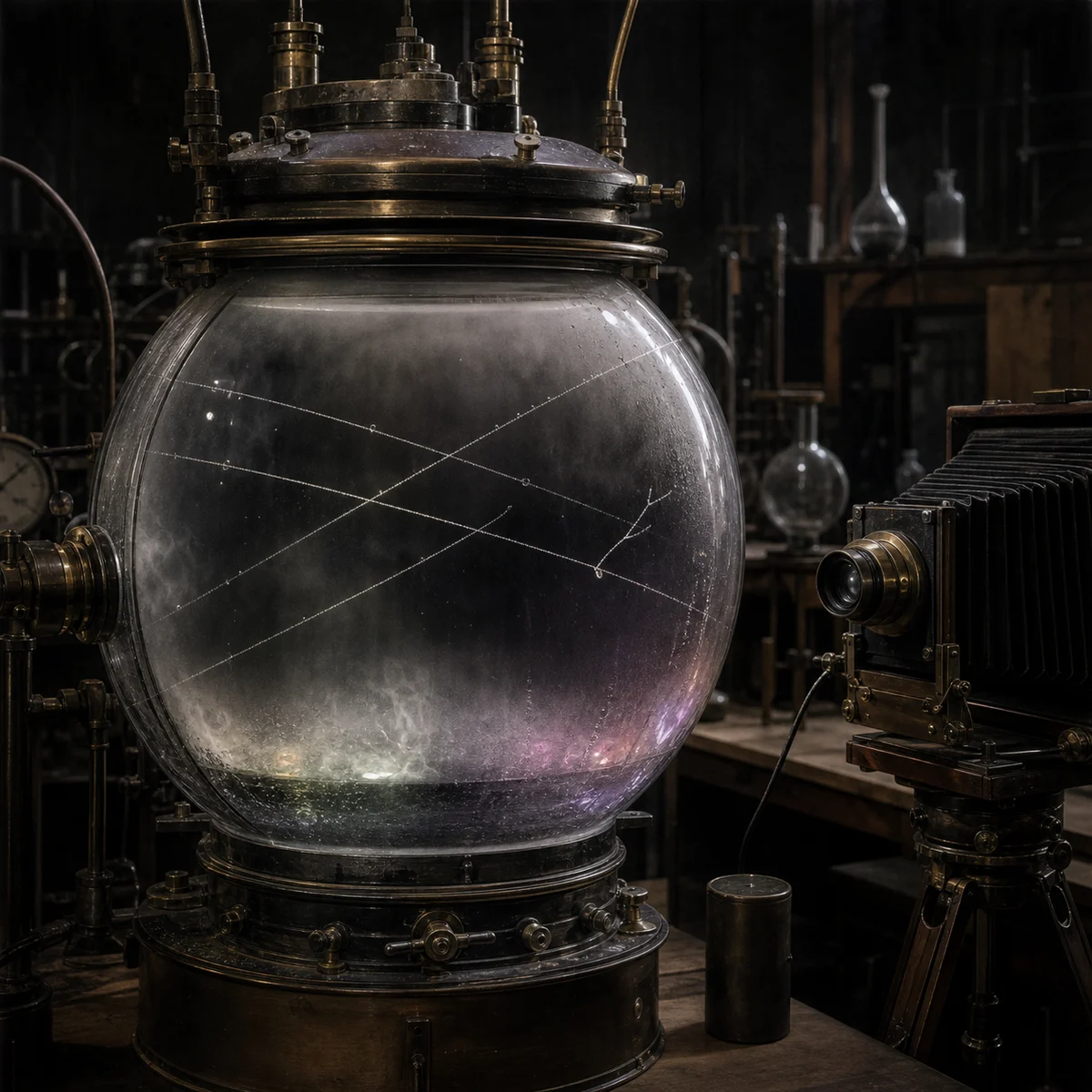
A cloud chamber begins with vapor in an unstable state. Cooling or expansion makes the air supersaturated, so it is ready to form droplets but needs suitable places for condensation to begin. A charged particle supplies them by ionizing molecules along the route it travels.
Droplets gather around those ions and a pale track appears. The line can be photographed and compared with other tracks before it disperses. Shape, thickness, curvature, and branching give investigators evidence about the particle's behavior and interactions. Invisible radiation acquires temporary geometry.
The visible material is ordinary condensed vapor, not the particle enlarged for human sight. A useful analogy is a contrail: the cloud reveals a path through changed surrounding matter. Keeping that distinction prevents the instrument from becoming magical while preserving its real achievement. Wilson made an indirect trace immediate enough to see.
The chamber grew from work on clouds and atmospheric phenomena. By reproducing the conditions for condensation inside apparatus, Wilson found a way to let ionization organize droplets. Weather physics became a detector for particle physics. A camera could then freeze evidence that the vapor would soon erase.
The result is both scientific and strangely graphic. A chamber holds blank mist; radiation passes; filaments appear with curves and collisions no hand composed. Each is a physical record assembled by vapor around an unseen event. The particle never draws with ink, yet the apparatus makes its passage legible as a fleeting line.
Sources