Share
Share







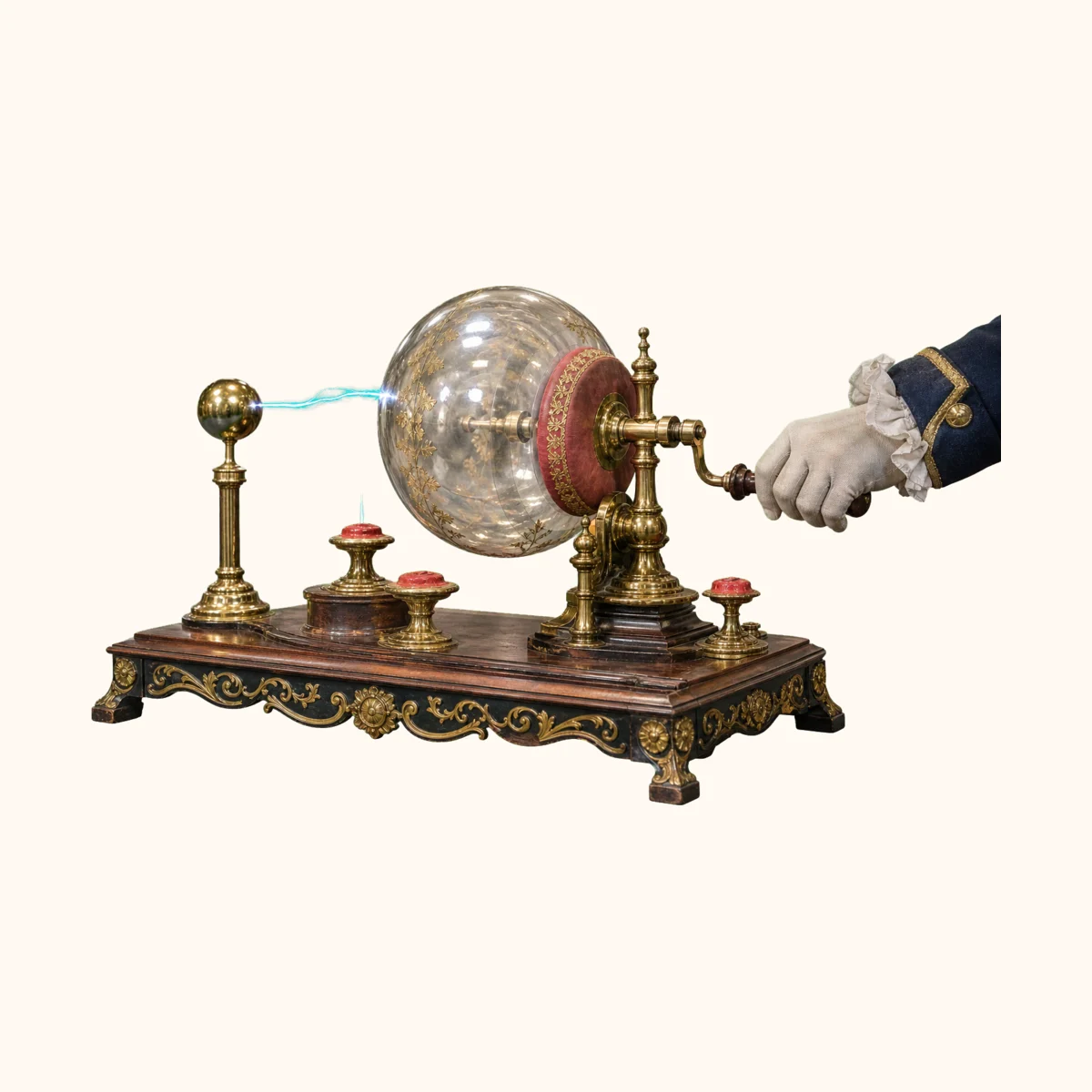
Around 1762, instrument maker George Adams built King George III an electrical machine whose moving part was a glass globe. A handle turned the globe against a cushion. Friction separated electrical charge, which could then be collected from the glass or from the metal backplate behind the cushion.
This was not a generator for lamps or appliances. Its output was static charge: enough to produce deliberate sparks and support the electrical experiments of the period. The machine made an invisible property accumulate until it announced itself in a visible, audible discharge.
Adams identified himself in the inscription as mathematical instrument maker to the king on Fleet Street, London. The object combines brass, glass, sealing wax, and steel; its present stand was added later. The globe sits horizontally in an elaborate instrument whose polished hardware gives friction the ceremony of royal science.
The operator supplied every burst by hand. Turn the crank, press glass against cushion, collect what the rubbing separated, and bring the charge close enough to jump. For a king examining electricity before wires crossed cities, the spectacle arrived one rotation at a time: human motion stored briefly in glass, then escaped as a spark.