Share
Share







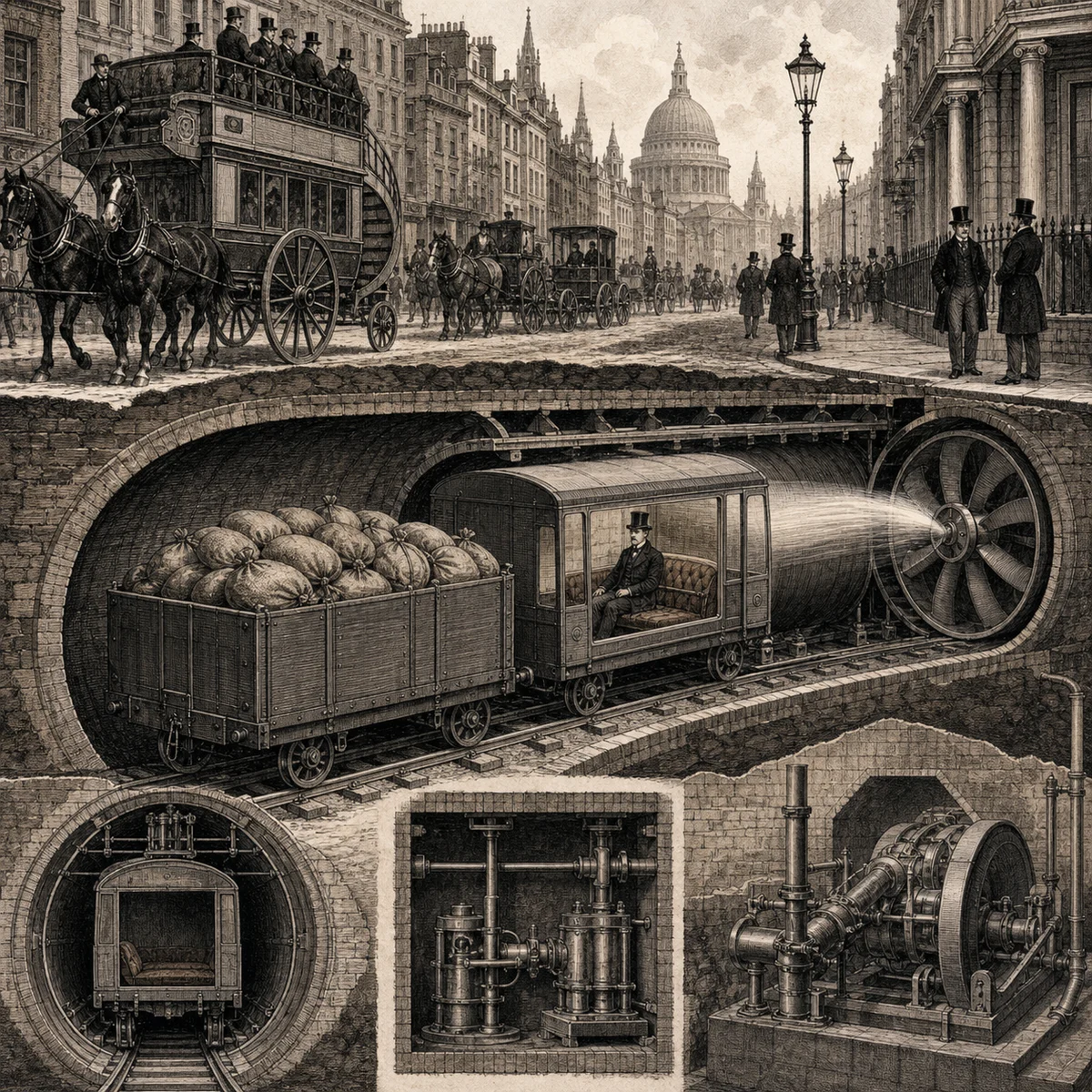
In 1863, London tested a postal shortcut that sounded like a magician's apparatus: place mail inside a narrow railcar, seal it in a tunnel, and use air to send it across the city. The Pneumatic Despatch Company built a line between Euston station and the North Western District Post Office. A large fan created pressure differences that sucked the car in one direction and blew it back in the other.
The loads were not always letters. Demonstration passengers rode inside the snug vehicles, providing irresistible evidence that the tube could move more than sacks. The system eventually linked parts of the postal network through underground tracks, but the commercial experiment did not last. Operations ended in 1874. Costs, reliability, and the economics of the service proved harder to conquer than the tunnel itself.
The machinery belongs to a moment when cities were trying to make information move faster by turning infrastructure into motion. It was a railway, but its locomotive was the air around it; a dispatch system, but one substantial enough for a person to squeeze aboard. London's later Mail Rail was a different system: an electric underground postal railway that opened in 1927. The pneumatic line was an earlier, stranger branch of the same urban dream: make the message vanish beneath the street and arrive before the traffic could catch it.