




 Share








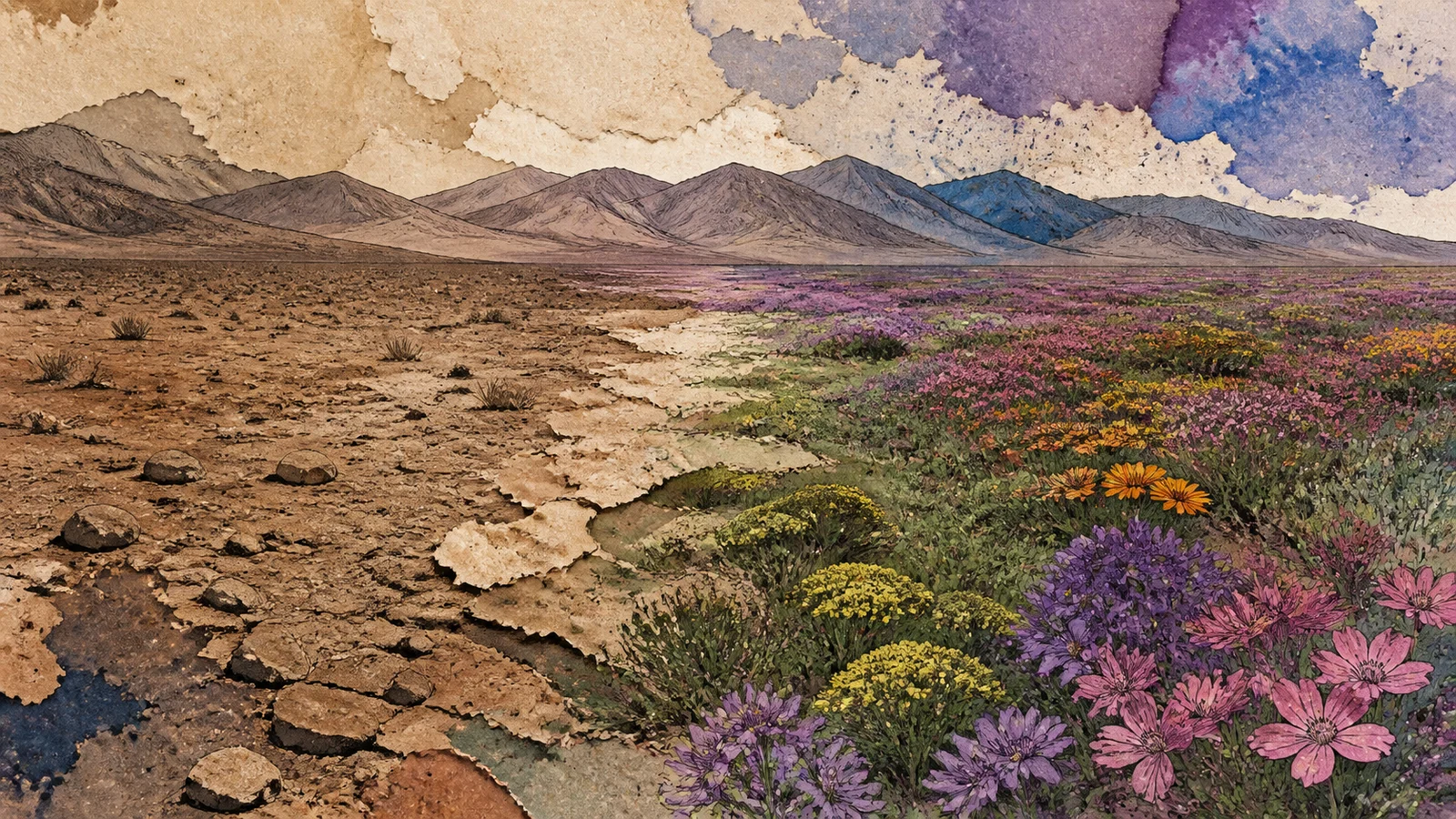
The Atacama Desert is assembled from reasons not to rain. The Andes cast a powerful rain shadow, a cool Pacific current limits moisture in the air, and persistent high pressure often turns storms away. Some areas receive only a few millimeters of rain in a year; some stretches can see none. Yet dormant seeds, bulbs, and other underground structures wait beneath the bare-looking ground.
When enough water arrives, parts of the desert can change quickly. In a documented greening event, exceptional storms caused destructive floods in northern Chile. Weeks later, wildflowers and other vegetation spread across surfaces usually read as brown and barren. Satellite instruments detected the pulse through reflected red and near-infrared light, revealing a band of unusual growth across hundreds of kilometers.
The flowers are not an annual costume stored on a timer. An analysis of decades of satellite observations identified 13 greening events, with location, duration, and intensity changing from one pulse to another. Species also respond on different schedules. The accurate wonder is not “the desert blooms every year.” It is that a long-lived bank of possibility can remain hidden through extreme dryness, then translate rare moisture into color.
Aridity in the Atacama comes from several large systems working together. The Andes rise along the desert's eastern edge and strip moisture from air crossing the mountains. To the west, a cool ocean current chills the lower atmosphere and limits how much water vapor it can carry. Persistent high pressure often blocks storms. The result is not one uniformly rainless plain, but a broad region containing some of the driest nonpolar environments on Earth.
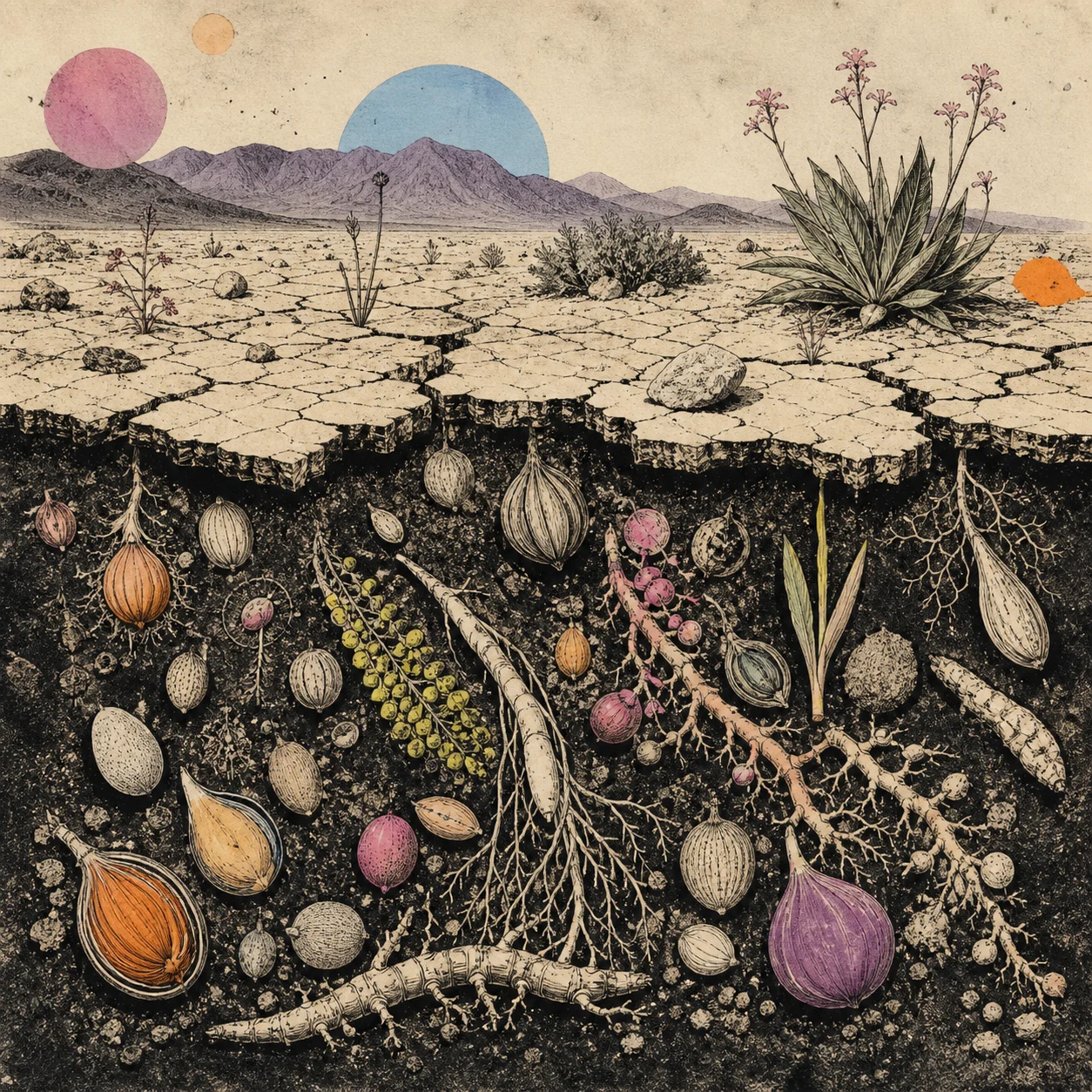
Plants survive that irregularity by treating time differently. Resistant seeds can remain dormant in the soil; bulbs and rhizomes can hold living tissue below ground. They are not active flowers hiding just beneath a crust. They are durable stages capable of waiting until moisture crosses a threshold. When the conditions do arrive, rapid germination and growth let ephemeral species use a window that could close almost as quickly as it opened.
One NASA case followed storms that reached northern Chile in January and February. Rain that was unusual for the western Andean slopes caused damaging floods in multiple regions, destroyed homes, cut power, and killed people. The later greening cannot be told responsibly as a purely cheerful weather surprise. The same water that triggered plant growth also arrived as a dangerous event for communities in its path.
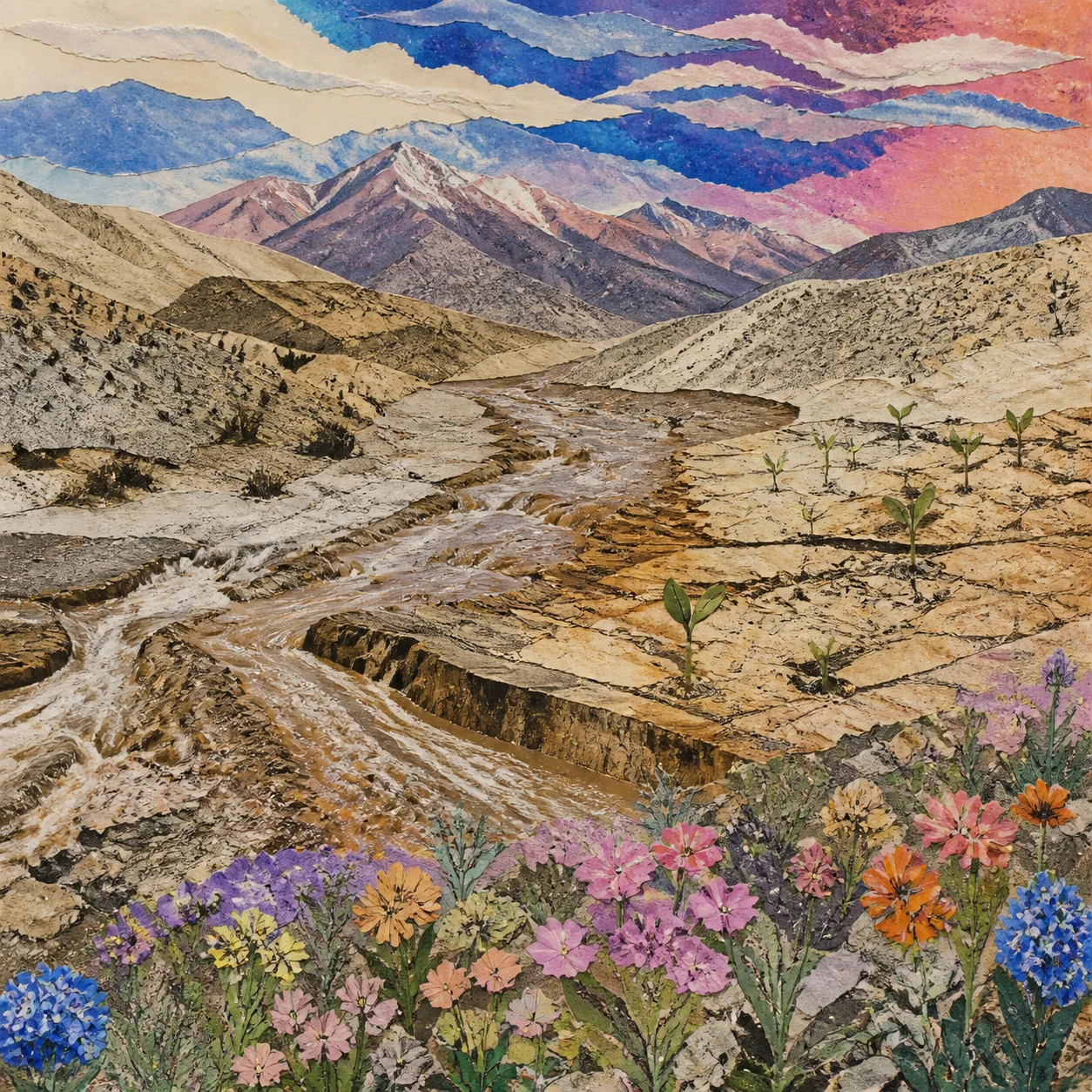
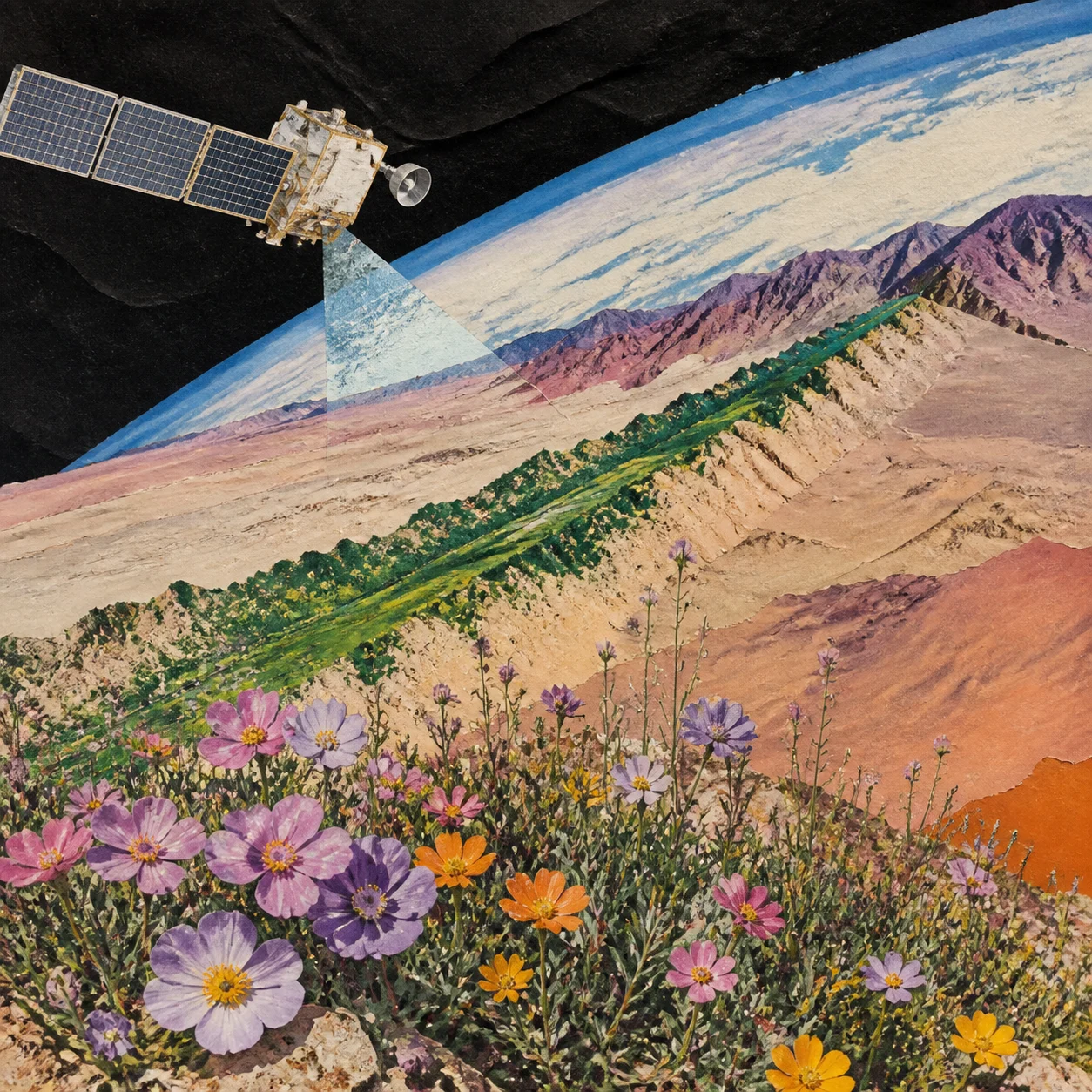
By the following weeks, surfaces normally dominated by bare mineral colors supported wildflowers and other vegetation. From orbit, individual flowers were too small to resolve in ordinary natural-color imagery. Researchers instead used the way healthy vegetation reflects light. Chlorophyll absorbs much visible red light and reflects strongly in near-infrared wavelengths, allowing instruments to map a green pulse even when a conventional satellite photograph looks subtle.
The resulting vegetation index compared the event with a long-term average. The strongest anomaly occurred at elevations around 2,500 to 3,000 meters and extended in a band for hundreds of kilometers. That geography was unusual for the case described by NASA: farther north and in austral fall rather than matching the more familiar winter flowering events in the southern Atacama. “The bloom” is therefore never one fixed patch.
A longer satellite record reinforces that variability. An analysis spanning the early satellite era through the mid-2010s identified 13 greening events. Most began in winter and lasted into the following summer, but the record did not turn the desert into a predictable annual flower show. Rain amount, location, soil, elevation, temperature, and the living seed bank all influence what appears and how long it remains.
Different species do not respond as one synchronized carpet. Some germinate quickly; others require different moisture or temperature cues. A field of color is the visible top of a pulse ecosystem that also includes pollinators, herbivores, microbes, and dormant stages that never emerged in that particular event. Satellite greenness captures the broad response, while field ecology is needed to identify which organisms produced it.
The phrase “wakes up” is useful only if it does not imply the desert was lifeless. Hyper-arid landscapes hold organisms adapted to scarcity, and the underground seed bank is one expression of that persistence. Rain does not manufacture a new ecosystem from nothing. It changes which stored capacities can become active, visible, and reproductive before dryness returns.
That is why the timing caveat improves the story. A guaranteed yearly spectacle would be a tourism schedule. A moisture-driven pulse is an ecological strategy. The Atacama's flowering episodes remain rare, uneven, and contingent, and the plants' achievement lies precisely there: survival measured across long quiet intervals, followed by a swift conversion of water into leaves, blossoms, and the next bank of waiting life.
Seen from the ground, the transformation is color. Seen from orbit, it is a change in reflected wavelengths. Seen across years, it is a sequence of irregular pulses. Those views describe the same event at different scales and keep the central claim honest: parts of the Atacama can flower spectacularly after rare rain, but no single place, intensity, or schedule stands for the whole desert.
Sources