Share
Share







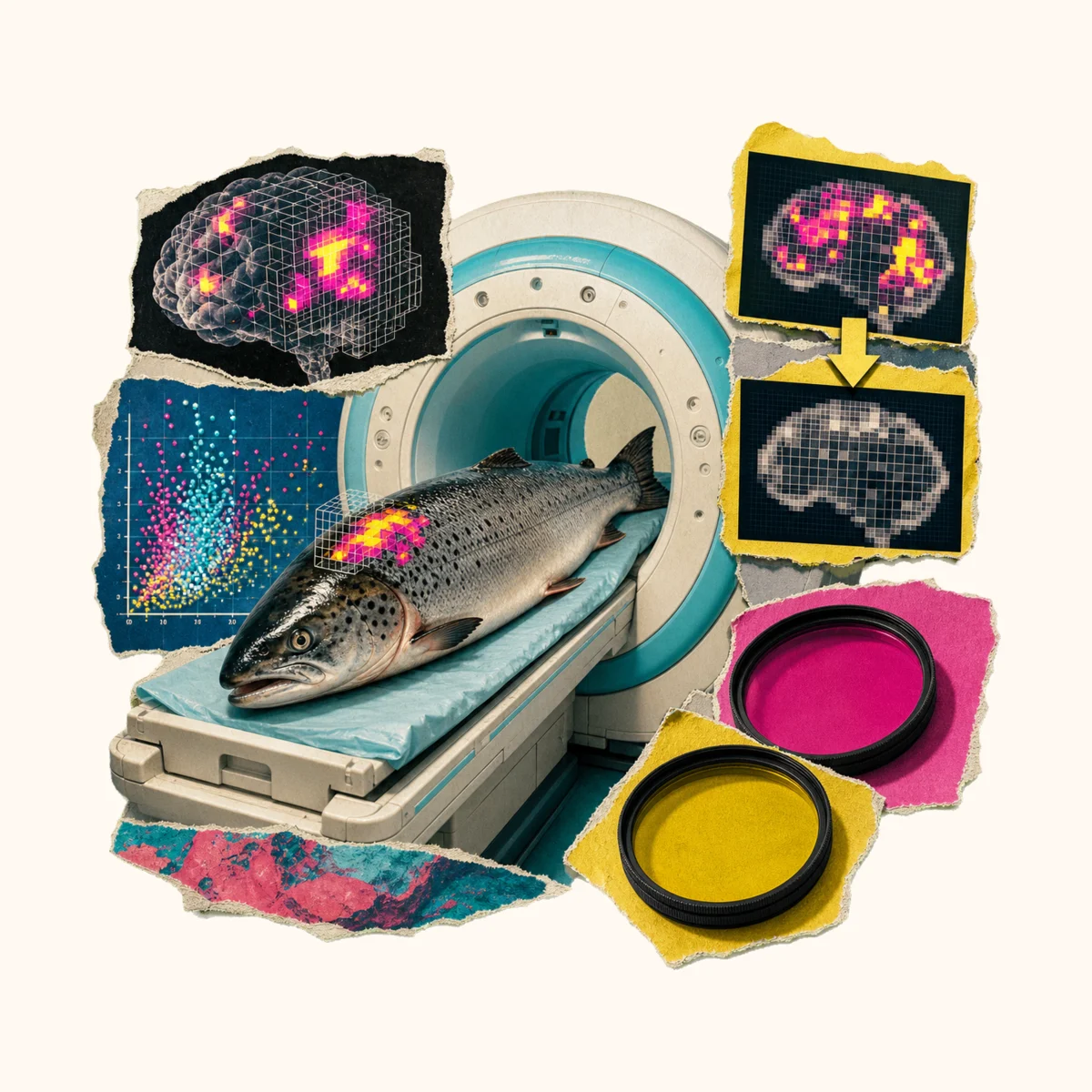
Researchers once placed a post-mortem Atlantic salmon in an fMRI scanner and presented it with photographs of people in social situations. The task was intentionally absurd: the non-living fish was treated as though it might identify the emotion being shown. The real subject of the experiment was not salmon cognition. It was statistical practice.
An fMRI dataset can contain measurements from an enormous number of voxels. Test enough locations independently and random noise can produce a few results that look significant by chance. In the salmon data, an analysis using an uncorrected threshold appeared to find a small cluster of “active” voxels. Nothing had awakened inside the fish. The method had manufactured a false positive.
The researchers then applied two established ways of controlling multiple comparisons: a false-discovery-rate correction and a familywise-error-rate correction. After correction, no voxel remained significant. The apparent brain activity vanished exactly as a properly skeptical analysis should make it vanish.
The experiment was not an argument that fMRI is fraudulent or useless. It was a deliberately memorable demonstration of what can happen when thousands of statistical tests are allowed to audition without an appropriate correction. A living human brain can produce fascinating signals; a dead salmon can produce a caution sign. The fish's contribution to neuroscience was simple: if your method can make it think, check your math.