Share
Share







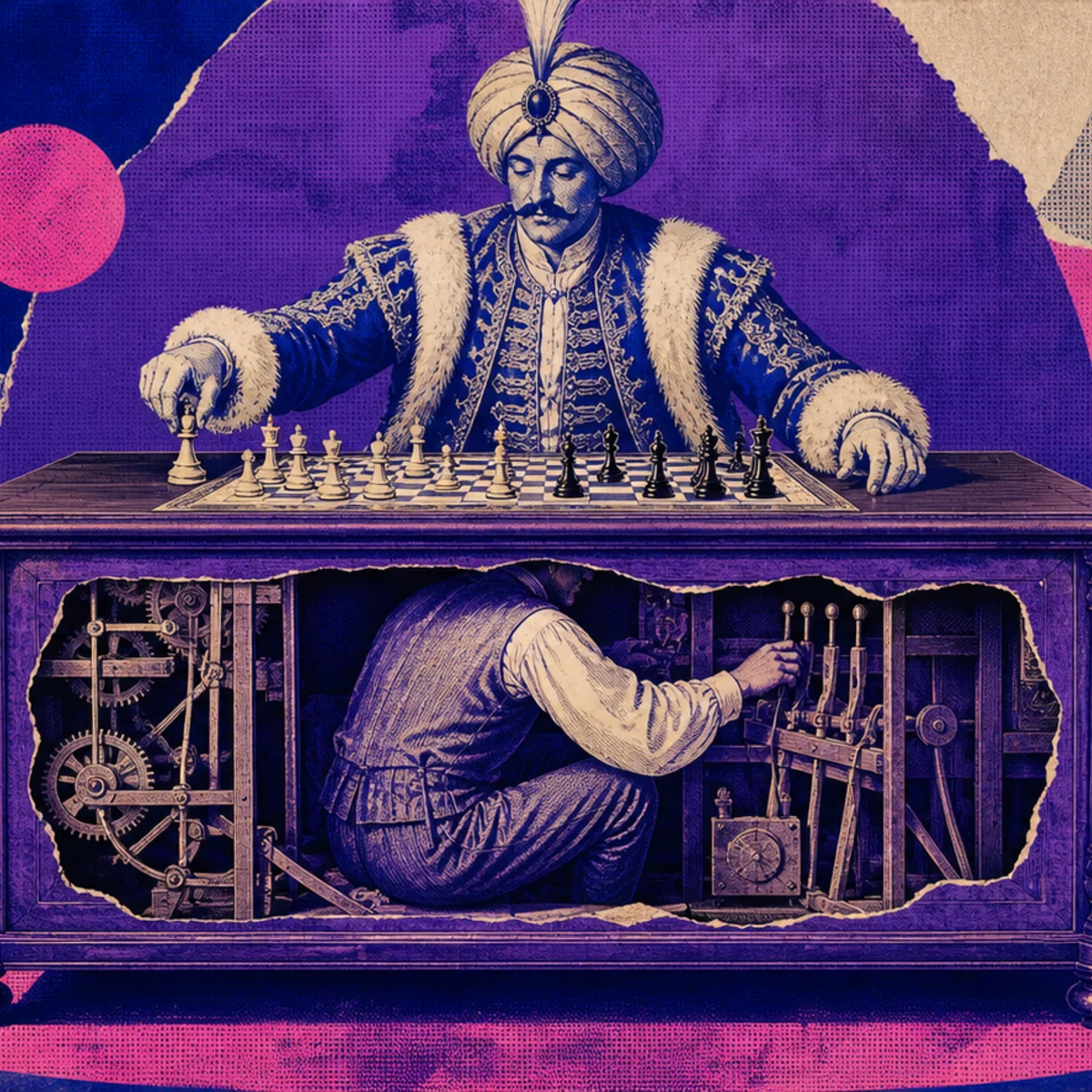
In 1770, Wolfgang von Kempelen presented the court of Empress Maria Theresa with a machine that appeared able to think. A life-sized figure in Ottoman dress sat behind a cabinet and played chess against human opponents. The figure moved pieces, signaled during the game, and behaved like a mechanical mind decades before anyone had a useful definition for such a thing. The cabinet was full of apparatus. The intelligence was full of person.
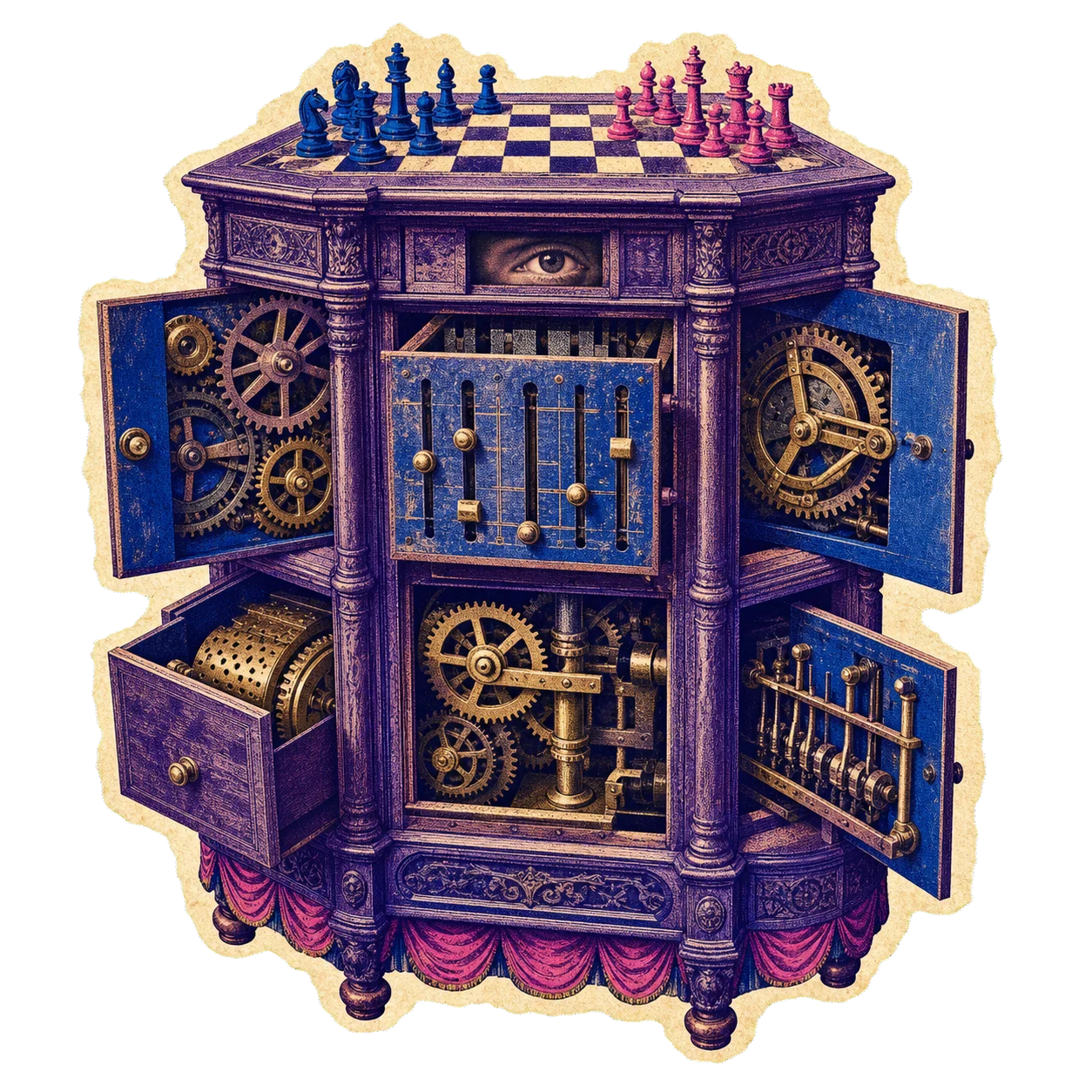
The machine became known as the Turk, or the Mechanical Turk. Its central trick was straightforward to describe and difficult to detect: a skilled chess player was concealed inside the cabinet and controlled the game. Everything the audience saw was arranged to make that explanation feel impossible. Doors could be opened. Mechanical parts could be displayed. The figure remained seated in full view. The performance turned inspection itself into scenery.
Kempelen's creation arrived at exactly the right border between engineering and theater. Eighteenth-century audiences already knew that clocks and automata could imitate movement. A machine that played chess seemed like the next impossible step. Chess was not a repeated gesture. It required responding to an opponent, recognizing a changing position, and selecting a move. If the Turk could truly do that on its own, it was not merely a clever mechanism. It was a challenge to the boundary between an object and a mind.
For roughly 84 years, different owners exhibited the Turk across Europe and the United States. Its opponents included Benjamin Franklin, Napoleon Bonaparte, and Charles Babbage. Those names became part of the machine's sales pitch long after each game ended. The Turk did not need to be unbeatable. It needed to make intelligent people sit opposite it and briefly entertain the possibility that the cabinet was thinking back.
The concealed operator made the illusion more impressive, not less. A chess player inside a cramped cabinet had to follow the position, choose moves, and translate those decisions into the visible figure's gestures while an audience watched for evidence of fraud. The operator could not simply play chess; the operator had to disappear. The machine therefore divided one performance into two roles: the false mechanical player outside and the real human intelligence hidden within.
Edgar Allan Poe encountered the version exhibited by Johann Nepomuk Mälzel and responded with an essay in 1836. In “Maelzel's Chess-Player,” Poe examined the performance as a problem in reasoning. He rejected the claim that the figure was a pure machine and looked for patterns that suggested human control. A genuine mechanism, he argued, should operate with mechanical regularity. The Turk's behavior instead contained choices, variations, and errors.

Poe also studied the ritual around the cabinet: what was shown, what remained obscured, how the exhibitor moved, and how the performance directed attention. Some of his proposed mechanical details were not correct, but his larger conclusion was. The chess player was human. His essay is fascinating because it treats stagecraft like evidence. The audience was not fooled only by hidden space; it was fooled by a carefully managed sequence of looking.
Chess made the deception especially potent because every move served as fresh evidence. A music box can repeat a tune without understanding it. The Turk had to answer a position its makers could not arrange in advance. Each response seemed to renew the claim of intelligence. What spectators were actually witnessing was a communication system: the board carried information inward, a concealed player decided, and the figure carried the decision back into view.
The trick also depended on cooperation from the spectator. To admire the Turk, an audience first accepted the frame: this was a machine, these were its workings, and the question was how far mechanism had advanced. Once that premise settled in, every good move strengthened it. The performance made doubt work on behalf of wonder.

That sequence is the Turk's real invention. It offered transparency in small, controlled portions. Open a door here. Display gears there. Invite the spectator to verify the least important part of the claim. Modern technology demonstrations still use a similar rhythm: show enough machinery to make the result feel legible, then let the audience fill the remaining gap with whatever intelligence it hopes to see.
The original Turk was destroyed by fire in Philadelphia in 1854. By then it had outlived its creator, crossed oceans, accumulated famous opponents, and spent more than eight decades converting hidden labor into apparent automation. Museum reconstructions now let visitors study the physical problem again, but the cabinet's deepest lesson requires no replica. A system can look automatic because the human work has been placed somewhere the audience does not think to look.
That is why the Mechanical Turk feels less like an antique joke and more like a durable warning. The figure did not beat people because a wooden head had learned chess. It beat them because the presentation made a person vanish—and because a thinking machine was a story the room wanted to believe.