Share
Share







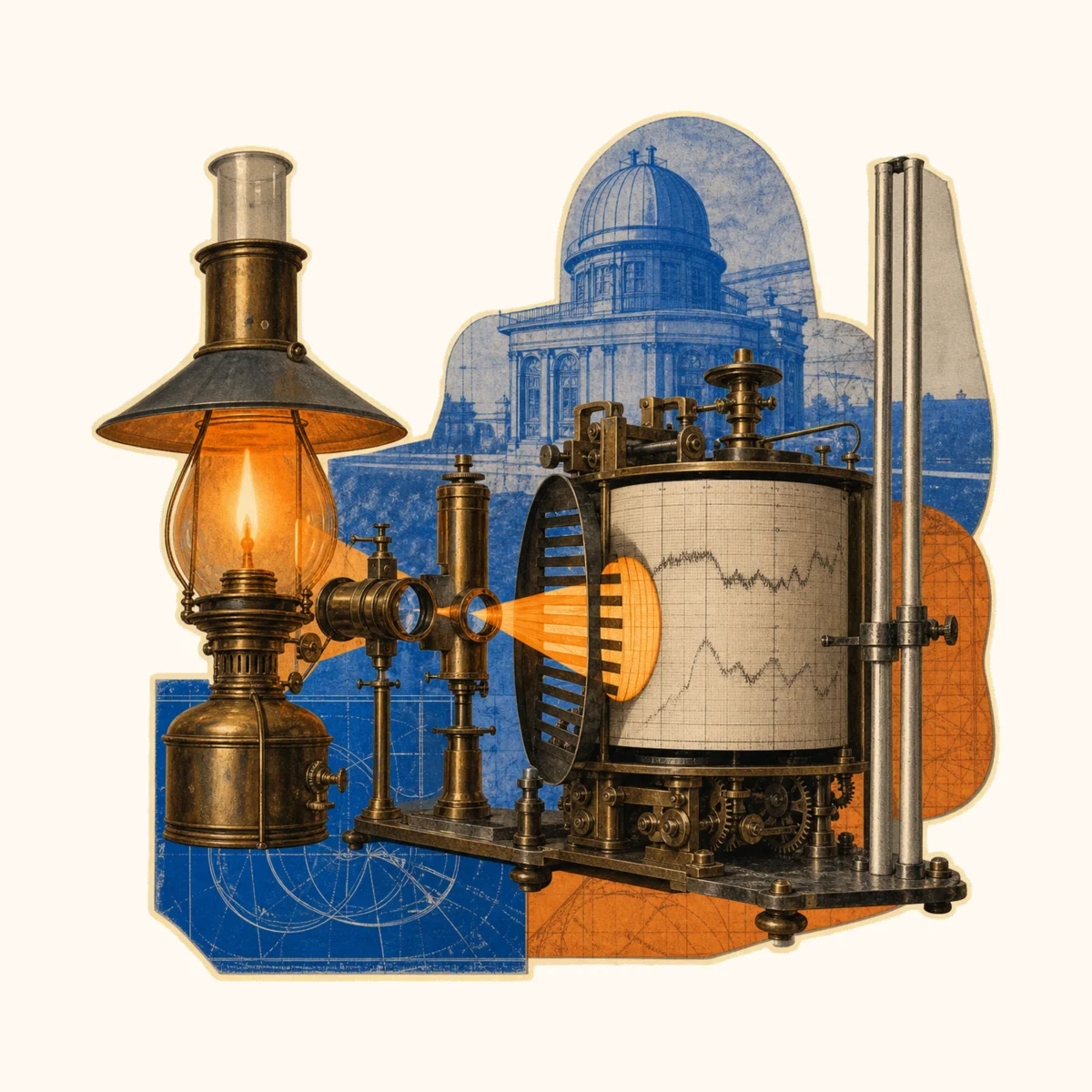
At Oxford's Radcliffe Observatory, an 1867 photobarograph asked the atmosphere to make its own continuous photograph. A gas lamp and lenses projected an image of the mercury surface in a barometer onto light-sensitive paper wrapped around a drum. As air pressure changed the mercury level, the recorded trace changed with it.
Clockwork rotated the drum once every forty-eight hours, converting time into horizontal distance across the paper. But a continuous line needed timestamps. Every two hours, an automatic vertical shutter blocked the lamp for four minutes. The resulting interruption left a time mark, allowing observers to locate pressure changes within the two-day record.
Temperature complicated the measurement because it also altered mercury height. The instrument compensated mechanically: zinc rods expanded with warmth and tilted a horizontal glass rod that adjusted the baseline traced on the photographic paper.
The device was not a camera pointed at clouds and did not forecast weather by itself. It was a room-sized negotiation among lamp light, mercury, metal expansion, chemistry, and clockwork. For forty-eight hours at a time, invisible changes in atmospheric pressure were translated into a photograph whose brief scheduled darkness supplied the clock.