Share
Share








A theremin performance begins with a musician standing perfectly still in front of a wooden box. One metal rod rises vertically. A second antenna curls into a horizontal loop. There are no keys to press, no strings to pluck and no surface that tells the hands where a note lives. The player lifts both arms into empty space, moves one hand a fraction closer to the rod, and sound appears.
The vertical antenna controls pitch. Move the right hand toward it and the note rises; move away and the note falls. The loop controls volume, usually with the left hand. Bringing that hand near the loop quiets the instrument, allowing a player to separate notes, shape a phrase or cut the sound completely. Every gesture happens without physical contact, which makes the performance look less like operating a machine than negotiating with invisible geometry.
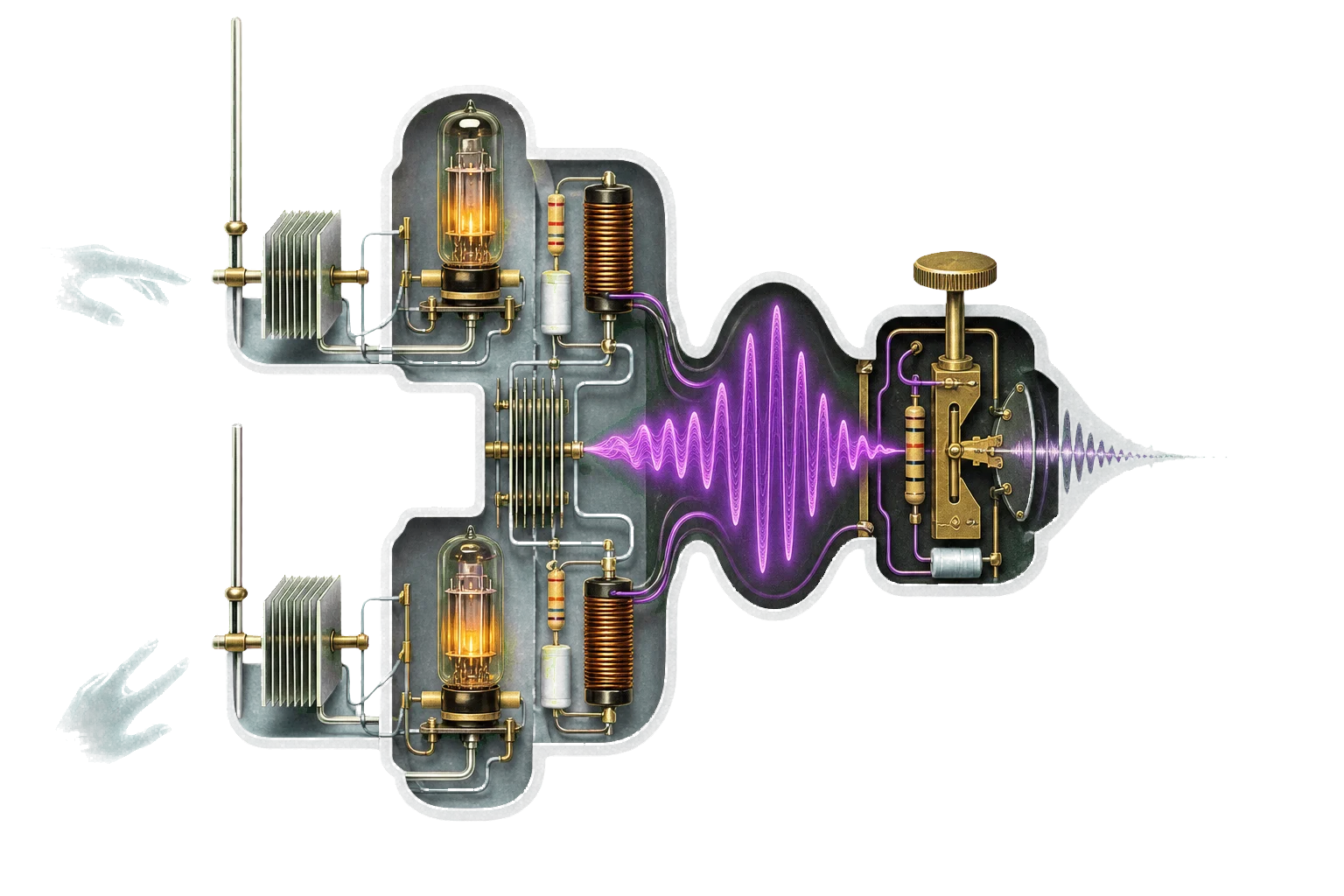
Inside the cabinet, the effect is electronic rather than supernatural. The player's hand and an antenna form part of a changing capacitive system. As the distance changes, so does the behavior of radio-frequency oscillator circuits. In the pitch section, two very high frequencies are combined. The difference between them falls into the audible range—a process called heterodyning. The volume circuit translates proximity at the loop into loudness. Human movement does not touch the circuit, but it becomes part of the circuit's electrical conditions.
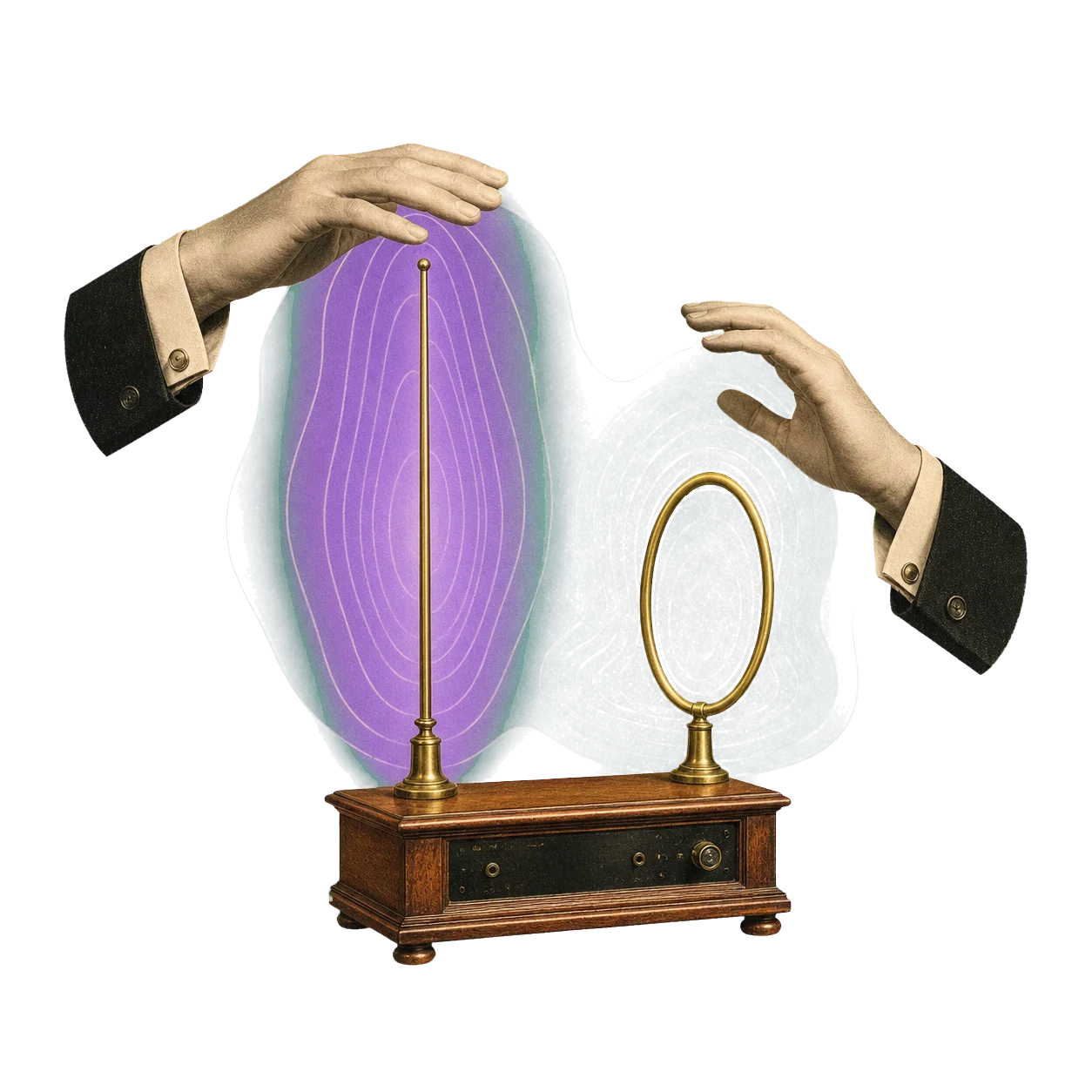
That is the theremin's great trick and its great cruelty. A piano key offers a fixed destination. A violin string supplies resistance and a fingerboard provides geography. The theremin gives the performer only air. The position of the whole body can affect the instrument, as can a nearby person or object. A player must locate pitch by ear, hold an arm steady, control volume independently and avoid sliding through every unwanted note on the way to the next one.
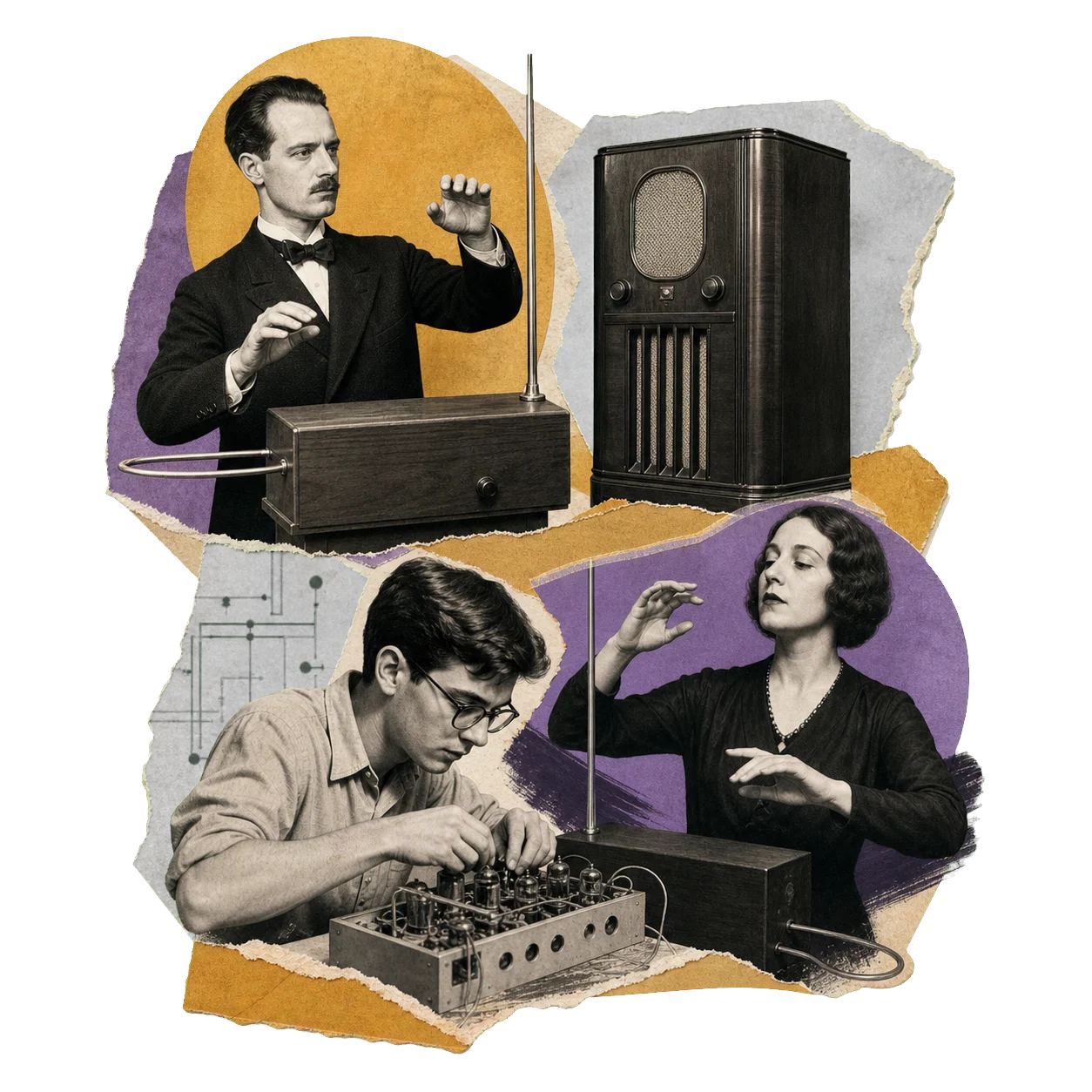
Leon Theremin, born Lev Termen, developed the instrument in Russia around 1920 while working with radio technology. According to histories preserved by Moog, Cornell and musical-instrument museums, he noticed that his movement altered the tone of electronic equipment. He refined that interference into a playable instrument and demonstrated it internationally. In the United States, RCA licensed a commercial version and manufactured roughly five hundred units in 1929. The timing was terrible: an expensive electronic instrument reached homes just as the stock market collapsed.
The instrument still found the person who could prove it was more than a laboratory effect. Clara Rockmore had trained as a violinist before physical problems forced her away from the instrument. The theremin required no pressure from fingers on strings, and she developed a precise technique for it. Her performances gave the floating tone articulation, vibrato and phrasing that could carry classical melodies instead of merely producing an eerie glissando.
Rockmore's control also reveals why the theremin's theatrical simplicity is deceptive. Her pitch hand used small, repeatable finger positions rather than broad movie-monster waves. Her volume hand shaped the beginning and end of each note. The body remained disciplined because even an unintended lean could change the sound. An audience sees hands moving freely; the performer feels an invisible instrument whose landmarks must be rebuilt continuously through muscle memory and listening.
Cinema embraced the theremin's unstable voice. Its sliding tone could suggest anxiety, hypnosis, machinery or something arriving from another world. It became closely associated with mid-century film scores, even though later pop-culture references sometimes credited a theremin where a different electronic instrument had been used. That confusion only strengthened its reputation: any wavering electronic voice could be assigned to the box nobody touched.
The instrument also changed the life of Robert Moog. He built theremins as a teenager, later sold kits and models, and carried lessons from those circuits into his work on electronic musical instruments. Moog's company continued producing modern theremins and manuals that make the invisible controls explicit: right hand for pitch, left for volume, careful tuning before playing, and constant reliance on the ear. The theremin was not merely a strange branch of electronic music. It helped train one of the field's most influential designers.
Museums preserve early instruments as unusually legible pieces of technological history. A 1929 RCA theremin at the Metropolitan Museum of Art still presents the essential arrangement. The Smithsonian holds a theremin built by Leon Theremin for Juliet Shaw, its straight pitch antenna and volume loop making the interface recognizable a century later. The cabinet styles changed; the central proposition did not.
That proposition is radical because most interfaces try to reduce ambiguity. Buttons click, sliders stop and screens confirm. The theremin removes the surface and asks the performer to make accuracy out of distance. It turns proximity into pitch, absence into touch and stillness into technique.
When a skilled player finishes a phrase, the left hand moves toward the loop and the tone collapses into silence. Nothing visible has been struck or muted. The hands simply leave the correct volumes of air. For a moment, the instrument's entire keyboard existed between a body and two antennas—and then it disappeared.