Share
Share







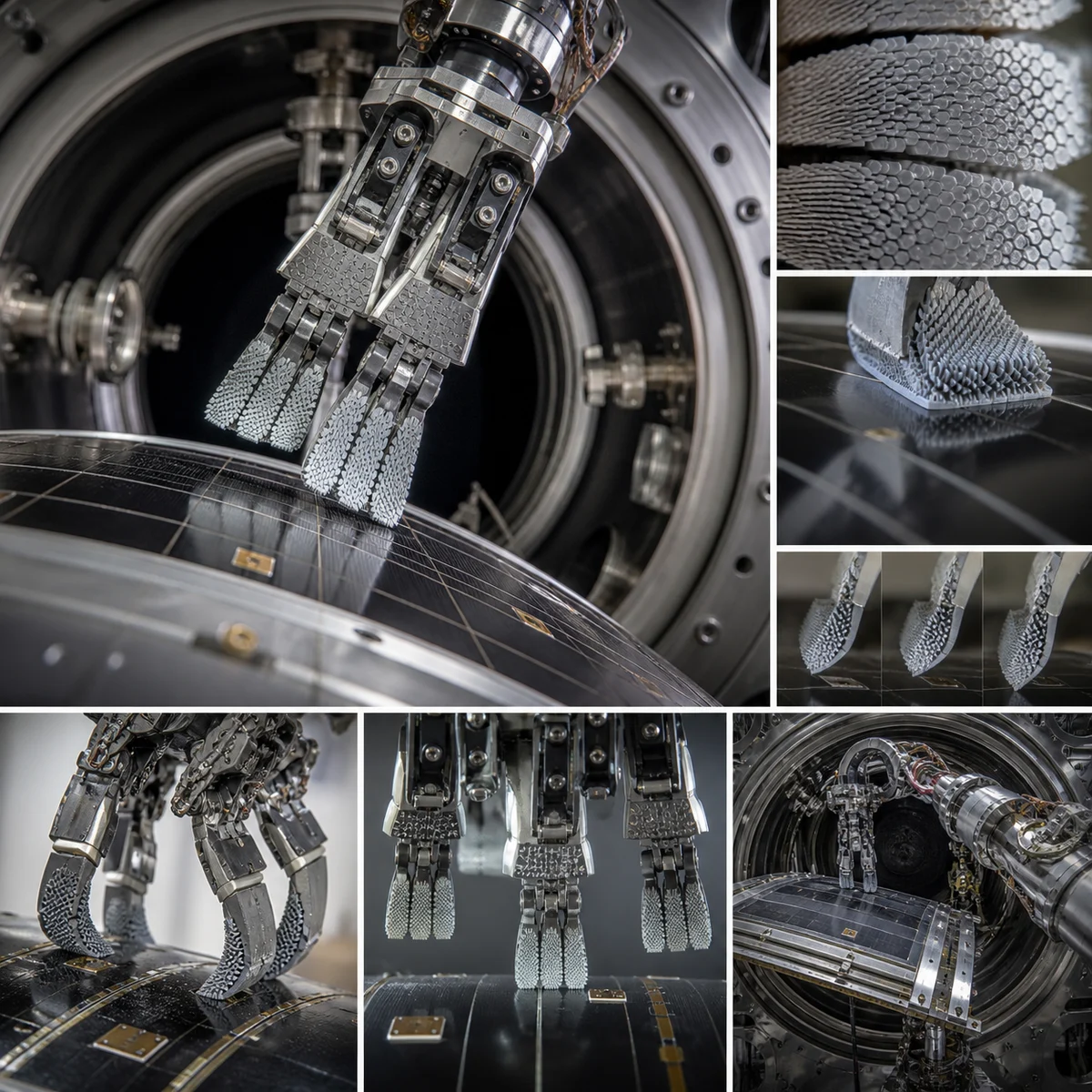
Orbital debris is difficult to grab because a target may be smooth, curved, tumbling, and impossible to pin against a table. Stanford engineers built a robotic gripper inspired by gecko feet, whose microscopic structures create dry adhesion through intimate surface contact. The device can engage without liquid glue, then release when the load is redistributed.
The prototype was tested on flat and curved objects and in vacuum-related conditions relevant to space. Its adhesive elements are arranged so a light initial touch can be transformed into a stronger hold across the contact surface. Because adhesion is directional and controllable, the gripper does not need to remain permanently sticky like tape. That makes it appealing for handling objects that should be captured and then moved.
The work suggests a candidate tool, not an operating cleanup fleet. No service is currently roaming orbit with these grippers collecting discarded satellites. Spaceflight adds navigation, tumbling targets, contamination, extreme temperature, and system-level reliability beyond an adhesive test. The demonstrated mechanism is nevertheless useful: a robot can borrow the contact physics of a gecko foot to hold a hard object where suction cups have no air and wet glue would create new problems.
Sources