




 Share








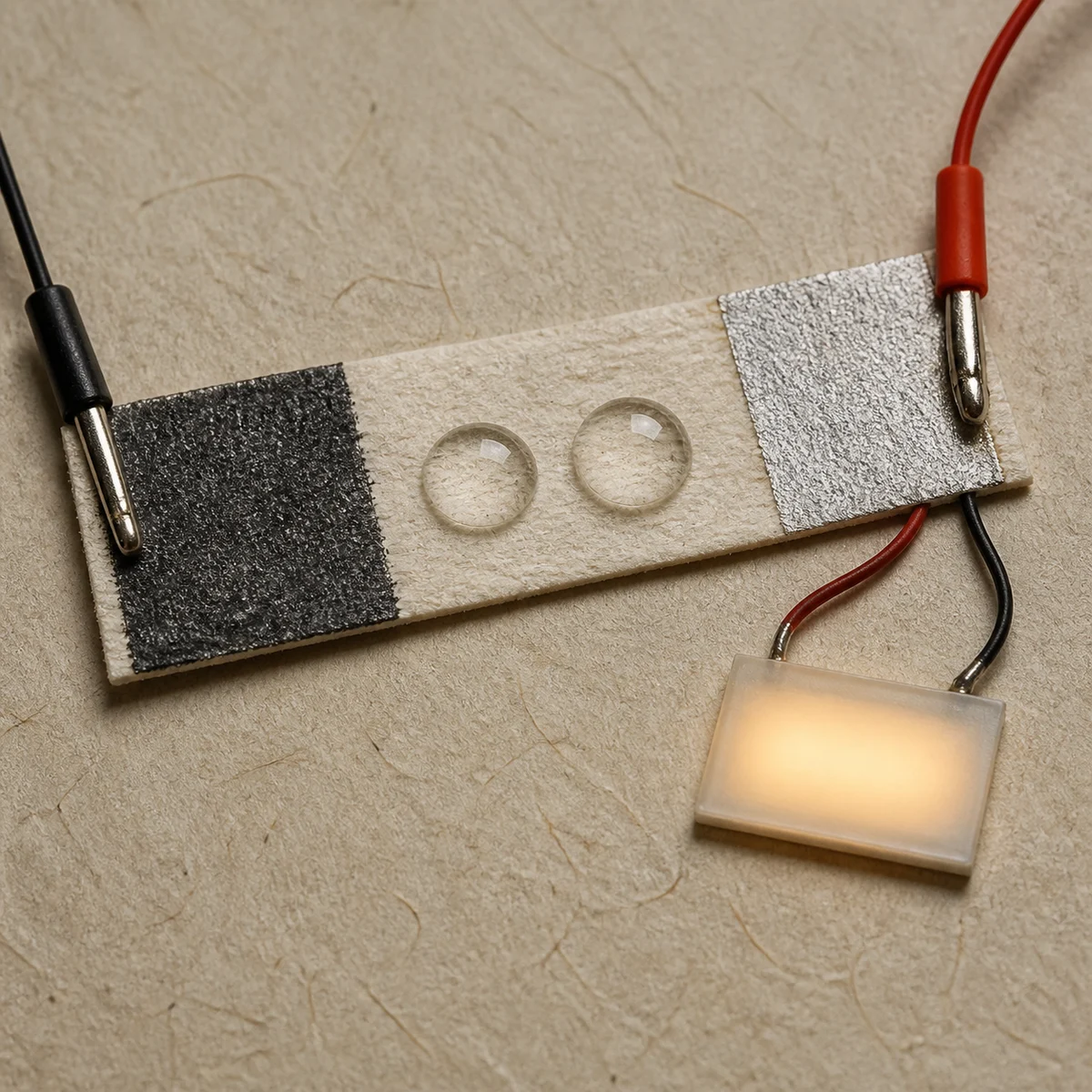
A dry paper battery can store its readiness without producing useful current. Empa researchers printed zinc on one region of paper and graphite and carbon materials on another, then distributed salt through the sheet as an electrolyte. In the dry state, the charged particles needed for the electrochemical process cannot move freely.
Two drops of water change that. The liquid dissolves the salt and opens ionic transport through the paper. Zinc begins its electrode reaction, electrons move through the external circuit, and the small cell supplies power. The activation step can be tied directly to contact with water rather than a separate switch.
Evaporation also limits the operating window. As the paper dries, ion movement slows and voltage falls. Adding water can revive the chemistry temporarily, but the device is not a substitute for a sealed, long-life consumer battery. Its behavior fits short-lived electronics that need modest power only after a test sample, environmental event, or deliberate activation.
The proof of concept points toward lower-impact disposable systems, using paper and relatively accessible electrode materials. Full sustainability still depends on every component and production step. What the experiment establishes is a useful architecture: print a dormant electrochemical cell into a thin sheet, keep its electrolyte immobile while dry, and let a tiny amount of water turn the paper into a circuit.
Sources