Share
Share







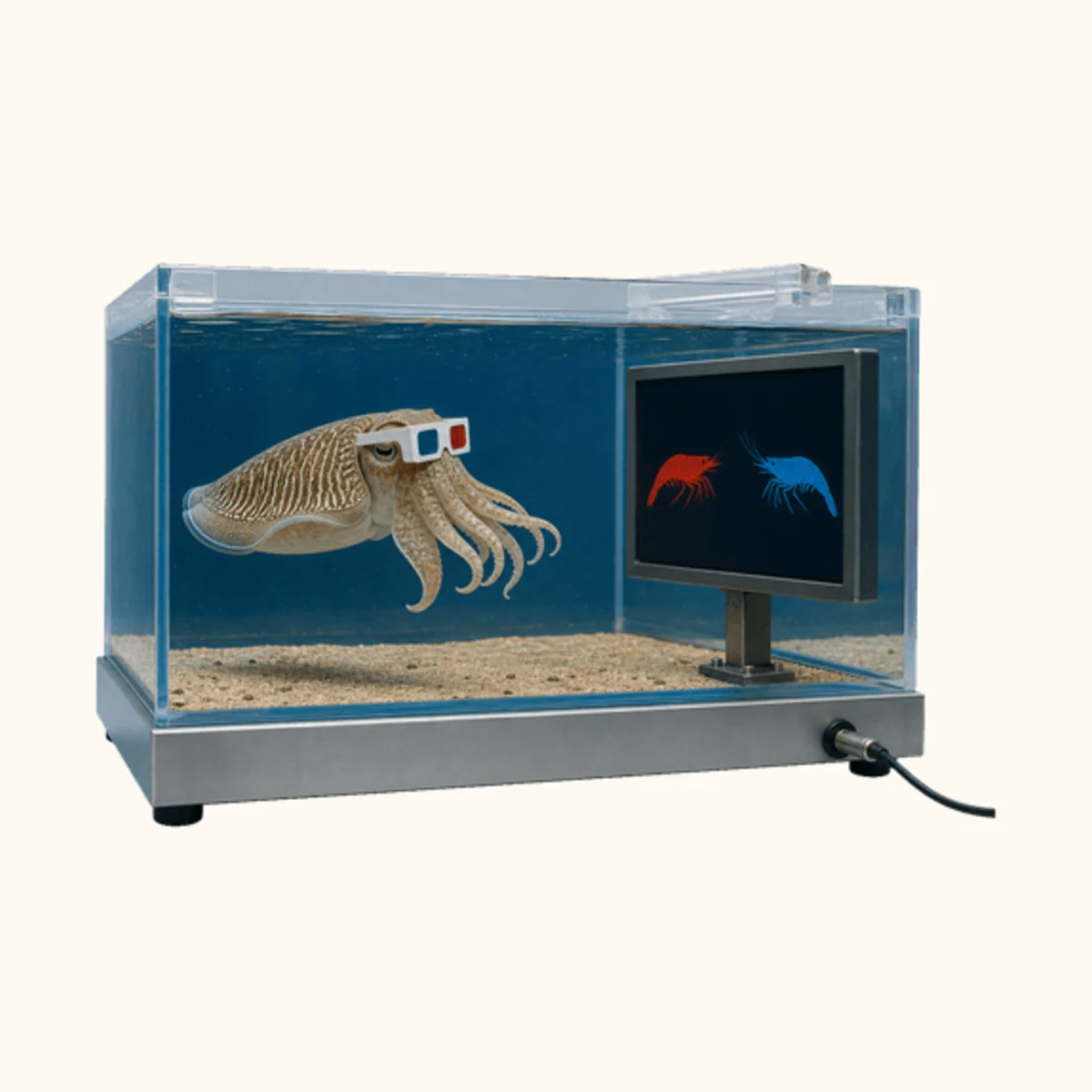
To a cuttlefish, lunch is a geometry problem. Its feeding tentacles need to begin at the right distance: too close and the prey may bolt; too far and the strike cannot reach. A University of Minnesota-led team asked how the animal measures that gap, then chose an experiment with the energy of an underwater matinee.
At the Marine Biological Laboratory in Woods Hole, the team trained cuttlefish to wear specialized red-and-blue 3-D glasses. In front of them, a computer screen played images of walking shrimp, with a different color delivered to each eye. By offsetting the left-eye and right-eye pictures, the researchers could make the virtual prey appear to sit in front of the screen or behind it.
The cuttlefish did not merely tolerate the wardrobe. They changed where they positioned themselves and launched their tentacles. When the image disparity made the shrimp appear closer, their strikes landed correspondingly close to the screen; when it made the shrimp appear farther away, they struck farther out. The false depth produced a predictable physical answer.
That response demonstrates stereopsis: comparing the slightly different views from two eyes to estimate depth. Humans use the same broad trick, but the experiment suggests that the cuttlefish brain computes it differently. The animals could still judge distance from anti-correlated images, in which the pattern shown to one eye was reversed in brightness for the other. Humans cannot do that reliably.
Using both eyes also made the attack more efficient. When only one eye could see the shrimp, the cuttlefish took longer to position themselves correctly. With binocular information available, they made faster decisions and traveled less before striking. For a predator trying to surprise something mobile, that saved motion matters.
Cuttlefish eyes can rotate into a forward-facing position, bringing the two views into an arrangement useful for this comparison. Yet their brains are not organized like ours and do not appear to reserve one human-style visual-processing region for the task. Somewhere in that very different nervous system, the images are still compared and the distance is still solved.
The glasses make the study unforgettable, but they are not the finding. The finding is convergence: two radically different brains faced the same problem and arrived at binocular depth perception. One does it while wearing temporary cinema glasses and aiming spring-loaded tentacles at a digital shrimp. Science occasionally dresses exactly as strange as it is.
Sources