




 Share








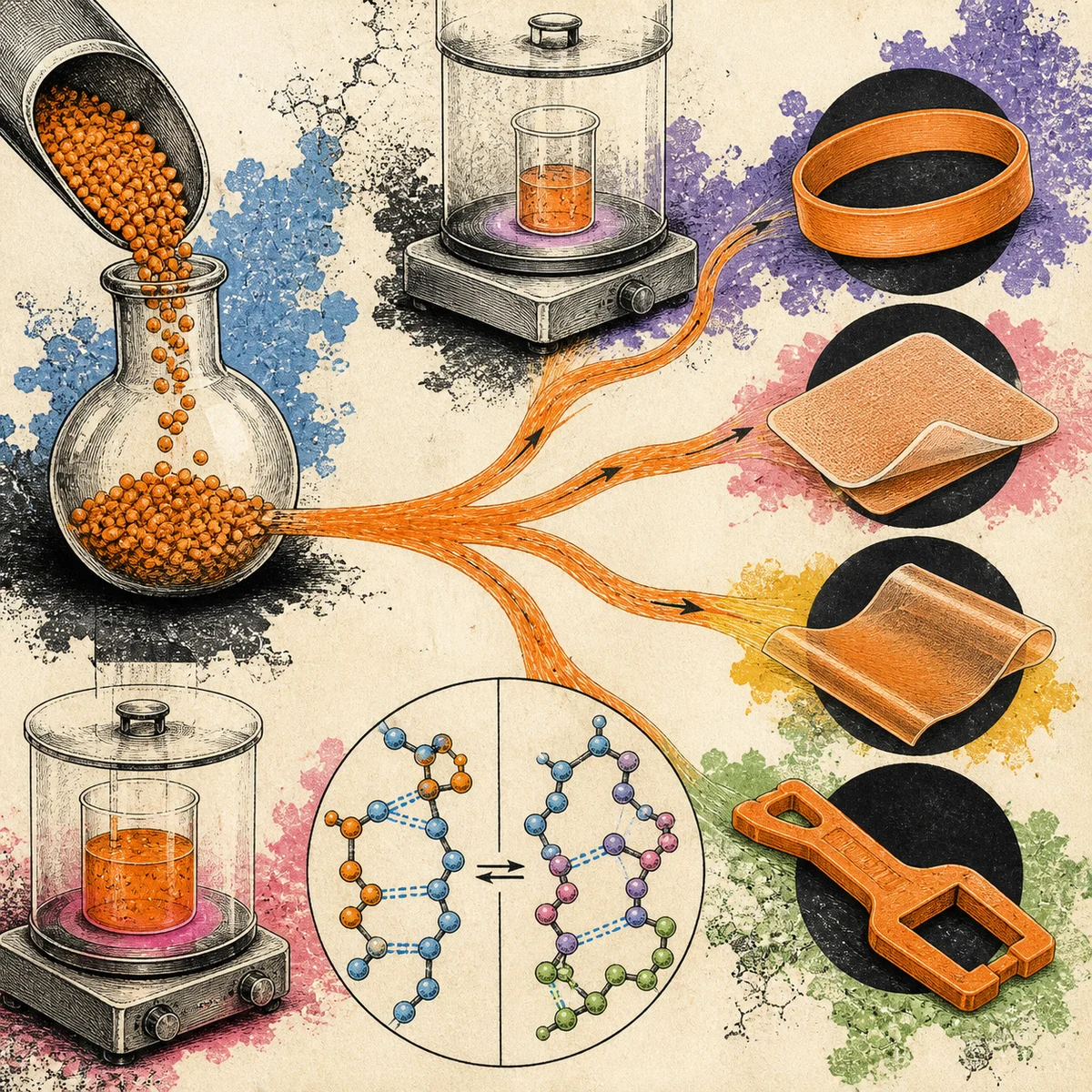
Most plastics are formulated toward one mechanical job. University of Chicago researchers instead built a polymer network from dynamic covalent bonds that can break and re-form. By tempering the same feedstock at different temperatures, they changed how densely those bonds reconnected and therefore what the cooled material felt like.
Heating to about 60 degrees Celsius encouraged more bonds to form, producing a stiff, high-strength solid at room temperature. Processing near 110 degrees left fewer bonds and yielded a softer, highly extensible material suitable for pressure-sensitive adhesion. Intermediate temperatures produced intermediate behavior, spanning rubber-band-like elasticity, putty-like deformation, flexible sheets, and rigid molded objects. A finished piece remained stable at room temperature yet could be heated again and retuned into another state.
The researchers call the system “pluripotent” by analogy with stem cells that can differentiate into different forms. The polymer is not alive, and the term does not mean it can become every possible plastic. It remains a laboratory materials platform whose property range, durability, manufacturing, and reuse still need development. Its design challenge is compelling: instead of carrying several incompatible materials for repair, could one reversible network be processed into whichever mechanical role is needed next?
Sources