





 Share








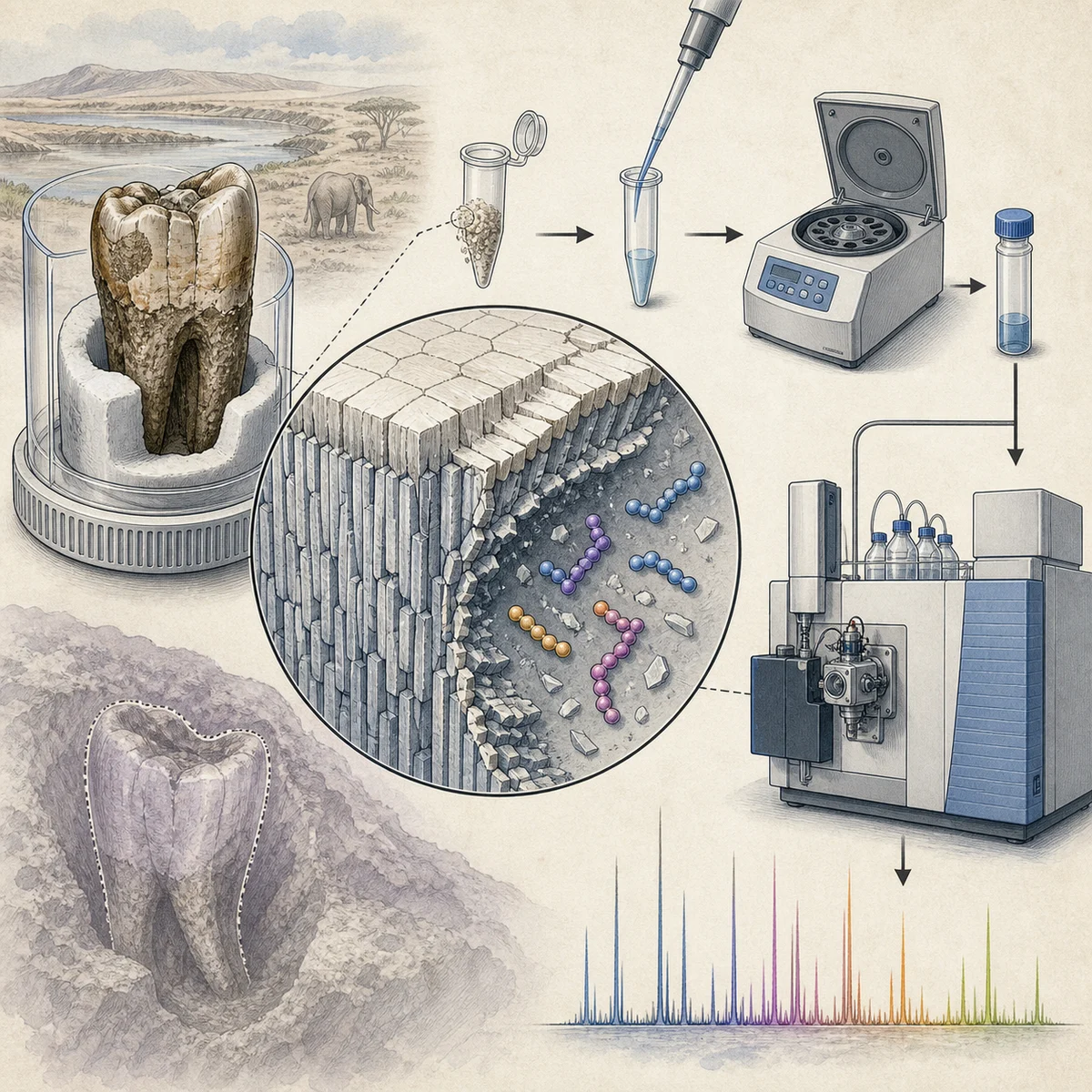
DNA decays too quickly to reach most deep chapters of mammal evolution, and ordinary proteins rarely survive tropical heat for millions of years. Tooth enamel offers a tougher archive. Its dense mineral crystals can trap protein fragments used while the tissue was forming, protecting molecular evidence long after bone and dentin have lost theirs.
Researchers sampled fossil teeth from Kenya’s Turkana Basin, a famously hot and arid setting. Mass spectrometry recovered high-confidence sequences from enamel as old as eighteen million years, including fragments of enamelin, ameloblastin, and dentin matrix protein 1. The younger samples retained the most complete fragments, but even the oldest secure sequences pushed reliable protein recovery far deeper into warm-climate prehistory.
More tentative signals from an arsinoithere tooth may extend the record to twenty-nine million years. That result needs to stay separate from the firmly supported eighteen-million-year finding. Ancient proteins do not identify every feature of an extinct animal, but their amino-acid sequences can help compare evolutionary relationships where recognizable bones are incomplete and DNA is gone. A tooth can lose its owner, its color, and nearly all its original chemistry while keeping a few family clues locked in enamel.
Sources