Share
Share








On 18 June 1980, two thirteen-digit numbers were chosen at random at Imperial College London. They were 7,686,369,774,870 and 2,465,099,745,779. The task given to Shakuntala Devi was multiplication. The answer would contain twenty-six digits, too many to hold comfortably in a glance and far too many for most people to manipulate without paper. Twenty-eight seconds later, Devi gave the correct result: 18,947,668,177,995,426,462,773,730. Guinness World Records recognizes the performance as the fastest human computation.
The raw numbers make the event feel almost alien, but the setting matters. This was not a familiar multiplication table recalled on cue. Guinness describes the factors as randomly selected, and the demonstration took place before witnesses at a university. The feat joined two different kinds of difficulty: producing a correct answer at enormous scale and doing it while a clock converted every pause into part of the record.
A number that long resists ordinary intuition. People can readily picture three objects, perhaps estimate thirty, and understand that three thousand is much larger. A thirteen-digit integer is different. Its size is expressed mainly through notation and place value. Multiplying two of them requires preserving relationships among digits while partial results accumulate. The final answer must not merely sound plausible. Every position has to be right.
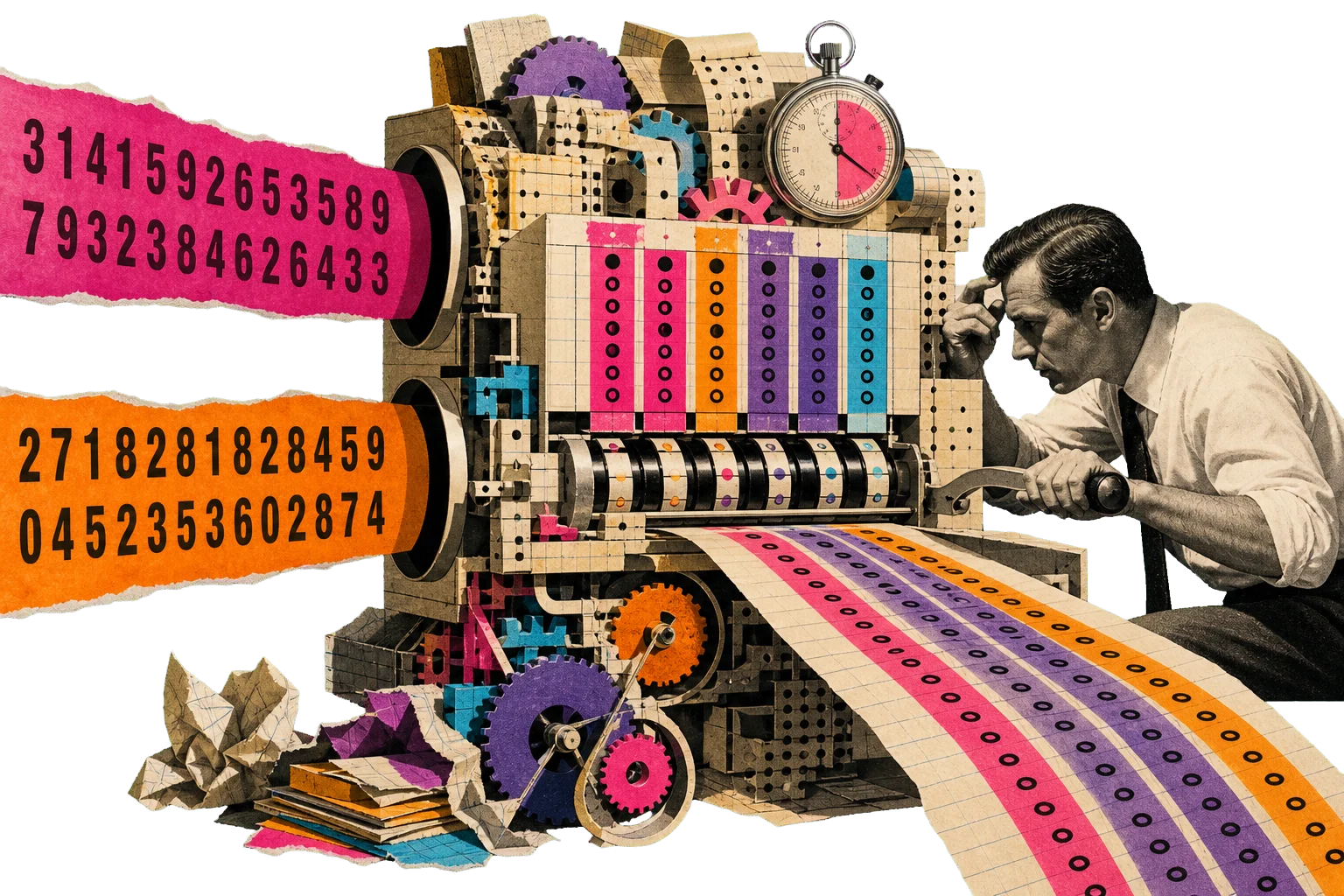
That precision is what separates the event from a guessing game. If one digit in 18,947,668,177,995,426,462,773,730 had slipped, the response would have been wrong. Speed did not replace accuracy; the record demanded both. Yet the spectacular answer created another, more interesting question. Was Devi's entire nervous system unusually fast, or had long practice made a particular family of mental operations exceptionally efficient?
Psychologist Arthur Jensen later examined that question in a study published in the journal Intelligence in 1990. The paper did not uncover a secret shortcut that readers could copy. Instead, Jensen compared Devi's extraordinary calculation with more elementary measures of information processing. His central finding was a productive contradiction: her reaction times on simple tasks were ordinary, even while her performance with very large numbers was extraordinary.
That contrast narrows what the demonstration can mean. It does not support the idea of a brain that simply runs every process at a universally higher clock speed. If general reaction speed alone explained the feat, unusual performance should have appeared across the simpler tests as well. It did not. The exceptional ability was concentrated in the practiced activity rather than spread evenly over every response.

Jensen interpreted Devi's calculation in terms of automatic encoding and retrieval of declarative and procedural information stored in long-term memory. Declarative knowledge includes information a person can know and retrieve; procedural knowledge concerns how an operation is carried out. With extensive practice, steps that would occupy a novice's attention can become organized, rapidly accessible routines. The paper also emphasized sustained practice and motivation, not a magic formula hidden inside the digits.
That account makes the feat no less remarkable. In some ways, it makes it stranger. The twenty-six-digit result did not require every human mental process to become superhuman. It required a highly developed system for recognizing, retaining, transforming, and retrieving numerical information at a scale most people never train for. An ordinary-looking response system coexisted with an extremely specialized performance.
Expertise often has this lopsided shape. A skilled musician does not necessarily hear every everyday sound sooner than everyone else, but can detect relationships inside music that a beginner misses. A practiced reader does not consciously decode each letter. Familiar units are grouped and retrieved as larger patterns. Jensen's study places Devi's calculation within that broad idea of specialized automaticity, while the size and speed of her result remain exceptional.

It is tempting to narrate a human calculator as a contest between a person and a machine. That framing offers a clean headline but blurs the better mystery. Computers and people do not arrive at multiplication through the same architecture, and the verified record does not need a universal claim that Devi defeated every machine of an era. The wonder is specifically human: practice and memory were organized well enough for a person to return an exact twenty-six-digit product in less than half a minute.
The public demonstration and the later laboratory study therefore reveal different halves of the same story. Imperial College supplied the astonishing output: two enormous inputs, one exact answer, twenty-eight seconds. Jensen investigated the machinery that might make such output possible and found no blanket acceleration of the mind. The ability was narrow, constructed, and deeply developed.
There is also something satisfying about how little the final answer explains. We can print the multiplication, verify the product, name the elapsed time, and describe the cognitive interpretation. None of that recreates the experience of holding the problem mentally while the seconds pass. The written result is stable; the act that produced it was fleeting.
Devi's record survives because both parts can be checked. The numbers remain available for anyone to multiply again, and the twenty-eight-second performance is documented by Guinness. Jensen's paper provides a separate, peer-reviewed effort to understand the prodigy without turning her into a myth. Together they replace the vague label “human computer” with a more precise marvel: an ordinary human response system containing a numerical practice so refined that, for one enormous calculation, twenty-eight seconds were enough.