





 Share








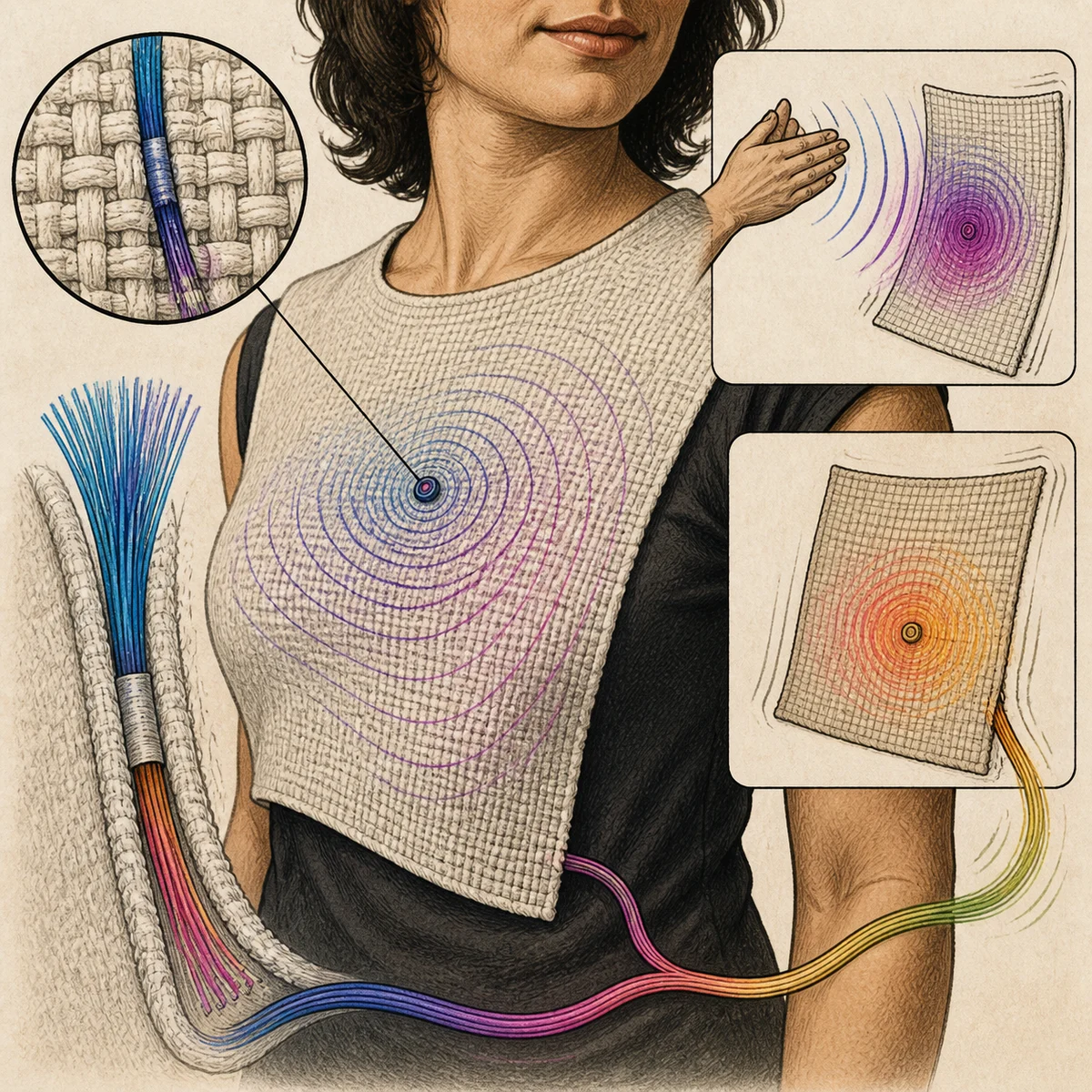
Every cloth panel vibrates when pressure waves pass through the air, but the displacement is usually far too small to measure. MIT and Rhode Island School of Design researchers wove a specially layered fiber into ordinary yarn so the fabric moved as one broad acoustic membrane. The fiber’s piezoelectric material generated an electrical signal whenever those nanometer-scale bends reached it.
The resulting cloth responded to sounds spanning a quiet library and heavy road traffic. Two fabric panels could locate the direction of a handclap to within one degree from three meters away. A single fiber sewn into a shirt lining over the chest detected a healthy volunteer’s heartbeat, including differences between the first and second “lub-dub” sounds. Reversing the signal path let an applied voltage make the fiber vibrate and play recorded speech for another fabric to detect.
The woven panels were lightweight, drapable, and machine-washable, but these demonstrations were a materials prototype. A shirt reading one volunteer’s heart is not a cleared diagnostic instrument, and proposed uses in health monitoring, hearing support, buildings, or spacecraft require separate validation. The established capability is sensory conversion: air moves cloth, cloth bends fiber, and a garment produces an electrical record of sound that would otherwise pass through unnoticed.
Sources