Share
Share







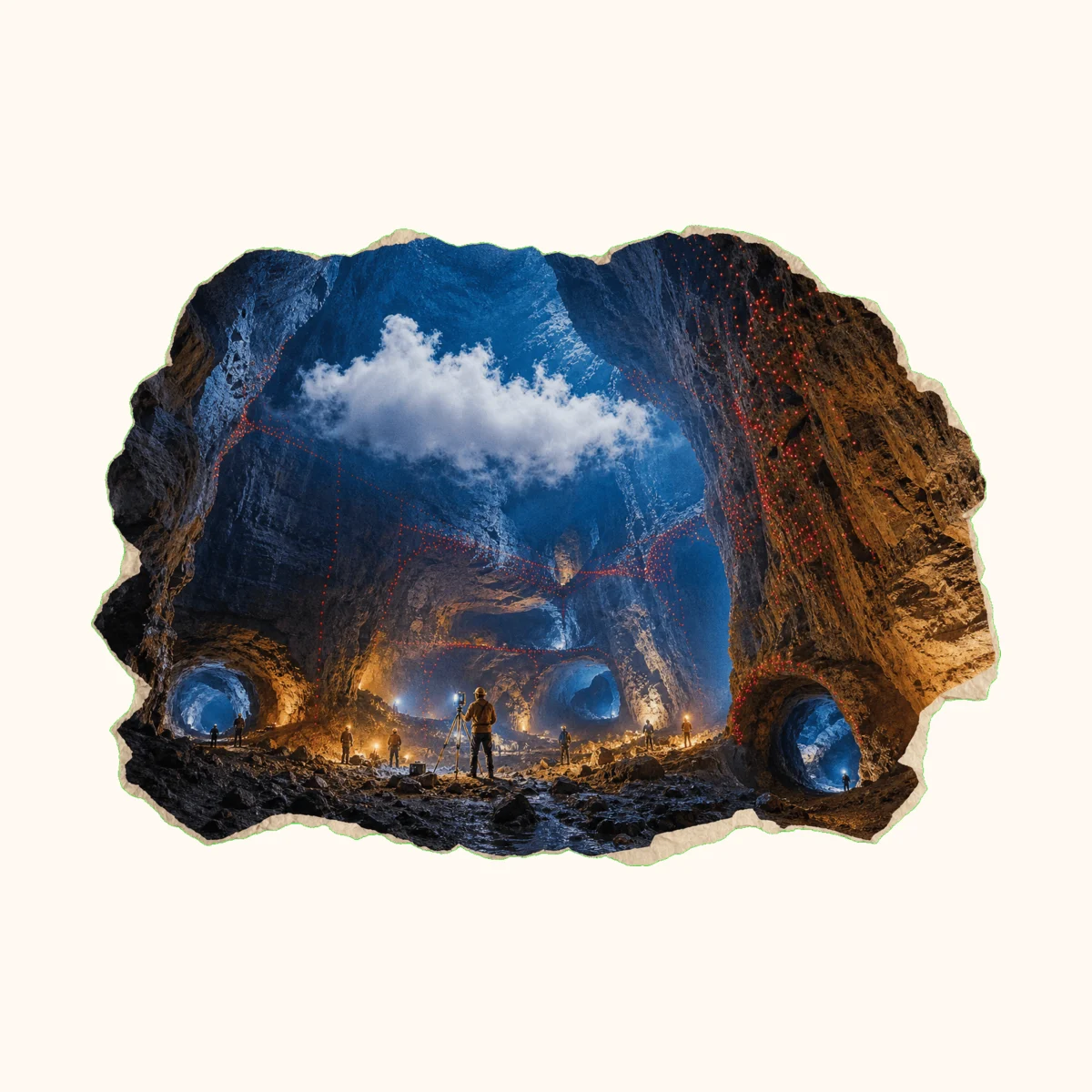
Cloud Ladder Hall is not the Miao Room, though accounts of China’s giant caves often blur their records. It belongs to the Quankou Dong cave system near Tongzi in Chongqing. Expedition mapper Roo Walters’s lidar model describes a chamber more than 360 metres high and greater than six million cubic metres in volume—enough vertical darkness for the ceiling to disappear behind suspended cloud.
The chamber was captured with a Riegl VZ-400 laser scanner. That instrument replaced the explorer’s impression of immensity with a three-dimensional surface assembled from measured points. The resulting model fixes the shape of walls, floor, roof, and connecting passages that cannot be taken in from any single position underground.
For the science documentary Giant Caves: China, an expedition mapped the system’s entrances and exits to trace how air moves through the chamber. The documented conclusion was architectural: Cloud Ladder Hall’s unusual size and shape allow cloud to form inside it. The sources used here do not establish every thermodynamic step or promise that a cloud is always present, so the wonder is narrower and stronger than the slogan. This is a mapped cavity whose geometry can organize air and moisture into visible weather below the ground—not a separate climate, but a room large enough for the atmosphere inside it to become a landscape of its own.
Sources