




 Share








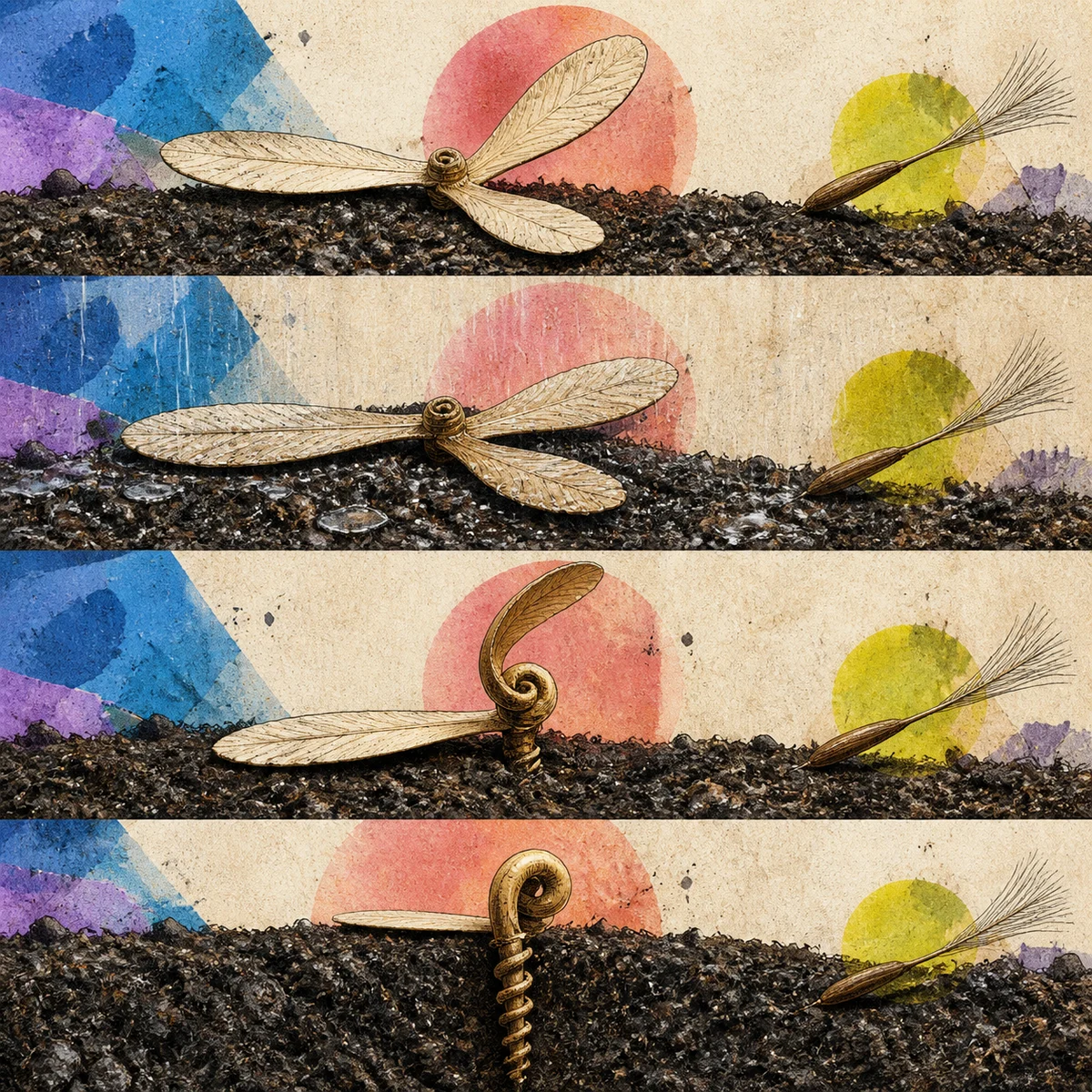
Erodium plants package seeds inside a wound stalk that responds to moisture. Rain or high humidity makes the corkscrew-like awn unwind; its curved tail catches the ground, lifts the seed upright, and converts further motion into torque that works the seed downward. Carnegie Mellon researchers translated that sequence into a biodegradable carrier called E-seed.
Their engineered version starts as white-oak veneer shaped and treated through a five-step process of chemical washing and mechanical molding. A natural Erodium carrier has one long tail and works best when it can catch a crack. The team gave the wooden version three tails. That geometry improves the odds that one will brace against a broader range of surfaces and push the seed-bearing coil upright as humidity changes.
The group built and field-tested carriers for seeds and demonstrated versions holding fertilizer, beneficial fungi, and nematodes used for pest control. Those experiments make E-seed a platform, not an autonomous forest machine. Fabrication was still laboratory-based, industrial scaling remained prospective, and successful planting still depends on rain, soil, seed choice, placement, and survival after burial. The clever part is already physical: a flat piece of responsive wood can land, absorb moisture, stand itself up, and screw its cargo into earth without a motor.
Sources