




 Share







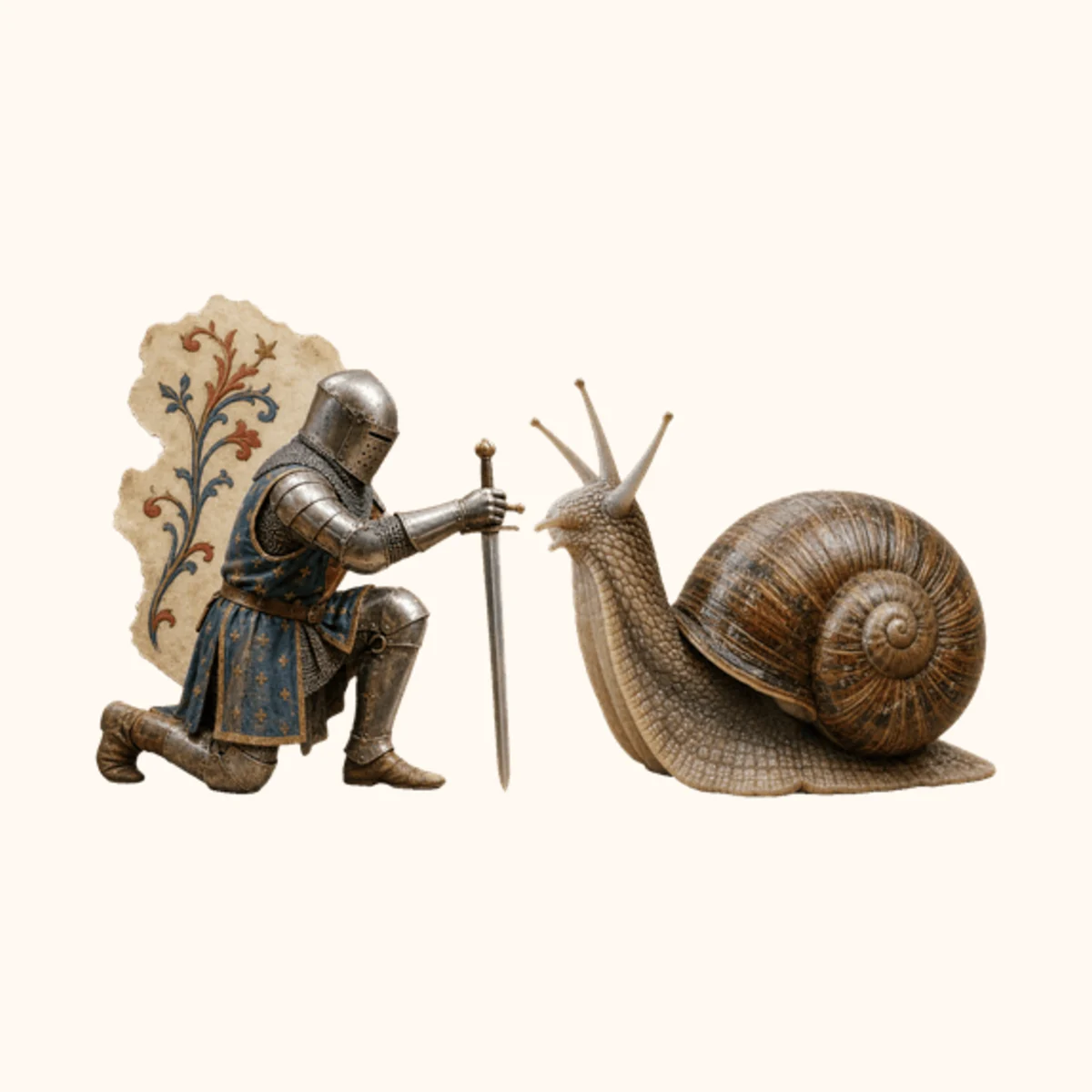
A knight in full armor lowers his lance. Across the manuscript margin, his opponent raises no weapon and makes no obvious effort to hurry. It is a snail. In decorated European books from the 13th and 14th centuries, this mismatch appears again and again: mounted knights charge snails, armed men kneel before them, and defeated warriors drop swords or surrender to gastropods.
The scenes live mostly in marginalia, the lively images painted around the formal text of Psalters, Books of Hours, genealogical rolls, and other manuscripts. The British Library holds examples from England and France. One late-13th-century genealogical roll shows direct combat. The Gorleston Psalter offers a kneeling knight facing a snail. A fragmentary Book of Hours goes further and leaves its knight comprehensively disarmed.
Frequency has not produced certainty. Scholars have proposed that the snail represented the Lombards, who were stereotyped in medieval writing as treacherous, usurious, or insufficiently chivalrous. That could explain an armored opponent, but it does not explain why the knight so often loses or why the motif wanders through books with no obvious Lombard subject.
Other readings turn the snail into a garden pest, a social climber carrying its house and status on its back, the weak triumphing over an oppressive aristocracy, a symbol with sexual meaning, or a general joke about reversal. A slow, soft creature humiliating an elite warrior certainly works as visual comedy without a footnote. It may also have changed meaning between workshops, readers, regions, and decades.
That instability is probably the safest conclusion. Medieval marginal imagery did not operate like a modern logo with one approved definition. The same motif could be copied, altered, enjoyed, and redeployed after its original context had faded. The artists left detailed evidence that the joke mattered, but no universal caption telling us why.
So the knight keeps losing. Not because medieval people believed snails were dangerous cavalry opponents, but because generations of image-makers found the contest worth repeating. The margin preserves the setup perfectly and withholds the punchline.
Sources