Share
Share







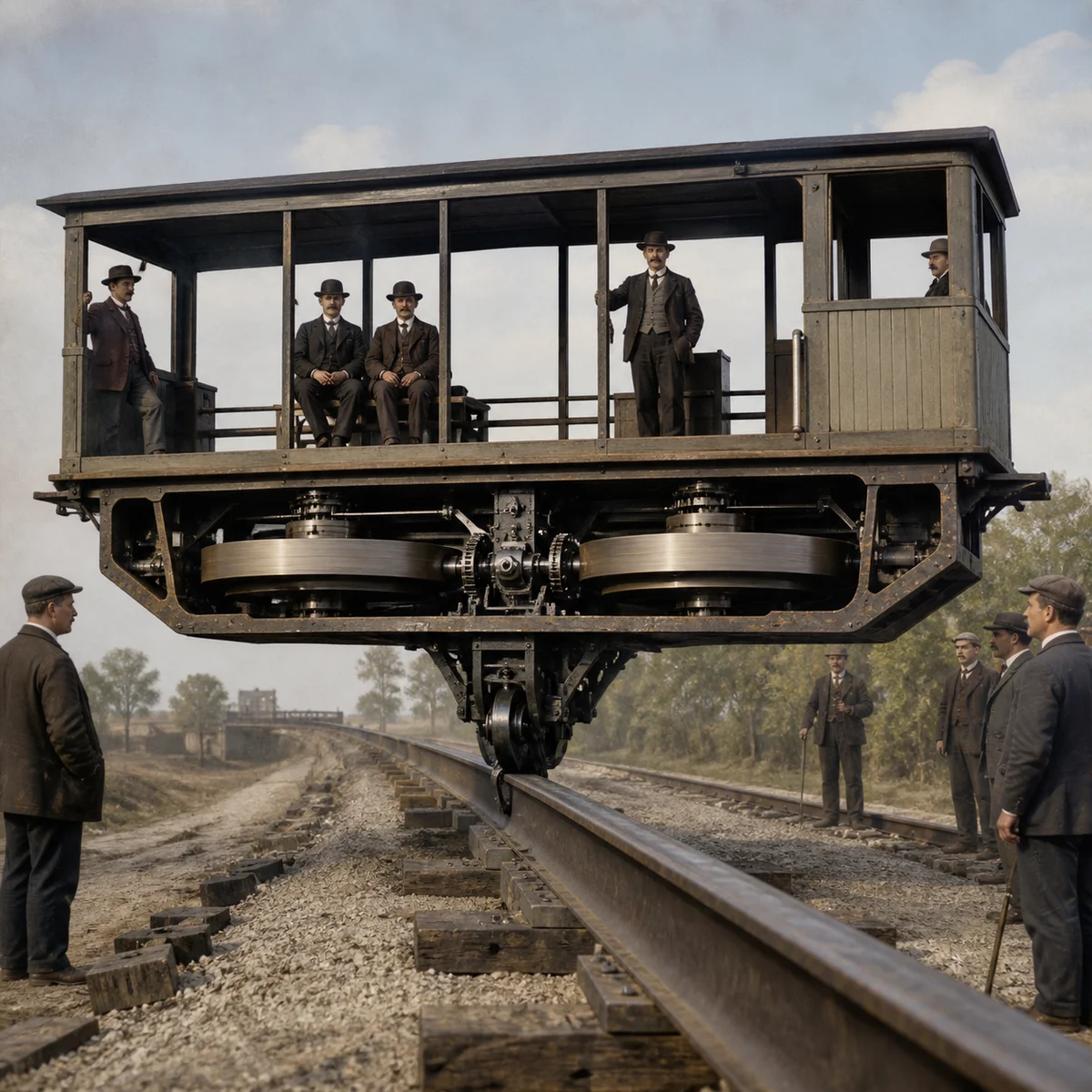
A conventional train spreads its weight across two rails. Louis Brennan proposed putting the vehicle on one and letting spinning machinery keep it upright. His early-twentieth-century gyroscopic monorail used two linked gyroscopes rotating in opposite directions. When the car began to lean, the system produced a correcting response that returned the body toward balance.
The paired arrangement mattered. Counter-rotation let the stabilizing machinery manage unwanted turning effects while supplying the torque needed to oppose a tilt. Unlike a bicycle, which depends heavily on forward motion and steering, Brennan's prototype could remain upright while stationary. Demonstrations made the impossible-looking posture visible: a substantial car perched above a single rail without simply toppling sideways.
Brennan advanced from a working model to a full-size prototype and carried passengers during public demonstrations. The machine proved that active gyroscopic balance could support a one-rail vehicle, but proof was not adoption. Investors were unconvinced, and the system did not become a lasting commercial railway. It also was not immune to every failure; its stability depended on powered, coordinated machinery. The invention's achievement is narrower and cleaner than a lost transport revolution. Brennan built and demonstrated a train whose missing second rail was replaced by two precisely managed spinning masses.