Share
Share







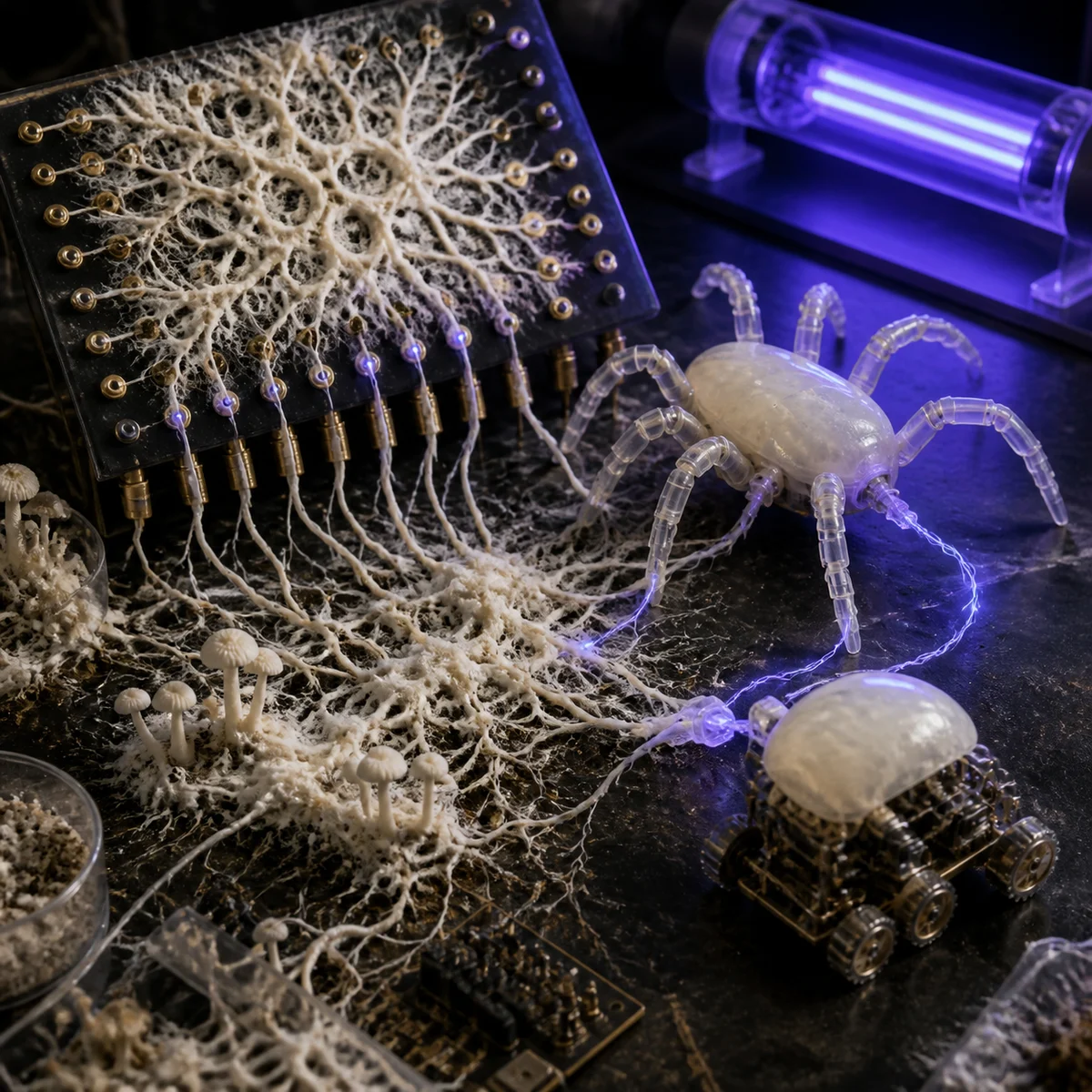
Cornell engineers built a control system around an organism that already senses its surroundings: fungal mycelium. Fine electrode interfaces recorded the living network's electrical activity, and electronics translated its changing spikes into commands for two machines. One was a soft, spiderlike robot; the other rolled on wheels.
The point was not that a mushroom had learned to drive. Mycelium produces measurable electrical signals as part of its biological activity. By growing it within a designed interface, the researchers could capture those signals and map them onto movement. When the fungus was exposed to ultraviolet light, its electrical response changed, and the robots' behavior changed with it. That connected a biological response to a mechanical action without pretending the fungus possessed a tiny steering wheel.
This remained a laboratory proof of concept, not an autonomous robot ready for a forest floor. Its value lies in the bridge: living material can be both part of a machine and part of its sensing system. The robots did not merely carry fungus. They listened to it.
Sources