





 Share








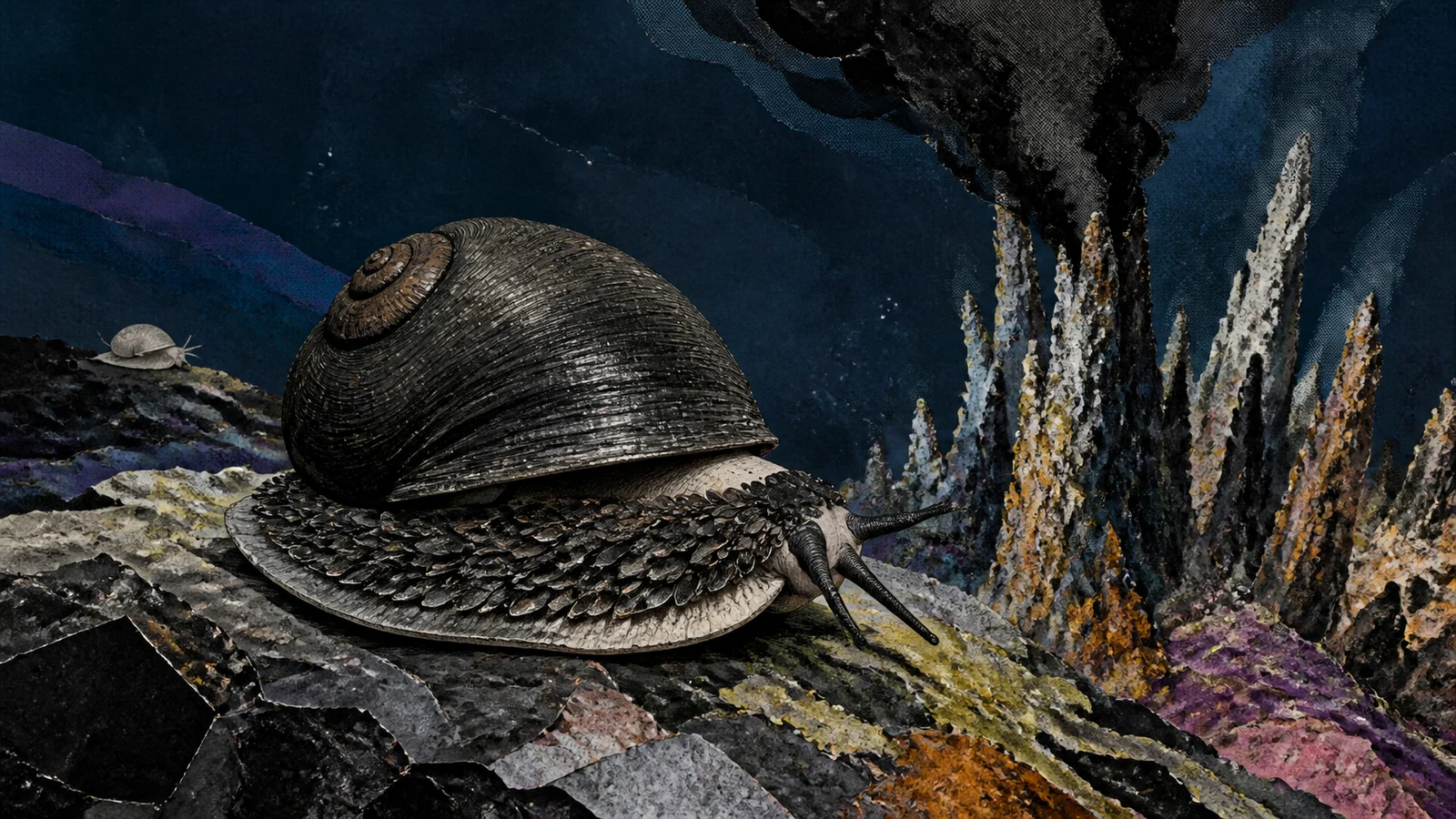
The scaly-foot snail lives where seawater meets mineral-rich hydrothermal vent fluid in the Indian Ocean. Its foot is fringed with hundreds of overlapping scales, or sclerites. In some vent fields those scales—and layers of the shell—take on iron sulfides, producing a dark metallic coating unlike the structural material of any other known animal.
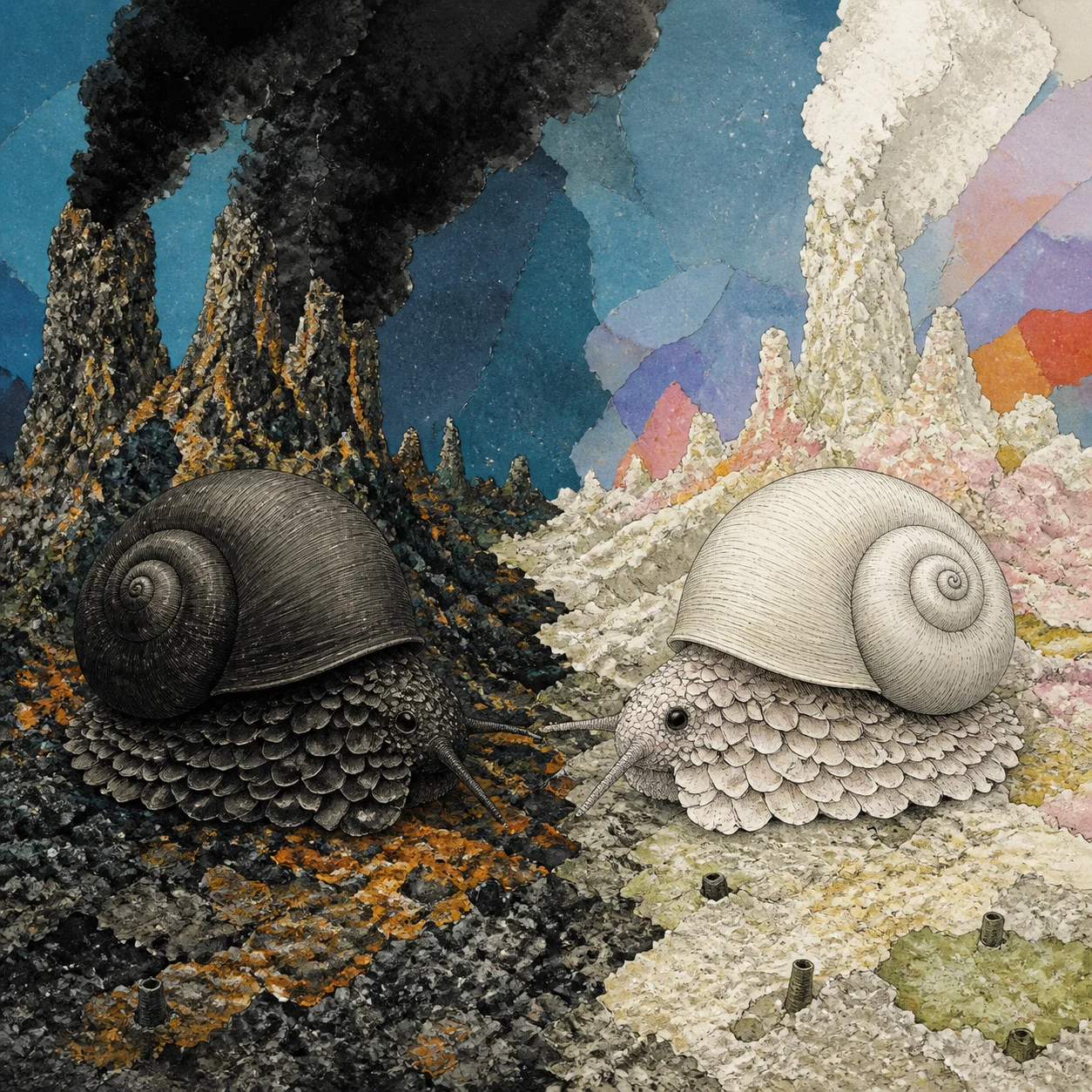
The snail builds each scale from soft tissue and conchiolin, a fibrous shell protein. Mineralization depends on its environment. Populations from metal-rich sites can be black or golden; another population of the same species is pearly white because its scales lack the iron coating. Iron plating is therefore a local finish on shared anatomy, not a universal suit worn identically by every individual.
The animal's stranger machinery continues inside. Symbiotic bacteria use vent chemicals to make energy and feed the snail. Because those microbes are housed within its body rather than directly exposed to flowing vent water, the snail circulates chemical supplies to them with an unusually large heart. It is not indestructible, and “armor” does not prove every scale evolved only for defense. It is a living partnership wrapped in geology: tissue, microbes, circulation, and metal assembled by one hostile seafloor.
Hydrothermal vents create a severe mosaic. Hot, chemically reduced fluid emerges into cold oxygenated seawater, building steep gradients over short distances. Animals live not in raw vent fluid but around places where usable chemicals, oxygen, and tolerable temperatures meet. The scaly-foot snail occupies that boundary in several vent fields along ridges of the Indian Ocean.
Its silhouette explains the common name. The broad foot is covered along the sides by rows of flattened, overlapping sclerites. They resemble scales, but they are not modified fish armor or tiny external bones. The snail grows them from its own tissue, coats them in conchiolin, and, depending on the surrounding water, acquires additional mineral layers.
The first documented population from the Kairei vent field appeared coal-black. A later population from the Solitaire field looked pearly white despite carrying the same unusual scales. When another dark population was found at Longqi, genetic work showed that all three belonged to one species, Chrysomallon squamiferum. Color had made local chemistry look like a species boundary.
Iron sulfide explains much of the contrast. Where vent water supplies abundant metals and sulfide, minerals can coat the conchiolin-rich scales and parts of the shell. The dark coating includes compounds familiar from vent deposits rather than an alloy manufactured like human steel. Where the relevant chemistry is absent or reduced, the scales remain pale. The body plan persists; the mineral finish changes.
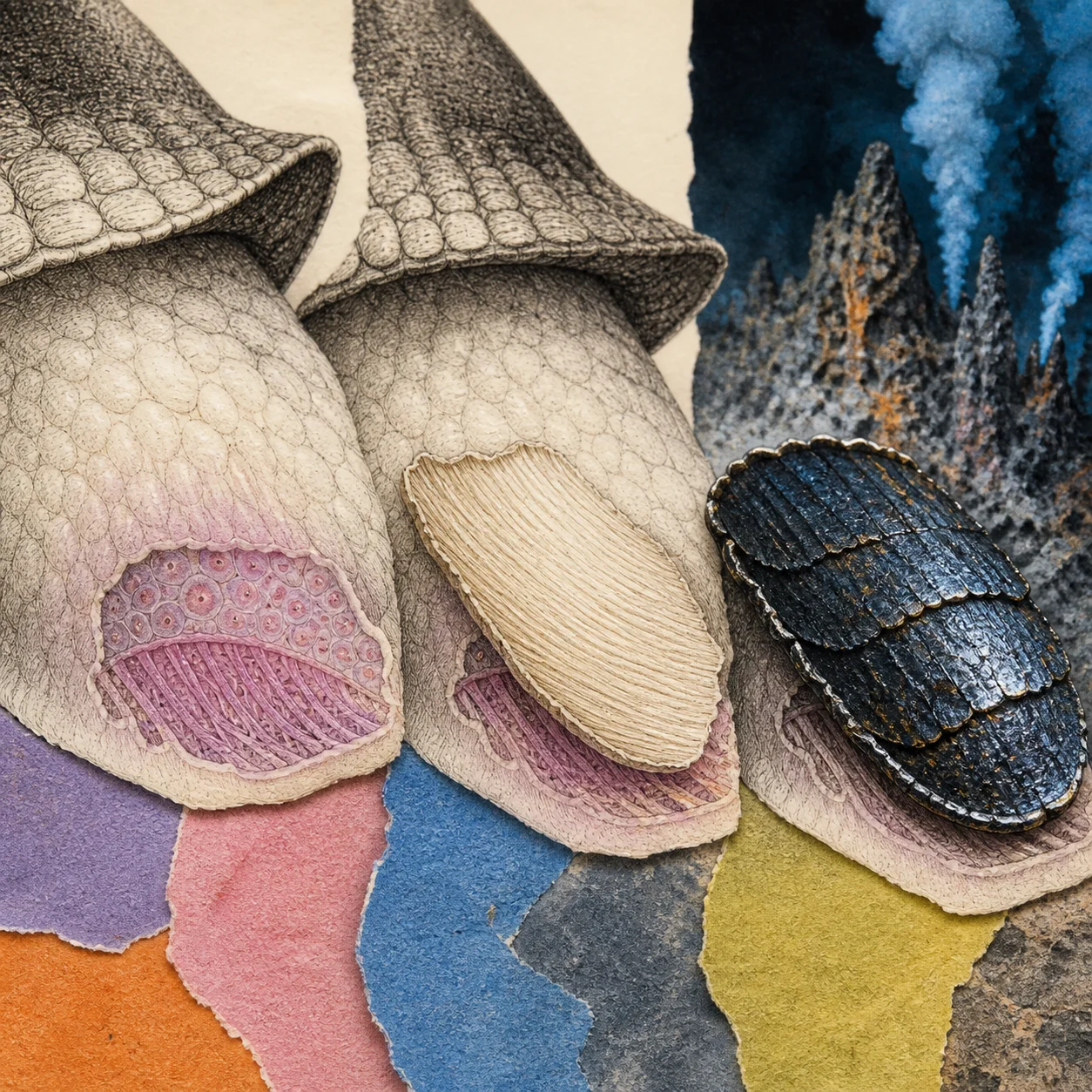
Calling the foot iron-plated is accurate for the mineralized populations, but the phrase invites superhero assumptions. The scales can contribute mechanical protection, yet the animal is not literally bulletproof or indestructible. Researchers continue to investigate how the layered shell and sclerites perform. “Armor” is a useful description of structure, not proof of one exclusive evolutionary purpose.
The snail does not graze a garden growing in sunlight. It depends on chemosynthesis. Symbiotic bacteria use chemicals available around the vent to build organic matter, doing for the partnership what photosynthetic organisms do with light elsewhere. The bacteria live inside the snail's digestive region, sheltered from direct contact with the external water.
That arrangement creates a delivery problem. Chemical substrates must reach the internal microbes through the host. The scaly-foot snail has a large circulatory system and a heart occupying about four percent of its body volume, unusually high for an animal. The organ helps move oxygen and vent-derived chemicals through the partnership. The metal exterior gets the headlines; circulation supports the actual food supply.
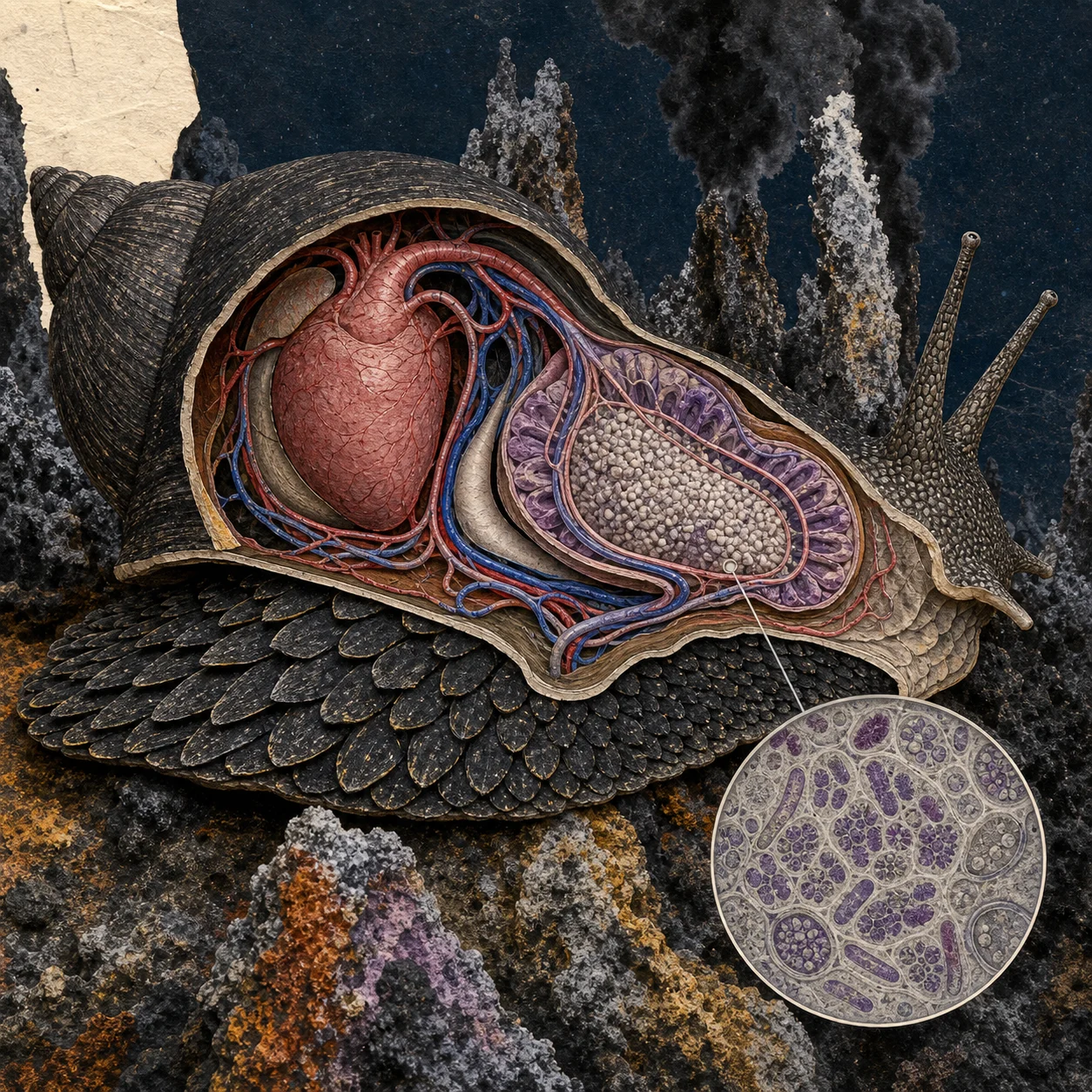
The vent field therefore writes itself into several layers of the animal. Geology provides sulfide and metals for external mineralization. Water chemistry supplies energy-rich compounds for internal bacteria. The snail provides tissue, blood flow, shelter, and access. None of the partners alone explains the whole creature. The weird form is an ecosystem compressed into one shell.
Different populations are especially valuable because they separate anatomy from environment. Pale and dark snails share a species and a scaled foot, allowing researchers to compare what changes when mineral conditions change. That natural contrast prevents the easiest mistake in the story: treating iron as the essence of the animal rather than one conditional layer on a much deeper adaptation.
The species name translates roughly to a golden-haired scale bearer, a reminder that human labels follow the most visible surface. From the snail’s perspective, the central challenge is continuous exchange: moving chemicals from vent water to symbiotic bacteria while maintaining a body in cold, pressurized darkness. The iron is spectacular, but the partnership is what keeps the animal alive.
The population contrast functions like a natural materials experiment. Where iron-rich chemistry is available, the conchiolin base acquires a mineral coat; where it is not, the same kind of scale remains pale. Researchers can compare those outcomes without pretending one form is more authentic. Both reveal what the snail builds and what the vent adds.
Sources