Share
Share







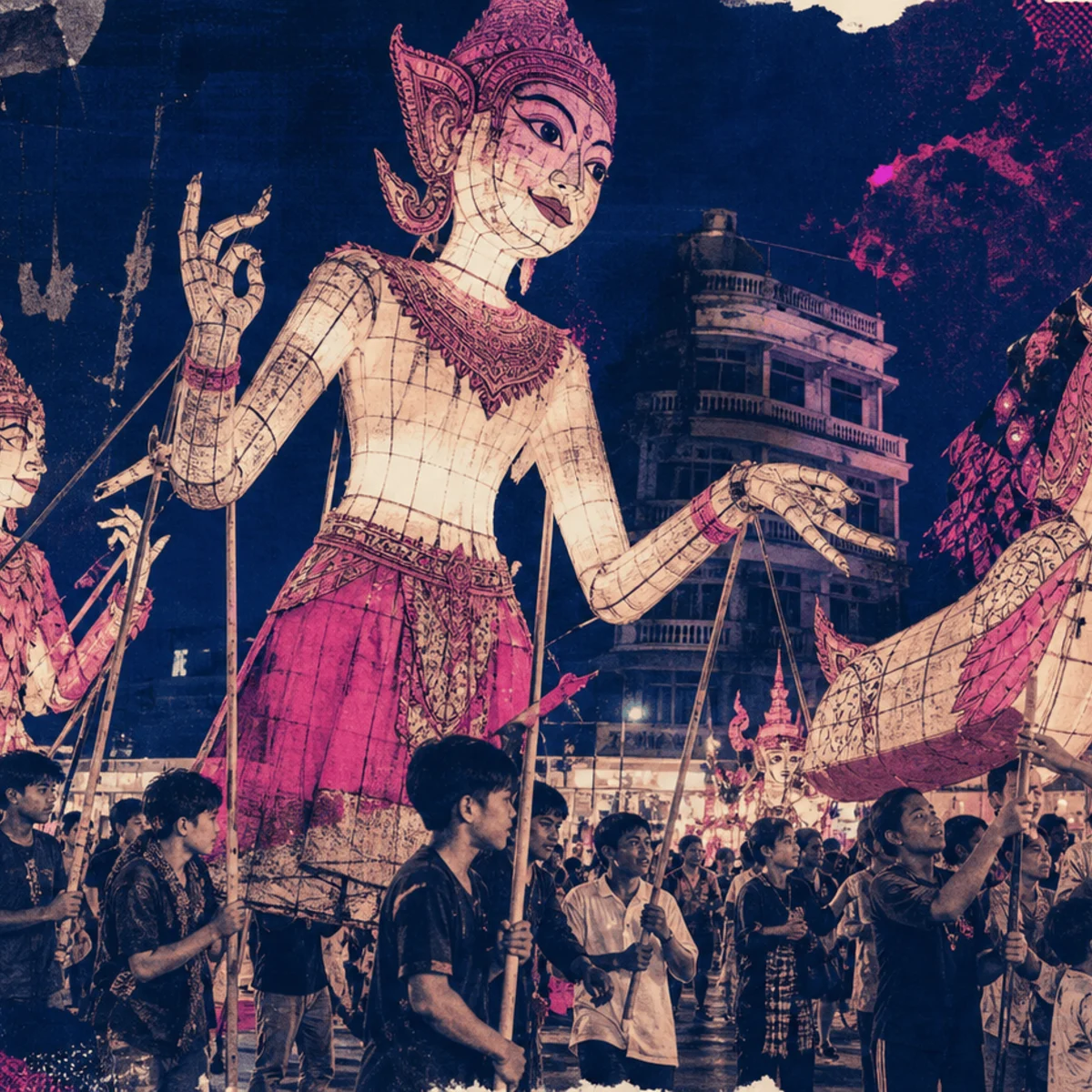
A giant illuminated puppet does not begin as a giant. It begins as a set of decisions spread across many hands: which creature or figure to make, how its outline will hold together, where light can pass through, which part a child can decorate, and how a team will carry the finished form without losing its shape. In Cambodia’s Giant Puppet Project, the night parade is the visible end of a much longer act of communal construction.
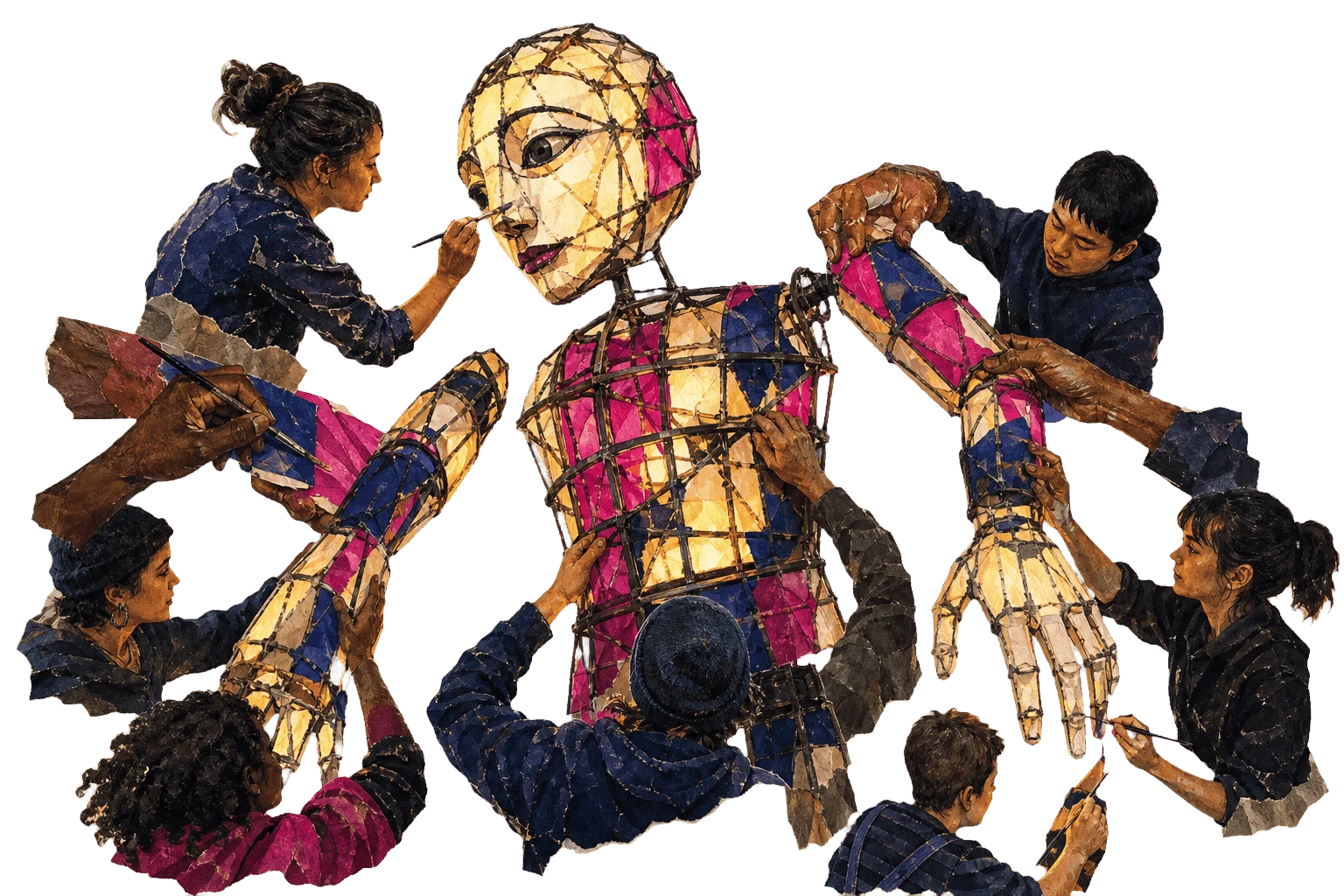
The project was established in 2007 and works in Siem Reap and Battambang. Its structure pairs an educational program with a public event. Hundreds of children and young adults join workshops drawn from local schools and community organizations. Artists and art students connected to Phare Ponleu Selpak help facilitate the making. Over roughly three weeks, the participants build large-scale puppets that will eventually leave the workshop and enter the city.
That sequence matters. A parade audience sees a luminous figure already moving through dark streets. The builders see its awkward earlier states: framework without surface, separate parts waiting to join, a design that must be adjusted because weight falls in the wrong place, or decoration that looks different once a light shines from inside. The puppet becomes an engineering lesson whose requirements are discovered through touch.
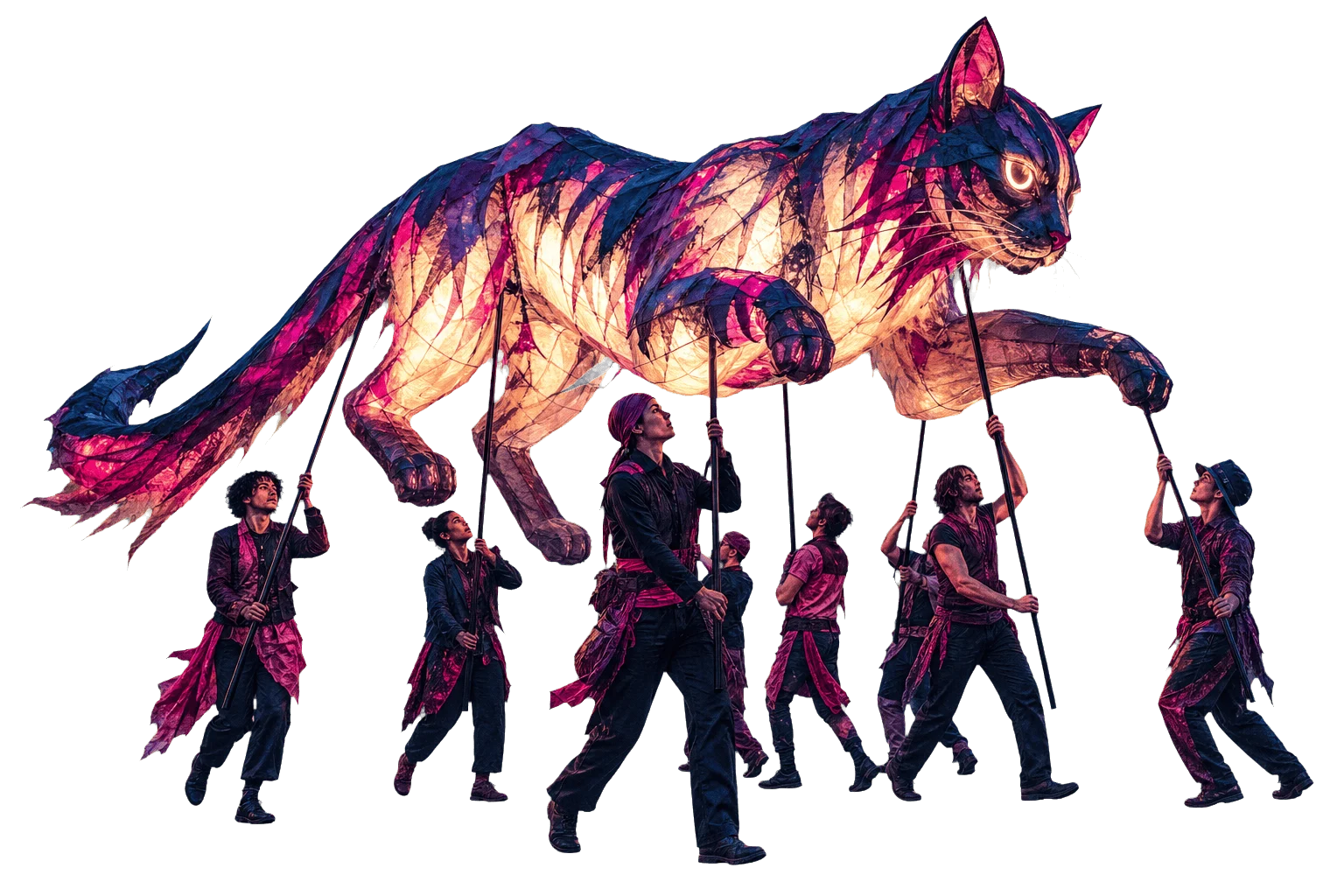
Scale changes the usual relationship between maker and object. A tabletop puppet can be manipulated by one pair of hands. A giant parade figure may need several people positioned at different points. No one carrier sees or controls the whole object. The head, body, limbs, and supporting poles must behave as one figure even though their movement comes from a team.
The nighttime setting gives the construction a second body. By day, viewers might first notice paper, framework, joints, paint, and the hands holding everything up. At night, illumination simplifies those parts into a glowing outline. The puppet can appear lighter than the structure actually is. Internal light turns seams into pattern and makes an object built in a workshop read from across a street.
The Giant Puppet Project’s documented model joins children from schools and community groups with trained facilitators. That does not mean every participant performs the same job. A large collaborative object naturally breaks into many useful scales of work. One person can contribute a painted section or repeated detail. Another can solve a joint. Others can assemble, test, carry, play music, or help guide the procession. The finished figure holds these unequal pieces without requiring them to look like separate assignments.
Jig Cochrane, one of the project’s co-founders, describes a broader practice of building large illuminated sculptures through community arts work. His portfolio emphasizes that the objects are constructed together and then celebrated through exhibitions or carnivals. The spectacle is therefore not imported at the last minute. It is a public form given to work that has already happened among the participants.
The parade changes who owns the image. In a theater, a puppet generally belongs to the stage and is viewed from seats. Here, the city street becomes both stage and route. The figure moves past shops, crossings, spectators, musicians, and buildings at ordinary walking speed. It shares the same ground as the people who made it. A familiar street briefly acquires an animal, ancestor, mythical being, or imagined presence large enough to reorganize the crowd around it.
The puppet’s movement is necessarily collective. If carriers accelerate at different times, the form twists. If a turn is too tight, the body must adapt. If the front rises while the rear remains fixed, the creature may seem to stretch or bow. Those practical negotiations become animation. The figure appears alive not because a hidden machine performs perfect motion, but because visible human effort keeps converting coordination into gesture.
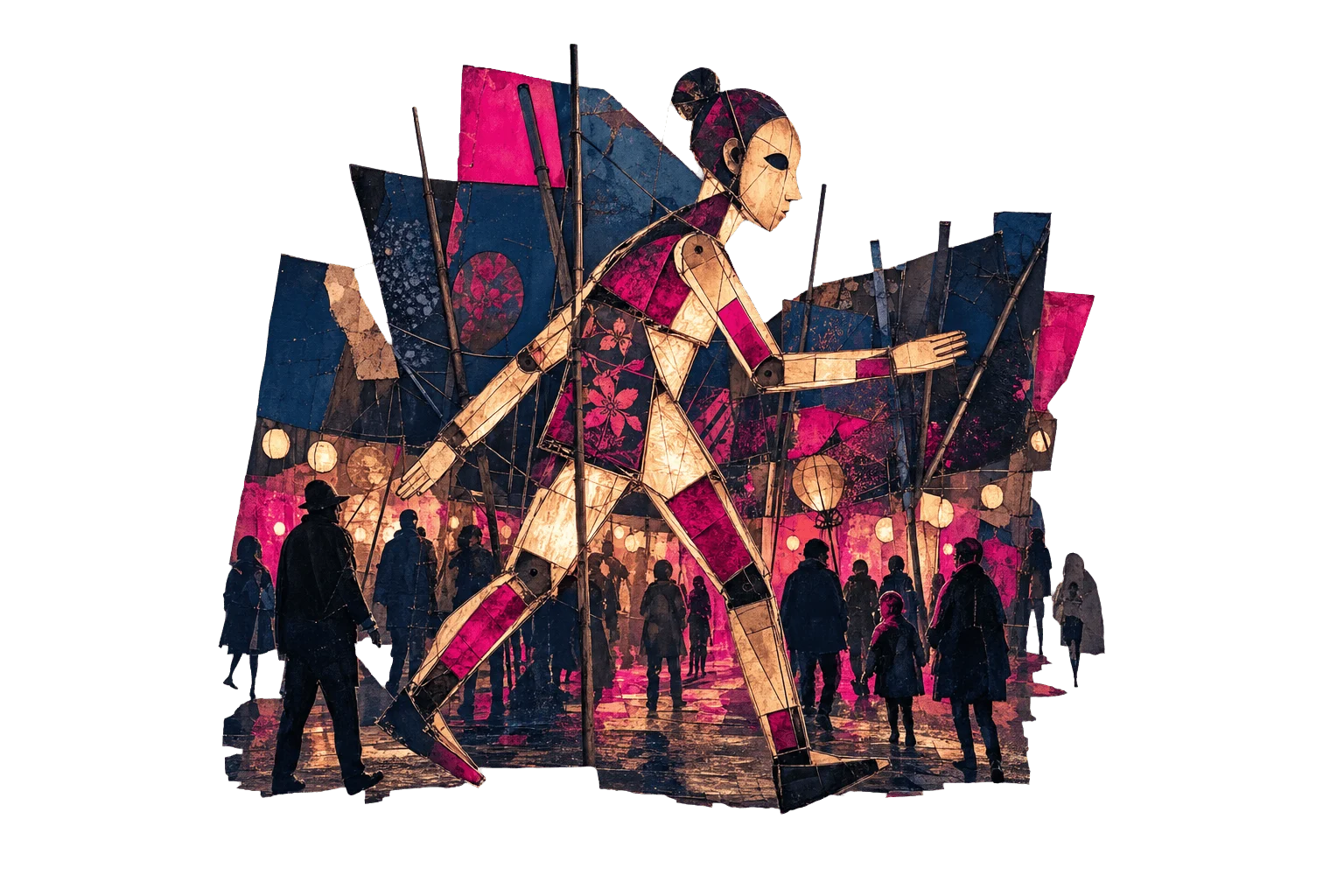
This is why the project is more interesting than a gallery of enormous props. The workshop supplies the knowledge of how the thing is made; the parade supplies the temporary illusion that it moves on its own. Participants experience both truths. They know where the framework flexes and which joint resisted assembly, yet they can also watch the illuminated whole become legible to thousands of other eyes.
Large public art is often delivered by specialists and encountered as a finished fact. The Giant Puppet Project reverses that order. The making is distributed before the viewing is collective. A child may contribute one small surface to an object far larger than any individual participant, then later see that surface carried through the city as part of a figure with its own apparent gait.
When the procession ends, the streets return to their ordinary scale. The puppets stop walking because the teams stop carrying them. But the important transformation has already happened twice: loose materials became a shared figure, and the shared figure became a moving public image. The night parade is not where a building learns to walk. It is where many separate acts of making agree, for a little while, to move as one body.