




 Share







A woven picture does not arrive on cloth all at once. It grows across repeated crossings of thread. Lengthwise warp threads are held under tension. A shuttle carries the weft across them. Before each pass, selected warp threads must rise while others remain down, opening a space called the shed. Change that selection from one pass to the next and color begins turning into pattern.
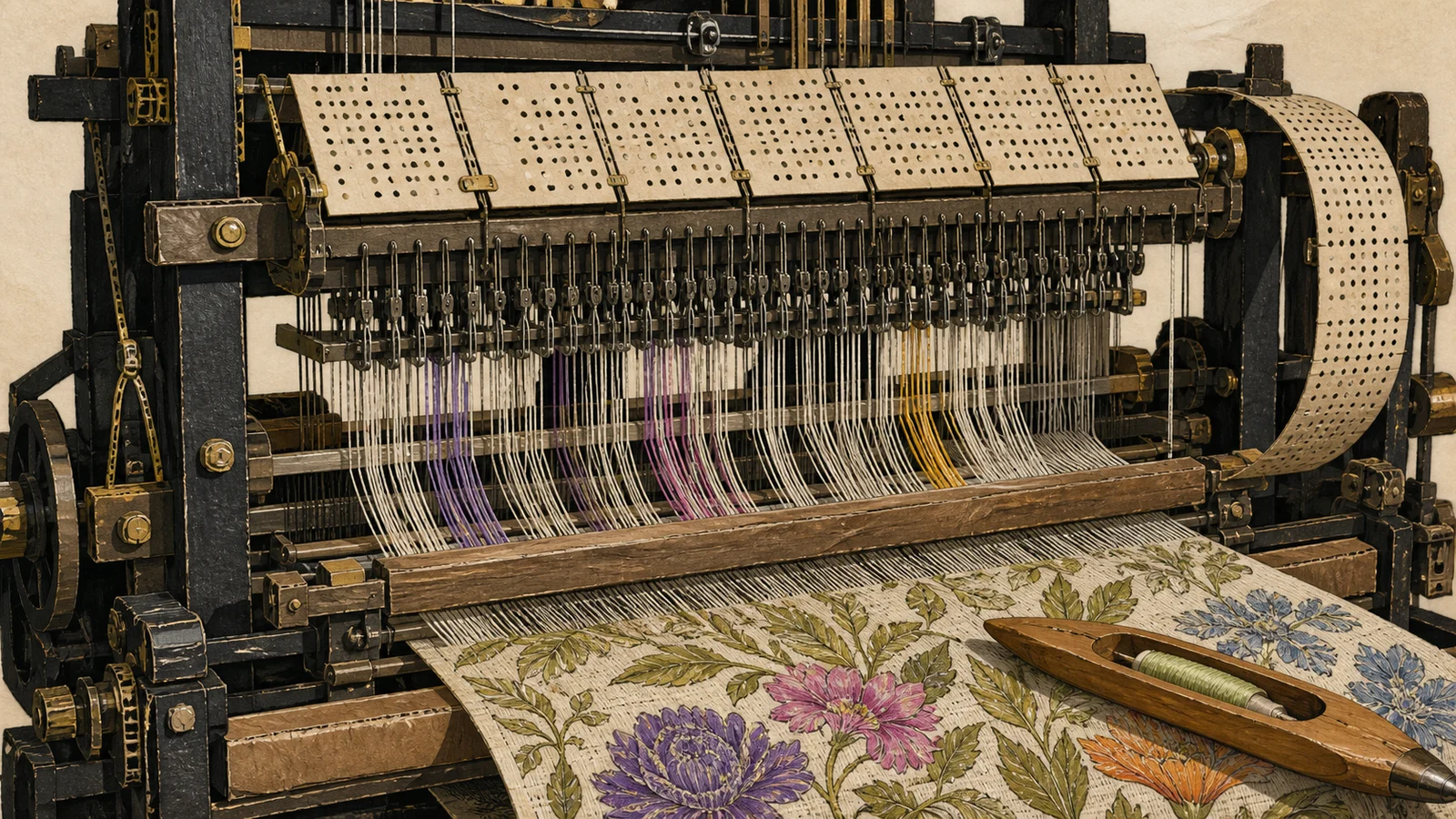
For elaborate figured cloth, those selections can become extraordinarily complicated. A weaver's assistant once helped manage which warp threads were raised. The Jacquard mechanism transferred that demanding sequence into a chain of stiff cards punched with carefully arranged holes. A floral spray, portrait, border, or geometric repeat could first exist as a physical sequence of open and solid positions.
The card did not carry a picture in the ordinary sense. It carried instructions for one stage of weaving. As a card pressed against the reading assembly, an array of needles encountered its surface. Where there was a hole, a needle could pass through. Where the card remained solid, the needle was blocked. That binary physical difference controlled hooks connected to selected warp threads.
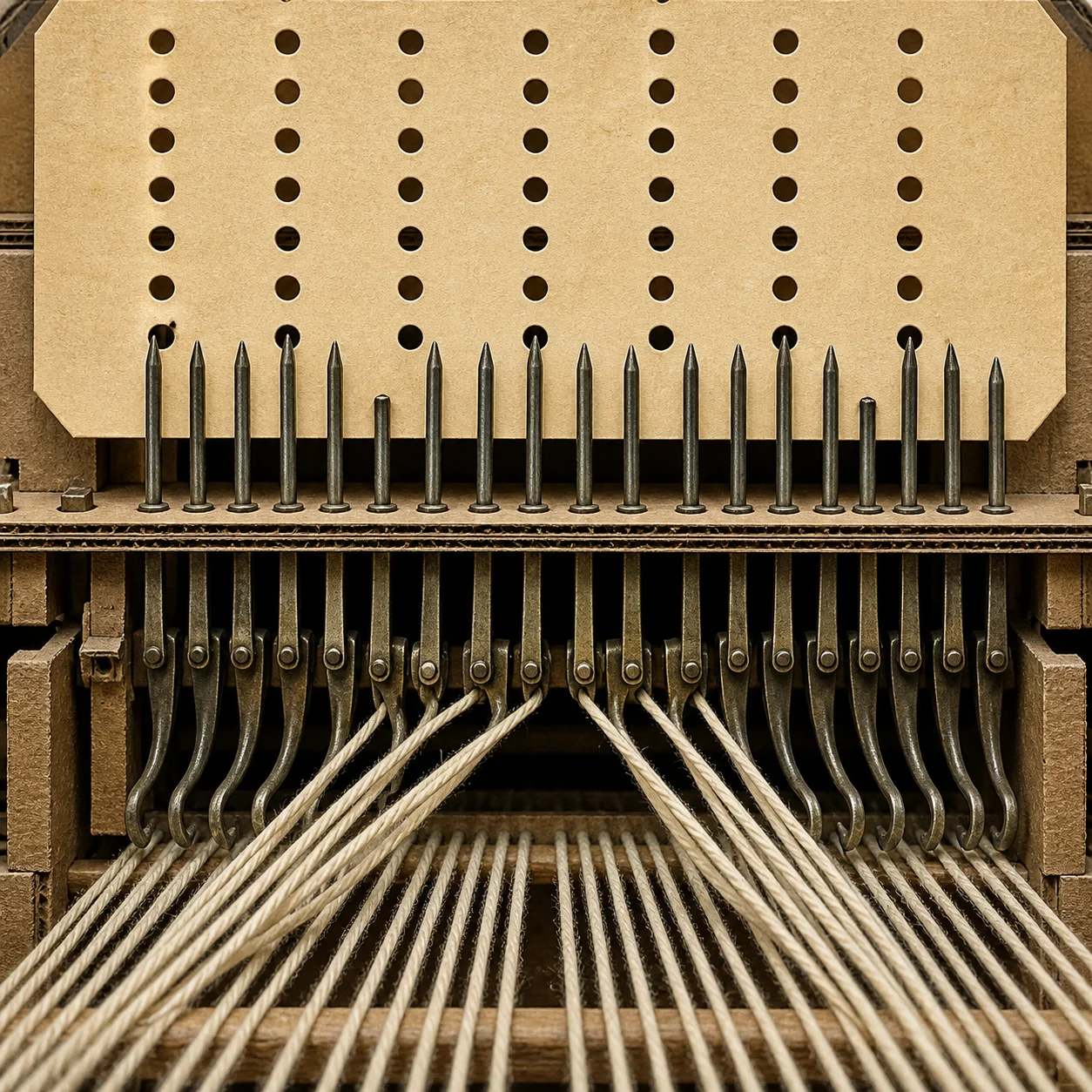
Hooks lifted the required groups, the shed opened, and the weft crossed. Then the card chain advanced. The next card presented another arrangement of holes and solid areas, producing the next selection for the next pick. With every pass, the loom translated a small portion of stored instruction into a physical row of textile structure. Repetition accumulated into an image.
A card punch was therefore part of the information system. The Science Museum Group preserves a hand-operated punch used to make Jacquard cards. A designer's pattern had to be analyzed and transferred into correct hole positions. The punch made those absences consistently enough that the card could meet a mechanical reader again and again without asking a human assistant to remember every lift.
Linking the cards into a chain established order. A loose pile would not be enough; sequence determines design. Repeat the chain and the motif repeats in the cloth. Replace it and the same loom mechanism can execute a different arrangement. The machinery remains largely fixed while an external instruction set changes what the machine does.
That separation is the source of the mechanism's modern resonance. Pattern no longer lived only in a skilled person's moment-to-moment movements or in a loom built permanently for one motif. It occupied a manipulable physical medium. Cards could be punched, inspected, linked, stored, corrected, duplicated, rearranged, and reused. Complex labor was not eliminated, but some of it moved upstream into preparing the instructions.
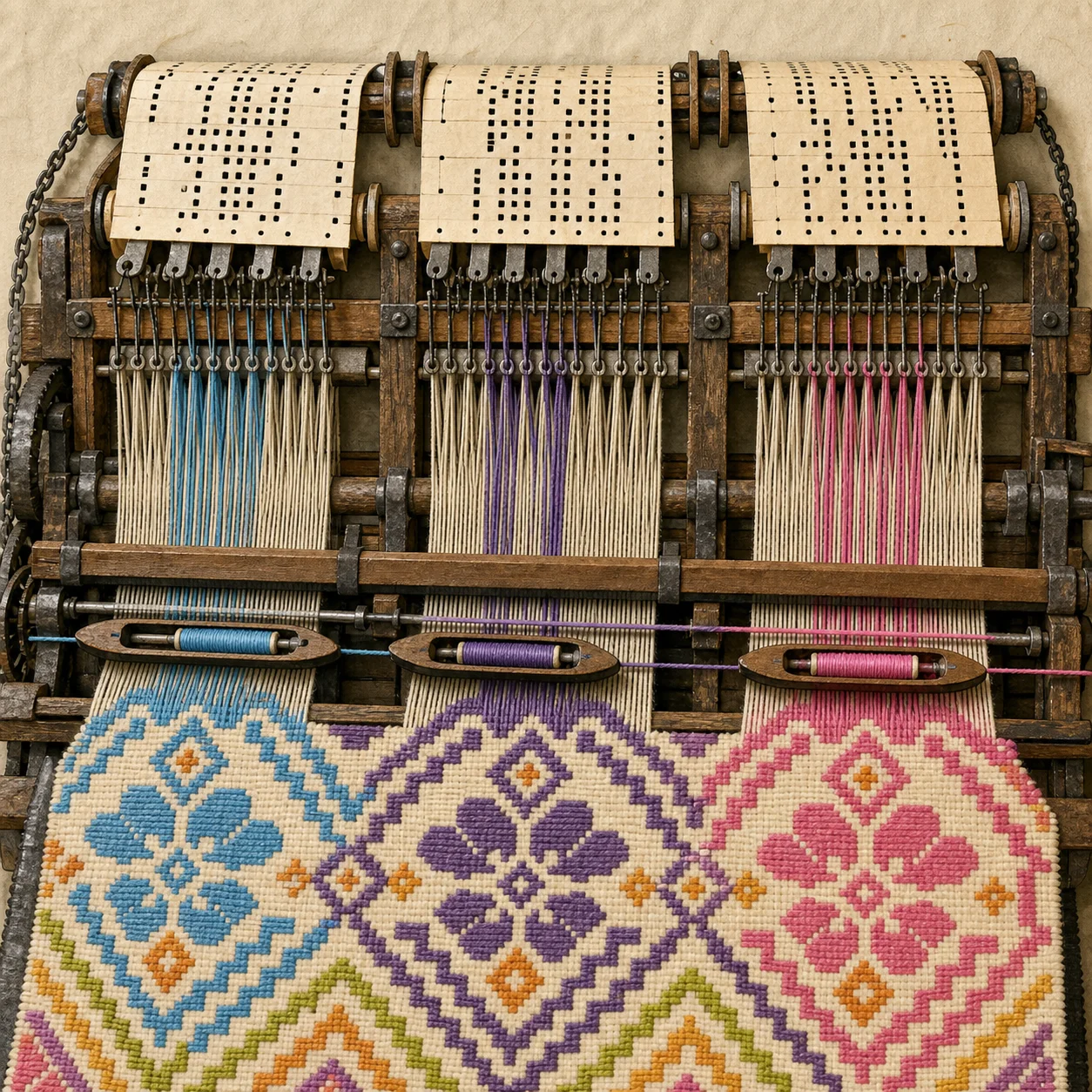
The loom still required material judgment. Threads had to be chosen, tensioned, and handled; shuttles carried weft; faults needed attention; color and fiber affected the result. A punched card could select warp threads, but it could not guarantee beautiful cloth. Like a musical score, the information became repeatable without becoming independent of instrument, material, and operator.
Museum objects make that entire chain visible. A preserved Jacquard hand loom includes its wood and metal frame, warp and weft supplies, shuttles, weights, and associated punched cards. Beside the cards, the punching device shows that “programming” began as manual fabrication: a person used a tool to make or leave solid each decisive position.
The comparison with later computing should remain careful. A Jacquard mechanism is programmable in the useful sense that an external card sequence controls a repeatable operation and can be changed. It is not a general-purpose computer. The cards do not by themselves perform arbitrary calculation, store changing numerical state, branch on a result, or run every kind of machine process. They direct thread selection in a loom.
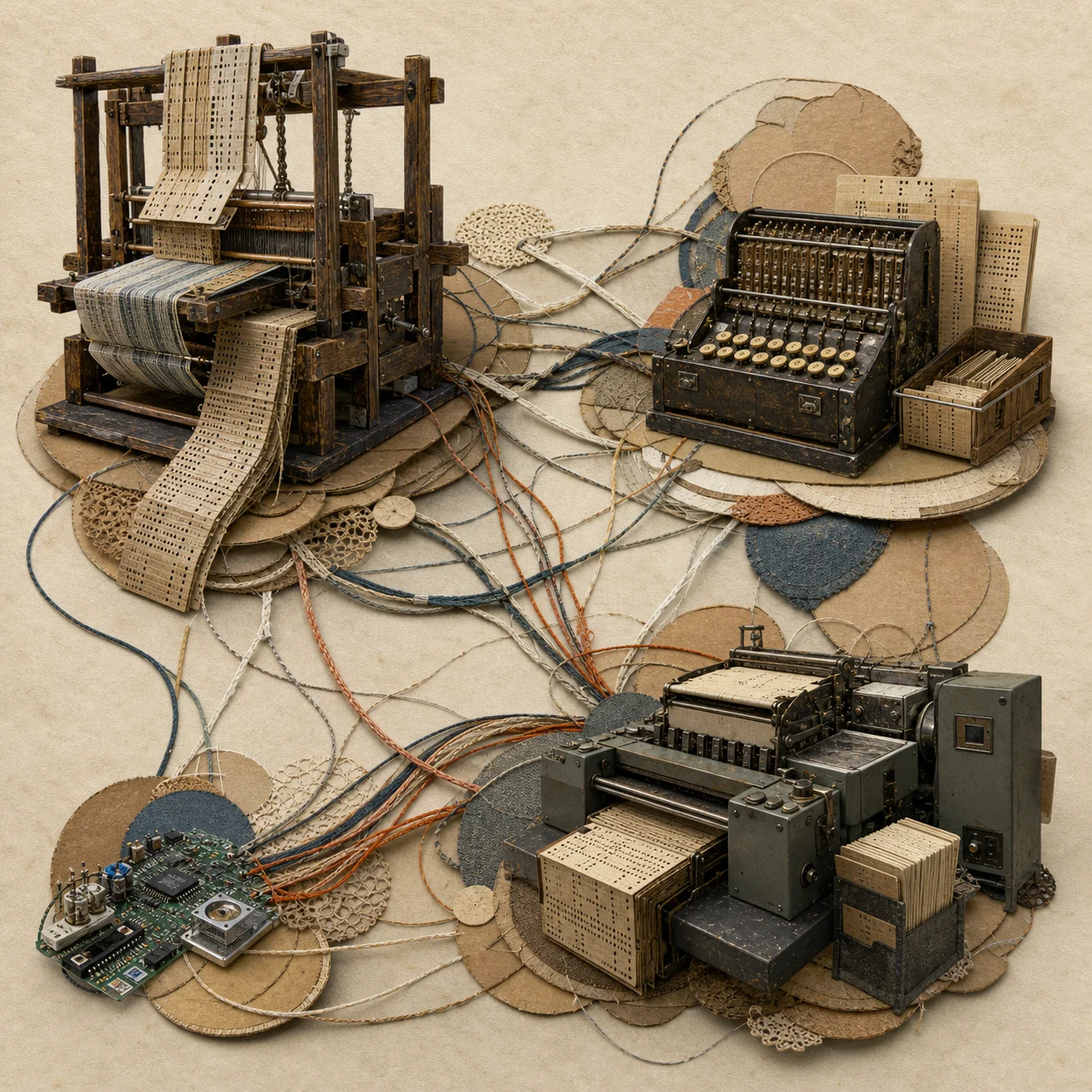
Punched-card control nevertheless proved adaptable. Later machine designers and data-processing systems used holes in cards for different purposes, from controlling operations to representing records. The influence is conceptual and technical, but history is not a single card chain running straight from woven flowers to software. Many inventions, institutions, mathematical ideas, and engineering choices sit between them.
What the loom demonstrates with unusual clarity is a conversion across media. A visual design becomes a planned grid. The grid becomes holes and solids. The reader turns those positions into mechanical motion. Hooks turn motion into selected warp threads. The shuttle binds those selections with weft. Information ends as a surface people can wear, hang, or touch.
A hole seems like nothing, yet inside the chain it has location and consequence. It opens a path for a needle. That needle changes a hook. The hook changes the shed. One missing circle of card helps place one sliver of color. Thousands of such decisions build complexity without requiring the machine to see the flower it is making.
This is the Jacquard mechanism's durable weirdness: it gives absence a job. The solid card says one thing, the hole says another, and order supplies grammar. Long before electronic memory, a textile machine could read a physical pattern outside itself and enact it step by step. Not a computer in the modern general-purpose sense, but unmistakably a machine taking instructions from stored information—and turning those instructions into cloth.