




 Share







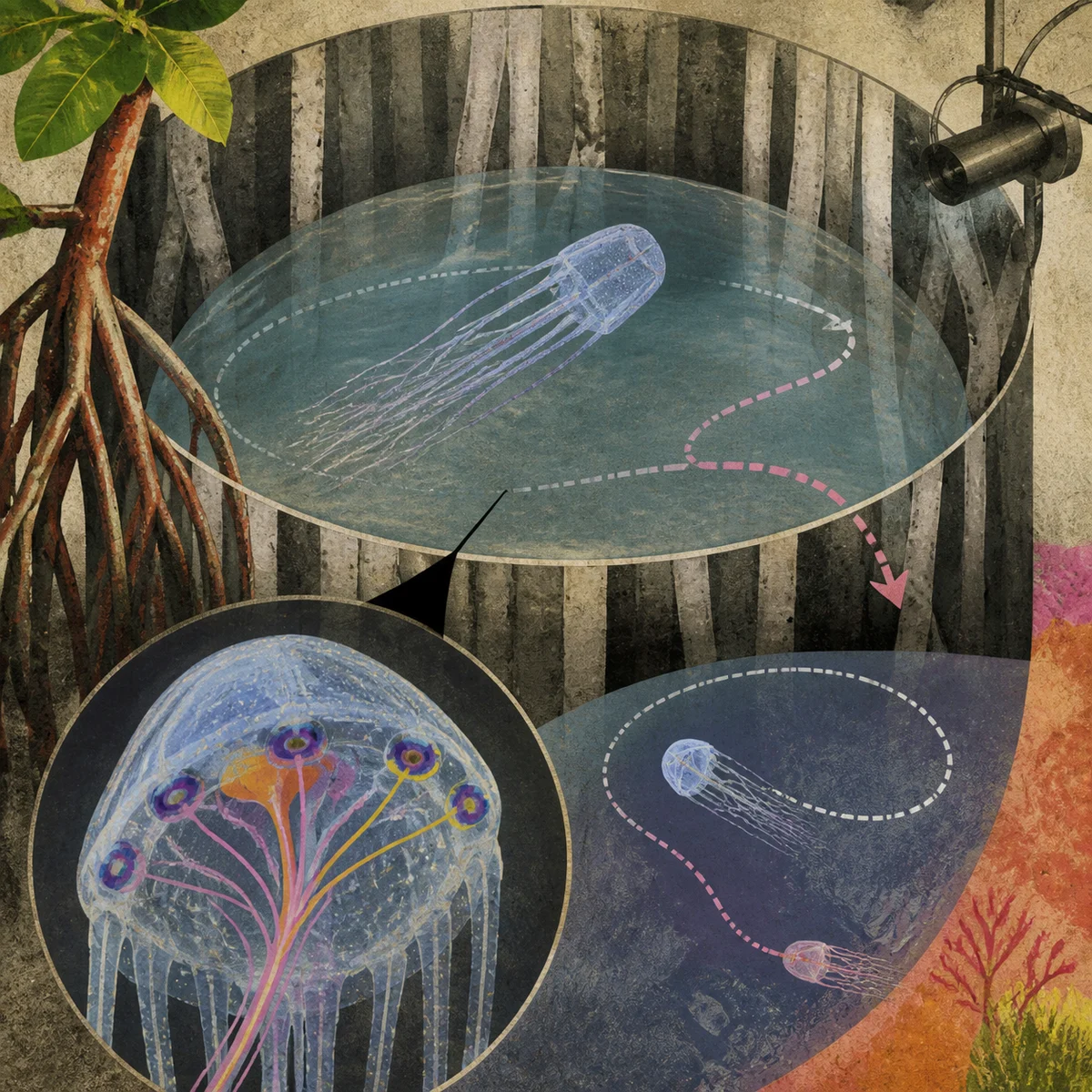
Caribbean box jellyfish, Tripedalia cystophora, hunt between mangrove prop roots. Their transparent bells carry four sensory centers called rhopalia, each equipped with six eyes and the neural circuitry that helps steer swimming. Researchers tested whether that distributed system could learn from a collision.
In a round tank, gray-and-white stripes on the wall mimicked low-contrast roots in murky water. At first the jellyfish swam close and bumped the side. After only a few minutes, they kept about 50 percent farther away and collided roughly half as often. The useful lesson joined two signals: the visual pattern of the stripe and the mechanical consequence of striking it.
Follow-up tests presented moving visual patterns to an isolated rhopalium and paired them with an electrical pulse standing in for a bump. The changed pacemaker response located the association within that small sensory-and-nerve center. This is evidence of associative learning in one species performing one obstacle task, not proof that every jellyfish thinks alike. Tripedalia has no conventional centralized brain; it has four local eye-and-nerve hubs that learned enough to stop hitting the wall.
Sources