Share
Share







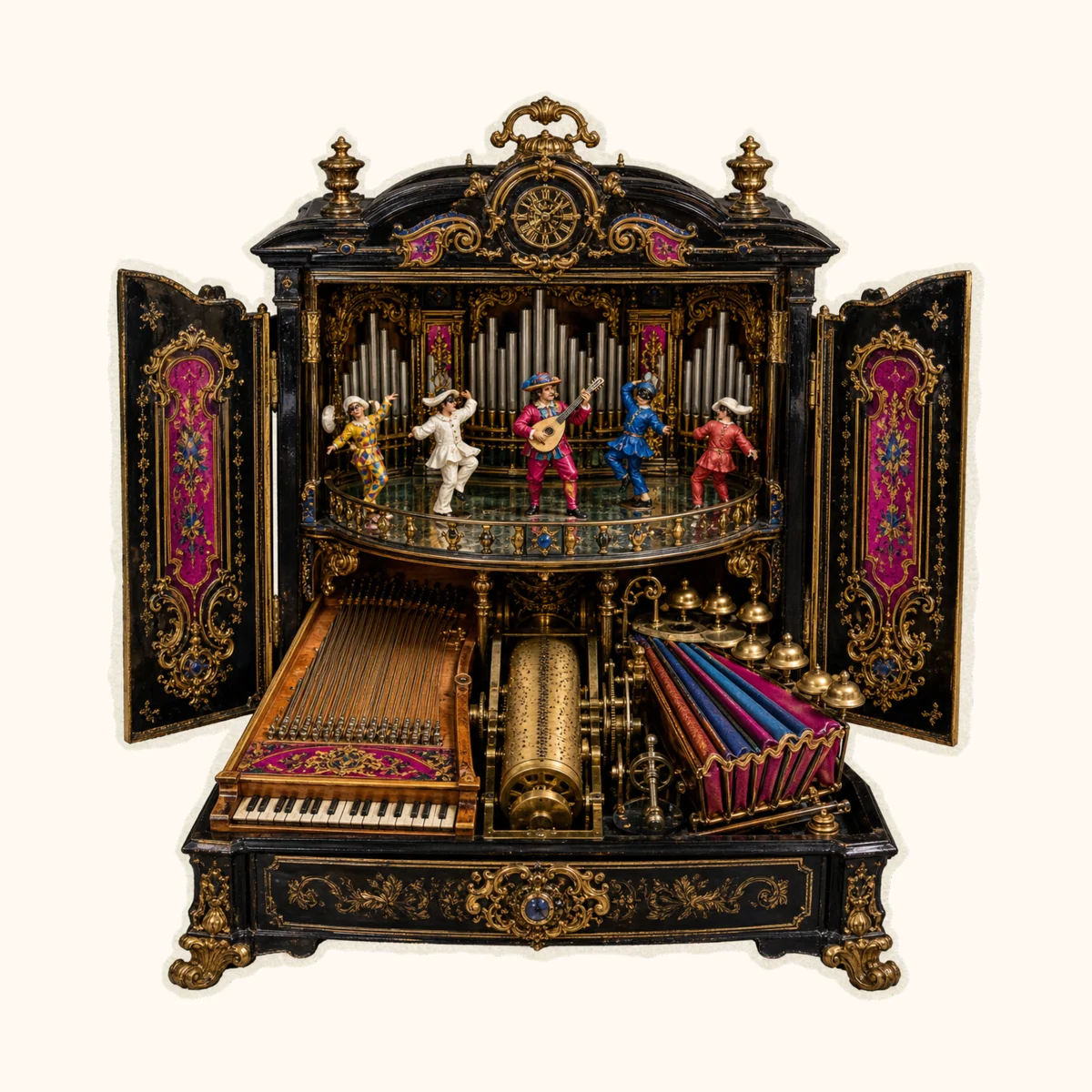
Around 1625, Augsburg craftspeople packed a clock, a sixteen-note pipe organ, a sixteen-string spinet, and a miniature theater into one ebony cabinet. When the instruments sounded to mark the hour, five brightly dressed commedia dell'arte figures performed a circling dance in the tower above the clock face.
The figures do not play the organ and spinet. They are a separate clockwork performance synchronized with the music. Four tiny musicians—a violinist, trumpeter, bell ringer, and triangle player—circle a lute player who turns in the opposite direction. The moving tableau makes the cabinet appear to supply its own ensemble as well as its own sound.
Inside, an original pinned cylinder stores three airs. Pins arranged across its surface mechanically encode when the instruments should sound, turning the cylinder's rotation into a repeatable performance. The survival of that cylinder matters because later owners often replaced such components and their music as tastes changed.
The Metropolitan Museum of Art calls this perhaps the most musically elaborate automatic instrument to survive from the early seventeenth century. The phrase fits its excess. A device that needed only to announce the hour instead operated two different instruments, released preserved music from a coded barrel, and sent five carved performers dancing around a mirrored balcony.
Sources