Share
Share







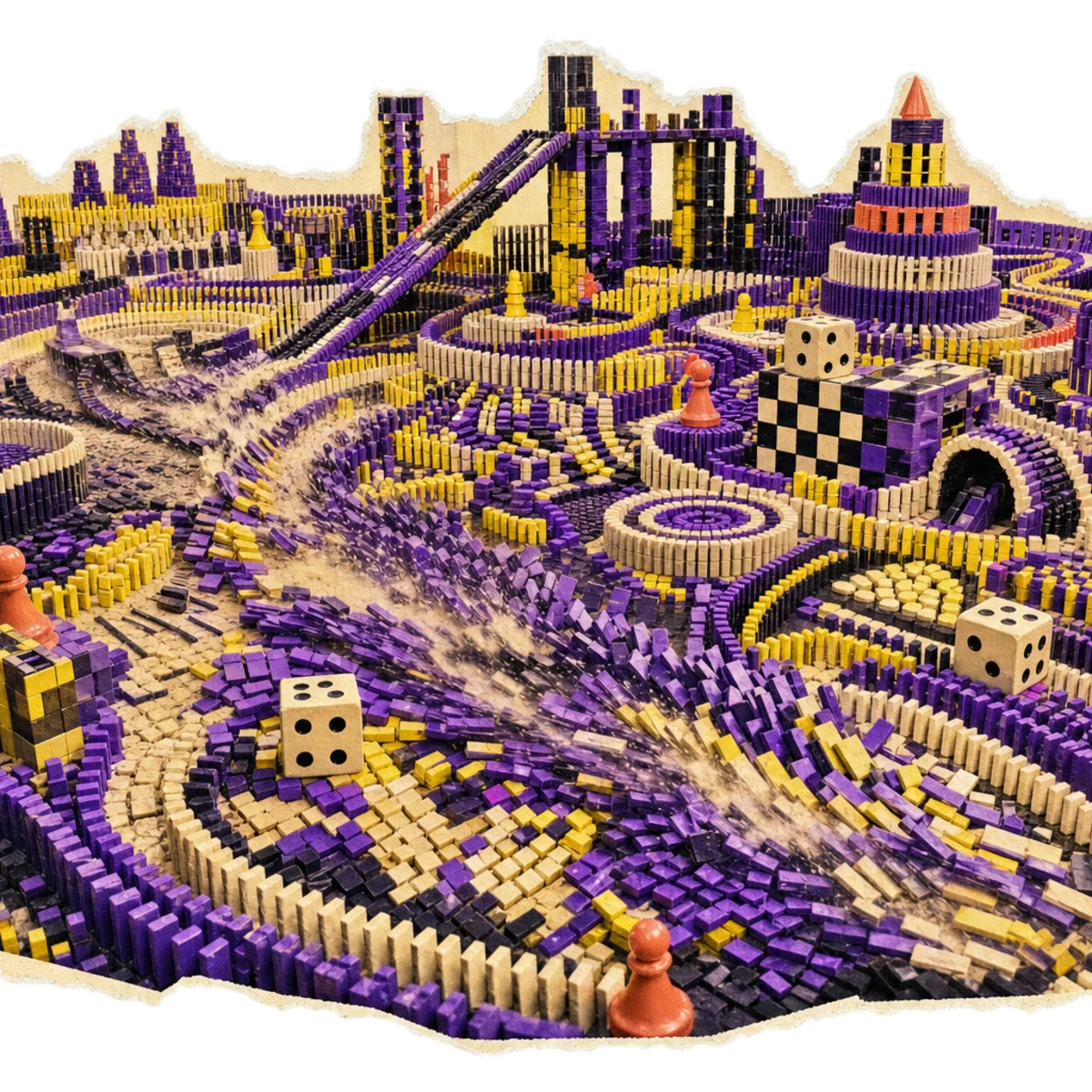
A domino installation has an unusual definition of finished. A bridge, clock, or calculator is complete when it can begin doing its job. A quarter-million-piece domino machine is complete only when every person has stopped touching it, the audience is ready, and one final action is permitted to destroy the arrangement. Its successful operation leaves the floor looking progressively less like the thing that took a week to build.
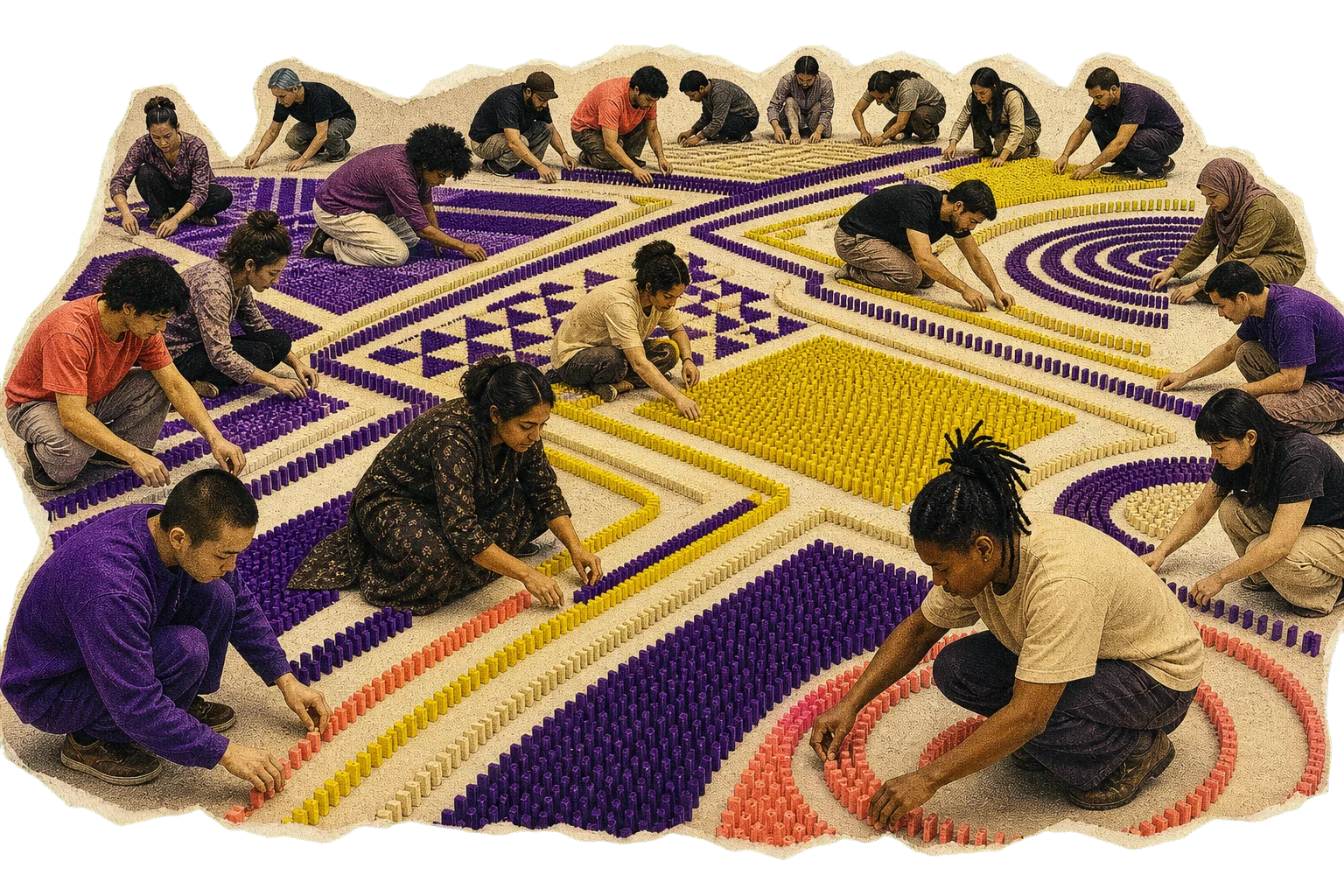
In 2017, the Incredible Science Machine team assembled Game On, a temporary chain-reaction installation built from more than 250,000 dominoes. The theme was play: video games, board games, and sports translated into fields, structures, images, and moving sequences. The official event fact sheet named 19 builders from the United States, Canada, Austria, Germany, and Switzerland. They worked for seven days and accumulated more than 1,200 combined building hours.
That arithmetic reveals the strange scale better than the piece count alone. More than 1,200 hours does not mean one person worked continuously for fifty days. It means many people spent the same week solving adjacent problems at once: where a line should begin, how a field should reveal an image, how one section should hand motion to the next, and how to move around unfinished work without turning a trouser cuff into an unscheduled trigger.
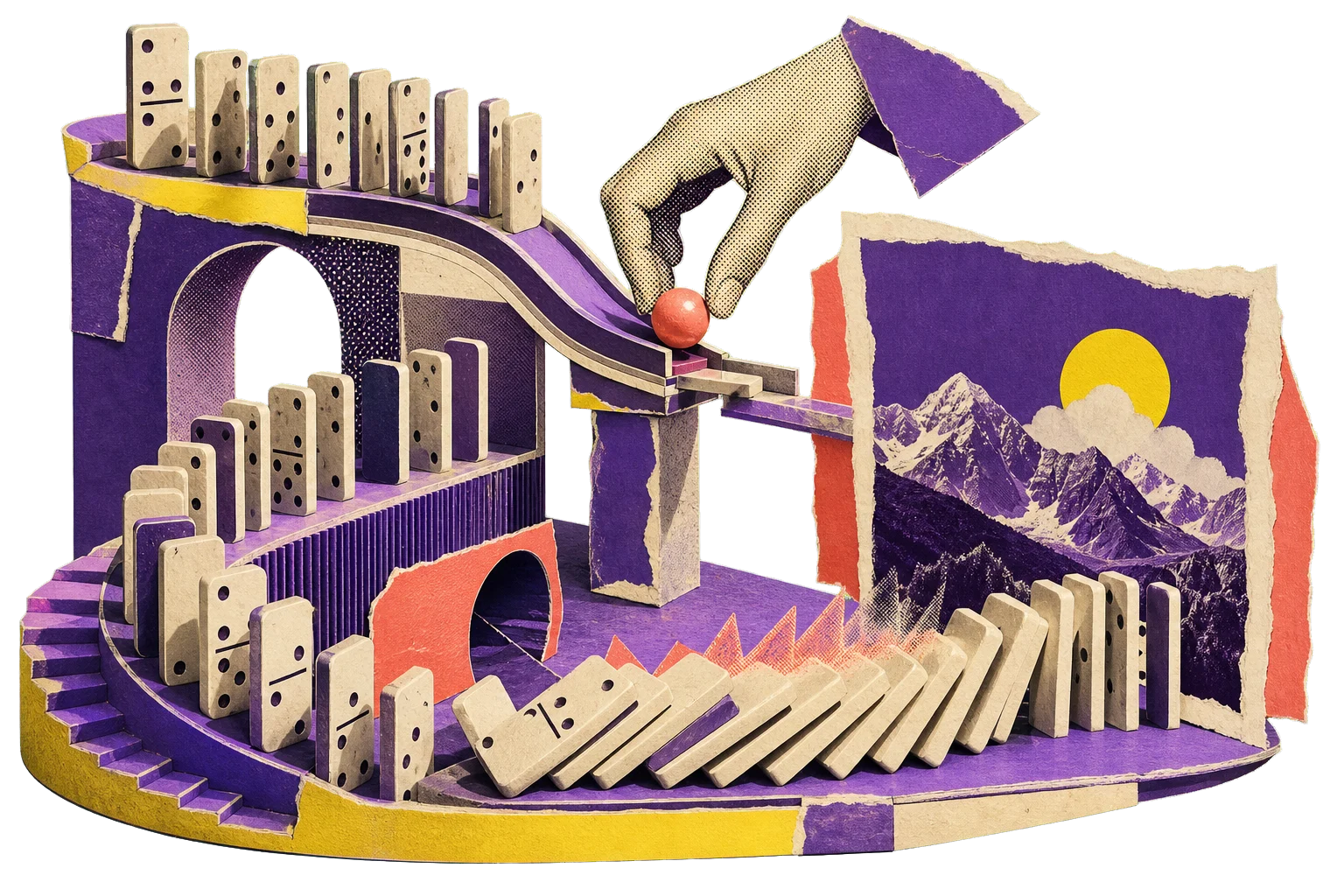
A domino is an extremely simple machine. Standing, it stores a small amount of gravitational potential energy. Tipped past its balance point, it falls and transfers enough energy to disturb the next piece. Complexity arrives through arrangement. Spacing controls whether the transfer continues. Curves change direction. Branches divide one signal into several. Ramps, balls, and larger structures can carry the action between sections that ordinary pieces cannot conveniently connect.
The individual components do not know the theme. A field of upright rectangles becomes an image because builders assign colors and positions, much as pixels form a picture. The picture exists while the pieces stand. When the wave reaches it, the image is replaced by motion. A dense region can appear to dissolve, flip, ripple, or change color as different layers fall in sequence. The machine performs by converting a static design into a timed disappearance.
That conversion must be planned from the end backward. Builders need a route that can be activated from one point yet reach many separate displays in the intended order. A section that falls too early can strand work downstream. A gap that is too large can stop the signal. A connection that is too sensitive can release hours of construction before neighboring sections are ready. The project therefore depends on controlling both motion and waiting.
Waiting is the dominant condition during the build. Each standing piece is prepared to move, but must remain motionless while people place thousands more nearby. Large projects use separations and safeguards so a mistake in one area does not necessarily travel through the entire installation. Those interruptions must later be joined or removed before the public run. The same design needs to resist accidental motion for days and then transmit deliberate motion for minutes.
Game On was planned to take more than fifteen minutes to topple. That duration sounds short beside seven building days, but it is extraordinarily long for a signal passed through small falling objects. The machine had to keep finding a next event: a field changing, a structure collapsing, a mechanism releasing, or a line carrying the reaction toward another game-inspired scene. The builders' long work was compressed into a single continuous performance.
The project followed an earlier Incredible Science Machine record involving 76,017 dominoes in a circle field. Guinness World Records describes that formation as eighteen expert domino artists working for ten days before the field fell outward from its center. The circle field was the component judged for that specific world record. It should not be confused with every piece in the later, larger Game On installation or used to turn the whole quarter-million-piece project into one undifferentiated record claim.
The distinction matters because domino art can contain several different achievements at once. A huge total count measures scale. A dense field tests layout and synchronized propagation. A tall or intricate structure asks pieces to carry motion through height. A long chain reaction tests continuity across mechanisms and transitions. Putting them in one room does not make them the same category, even though one falling path may connect them.
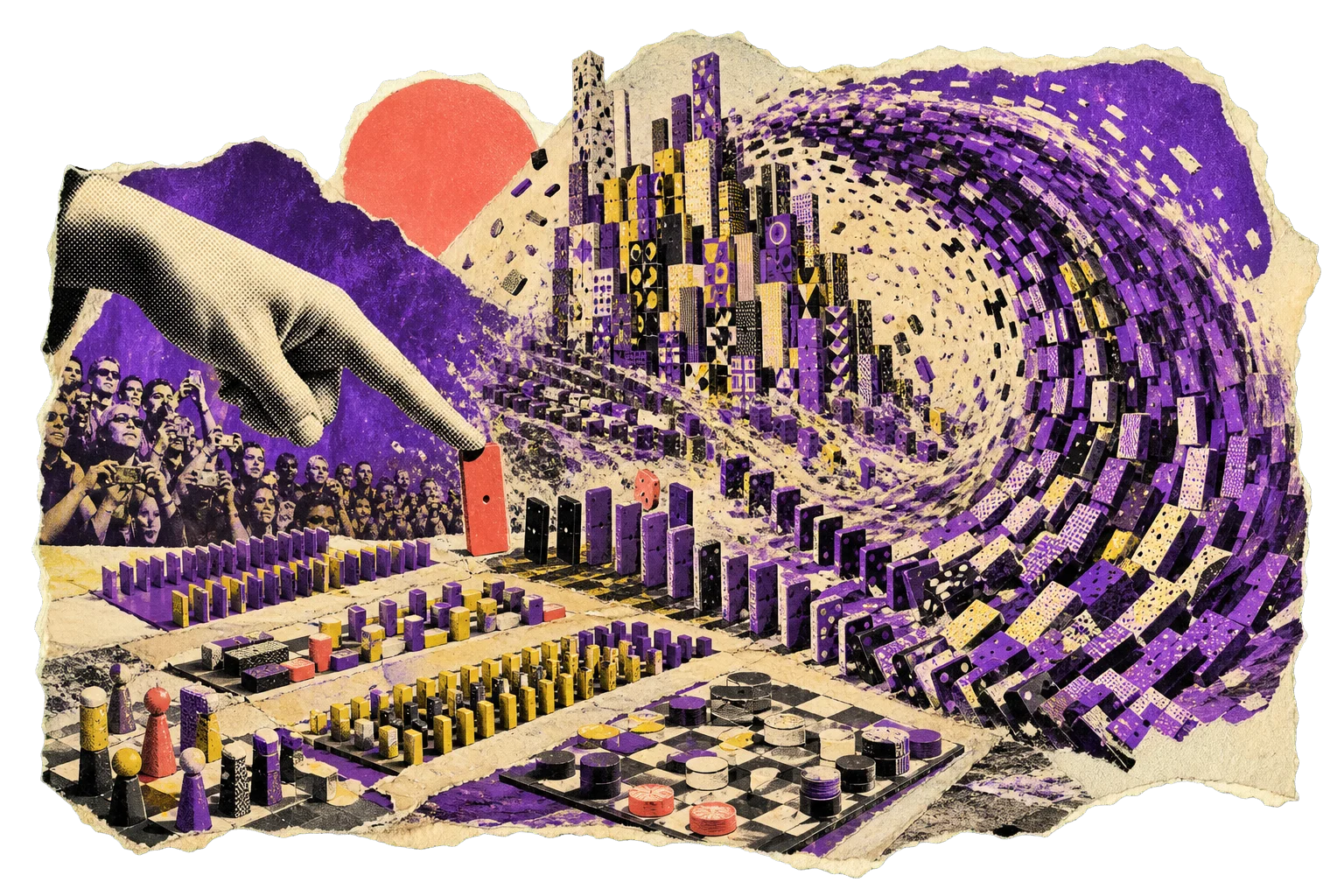
The international team also makes the project less like one artist enlarging a private sketch and more like a temporary factory. Different builders bring different specialties, but their sections still need compatible entrances and exits. One person's finale may be another person's trigger. Visual authorship has to coexist with mechanical handoffs. The audience eventually sees one machine; the build contains many local systems negotiated into sequence.
Its most peculiar material is not plastic or gravity but irreversibility. A rehearsal of the complete machine would consume the machine. Builders can test small modules, measure spacing, and verify mechanisms, but the full performance cannot be repeated without rebuilding what the first run removes. Ordinary machines are tested by running them many times. Domino installations reserve their complete test for the moment meant to count.
That makes the final trigger less like pressing a start button and more like releasing stored labor. The standing pieces hold a week's worth of decisions in visible suspension. Once motion begins, the work can no longer be edited. Each successful handoff converts preparation into spectacle, while each fallen field closes the possibility of changing it. The machine becomes most alive at exactly the moment it stops existing in its finished form.
Afterward, the dominoes remain, but the arrangement does not. They can be collected, sorted, and used again; the machine itself has become a recording and a memory of sequence. Game On's quarter-million pieces were not valuable because falling made them disappear. They were valuable because careful placement allowed ordinary rectangles to behave, once, like a fifteen-minute system built to erase its own instructions as it followed them.