Share
Share







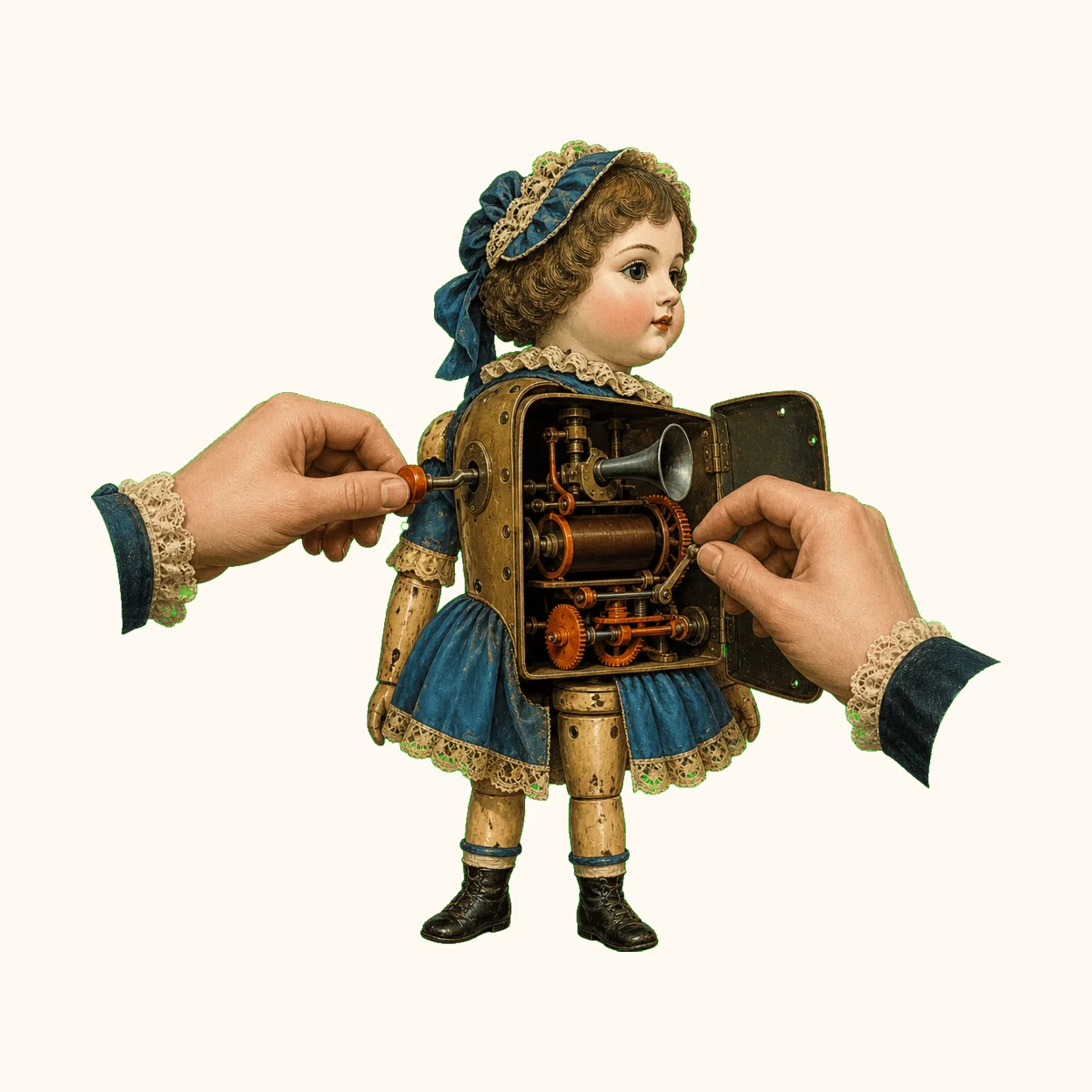
Edison’s talking doll placed its voice box exactly where anatomy suggested and engineering made difficult: inside a metal torso. The 1890 toy had a ceramic head, articulated painted-wood limbs, and a miniature phonograph carrying a brown wax record. The Smithsonian example recites “Jack and Jill” in a young woman’s voice, one of twelve recorded selections once offered.
A child—or more likely an adult—inserted a crank into the doll’s back and turned it to rotate the record. A nearby lever returned the stylus to the beginning. The mechanism did not merely hide a noisemaker beneath the dress; it miniaturized the central operations of a phonograph until the doll’s chest could record the illusion of speech.
The result arrived before its machinery was ready to disappear. The dolls worked imperfectly, sold poorly, and were manufactured only briefly in 1890. The Smithsonian says that by 1896 the remaining unsold phonographs for dolls were reportedly destroyed.
That failure leaves the object with two faces. From the outside, it belongs to the long tradition of dolls made to imitate a living child. Open the torso, and the imitation becomes industrial: crank, stylus, wax, and a tiny recorded worker repeating the rhyme whenever the mechanism returns to its start.
Sources