Share
Share







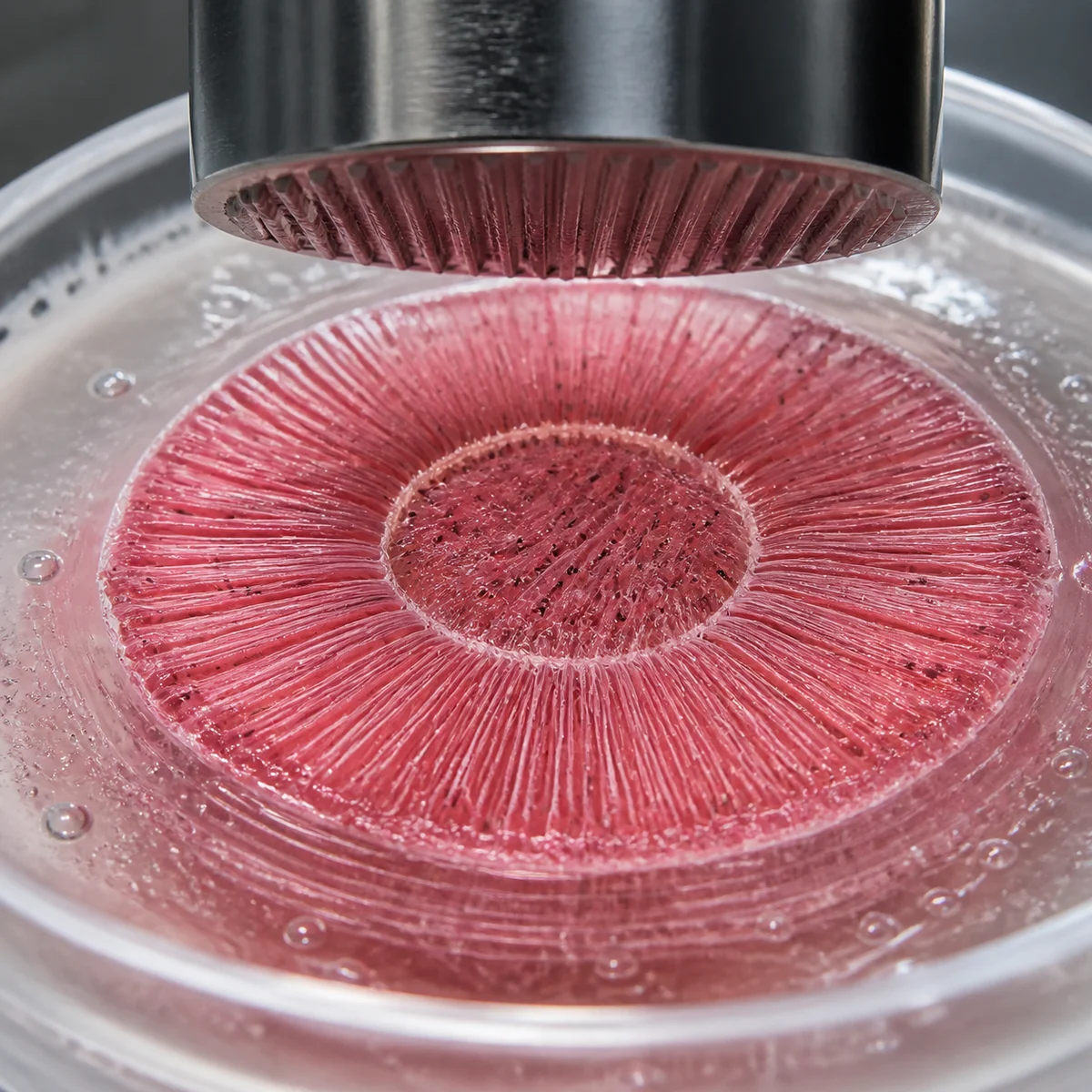
Most engineered muscle tissues pull mainly along one alignment. MIT researchers wanted a tissue that could contract in coordinated directions, more like natural structures whose fibers run in rings, rays, or angles. Their solution began with a tiny printed stamp. Microscopic grooves, each about as wide as one cell, were pressed into a very soft hydrogel to create a growth map.
The team coated the stamp so it could peel away without tearing the gel, then added genetically engineered skeletal muscle cells that responded to light. The cells settled into the grooves, fused into fibers, and followed an iris-like pattern containing concentric and radial orientations. Pulses of light made the resulting structure contract in multiple directions.
This was a demonstration of multidirectional biological actuation, not a replacement iris ready for a patient. A real iris uses smooth muscle, while the experiment used skeletal muscle cells. The value lies in manufacturing control: changing the stamp pattern can guide living fibers into more complex architectures, a possible route toward soft biohybrid machines and better tissue models.
Sources