Share
Share







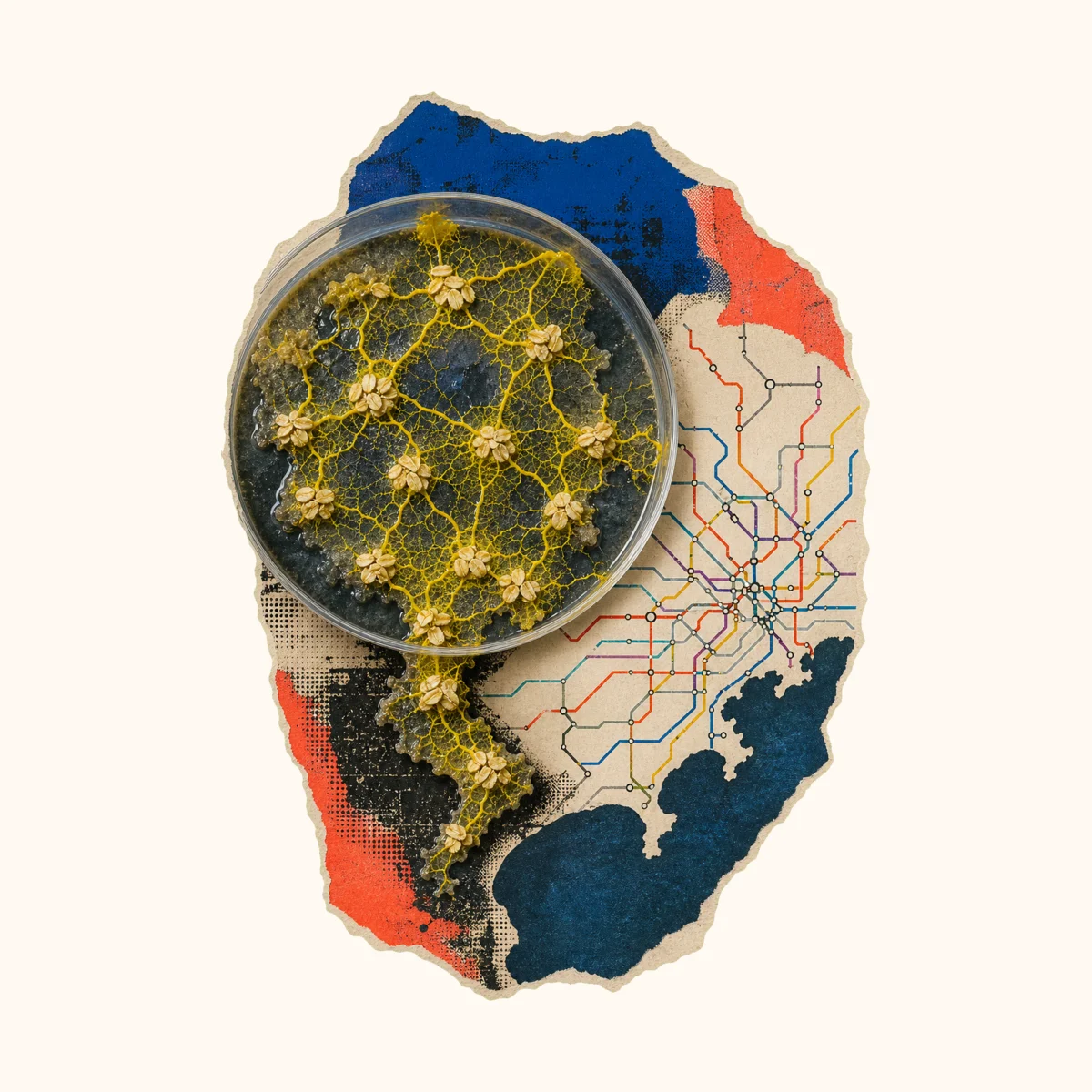
Researchers gave a slime mold a map-shaped meal. On a moist surface representing the Tokyo region, oat flakes stood in for major urban centers. Physarum polycephalum spread outward to reach them, then maintained a network of living tubes between the food sources. The organism had no transit authority, timetable, or planning department. It was simply solving the problem of connecting scattered meals while using its own material efficiently.
When the researchers compared the resulting biological network with the Tokyo-area rail system, the resemblance was not just visual. The slime mold’s routes balanced several pressures that also shape infrastructure: keeping paths reasonably short, limiting the total amount of network, and preserving alternate connections when part of the system fails. The real railway and the organism did not produce an identical map, but they arrived at comparable tradeoffs between cost, efficiency, and resilience.
The 2010 study, published in Science by Atsushi Tero and colleagues, turned that behavior into rules for network design. Its lesson was not that cities should hand construction to a yellow blob. It was that a decentralized living system can produce useful solutions without drawing the whole plan in advance. Tokyo’s rail map became a benchmark; the slime mold became an engineer nobody had hired.