Share
Share







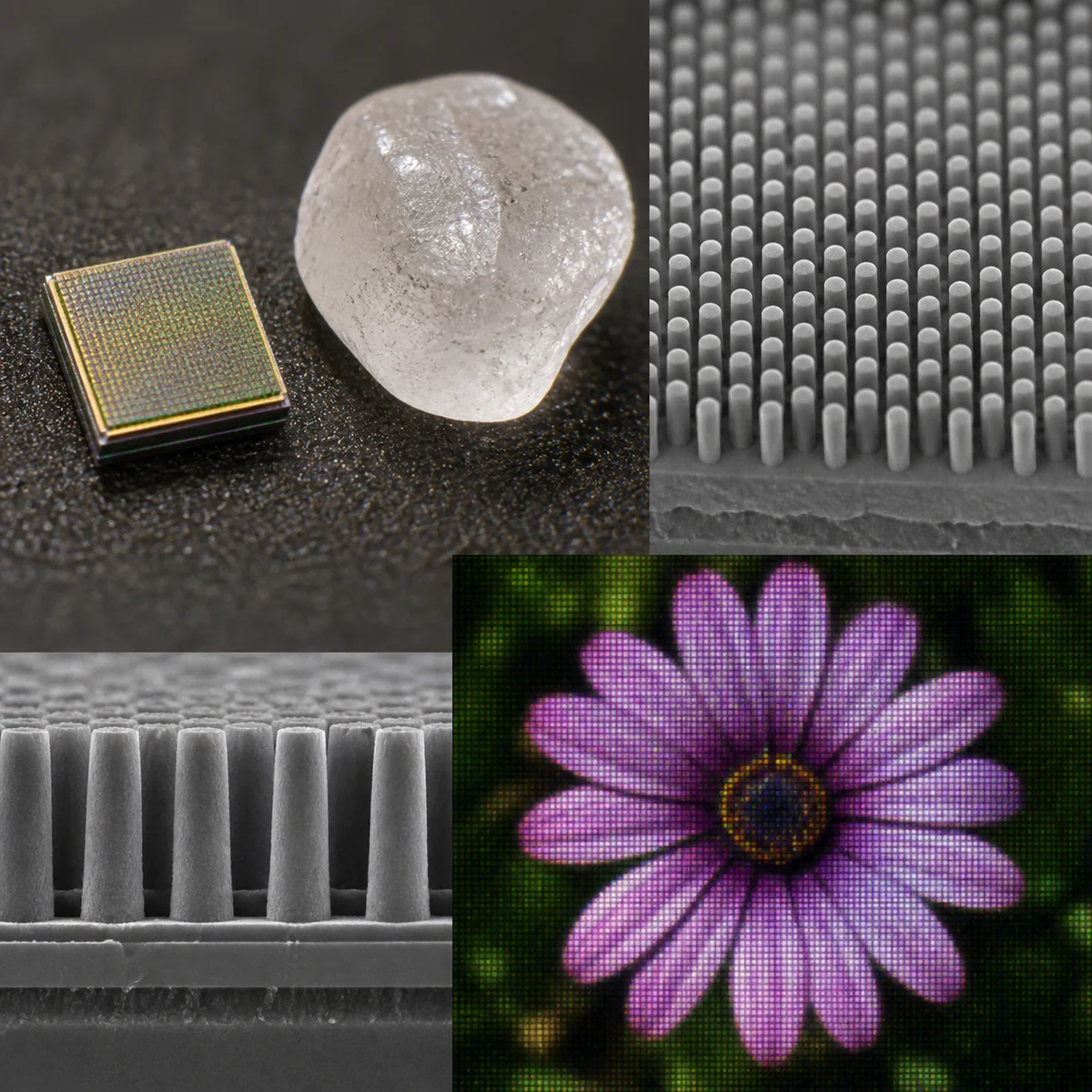
Princeton researchers built a full-color imaging system only half a millimeter wide—about the size of a coarse grain of salt. Instead of a conventional stack of glass lenses, it uses a metasurface patterned with 1.6 million cylindrical posts. Each nanoscale feature influences incoming light, and computational processing reconstructs the resulting information into an image.
Earlier miniature metasurface cameras struggled with blur, distortion, and narrow color performance. The team designed the optical surface and the reconstruction algorithm together. That pairing allowed the tiny device to produce a wide field of view and full-color images that were far more recognizable than the raw optical signal alone would suggest. The camera is therefore split between a physical surface and mathematical work performed after light reaches the sensor.
This remains a research prototype, not a salt-grain module ready to replace a phone camera. Packaging, sensors, processing, manufacturing, and performance across real conditions all matter outside the experiment. Still, the scale shift is remarkable. A traditional lens bends light through thickness. This system asks millions of tiny posts and an algorithm to organize it on an almost flat plane.
Sources