Share
Share







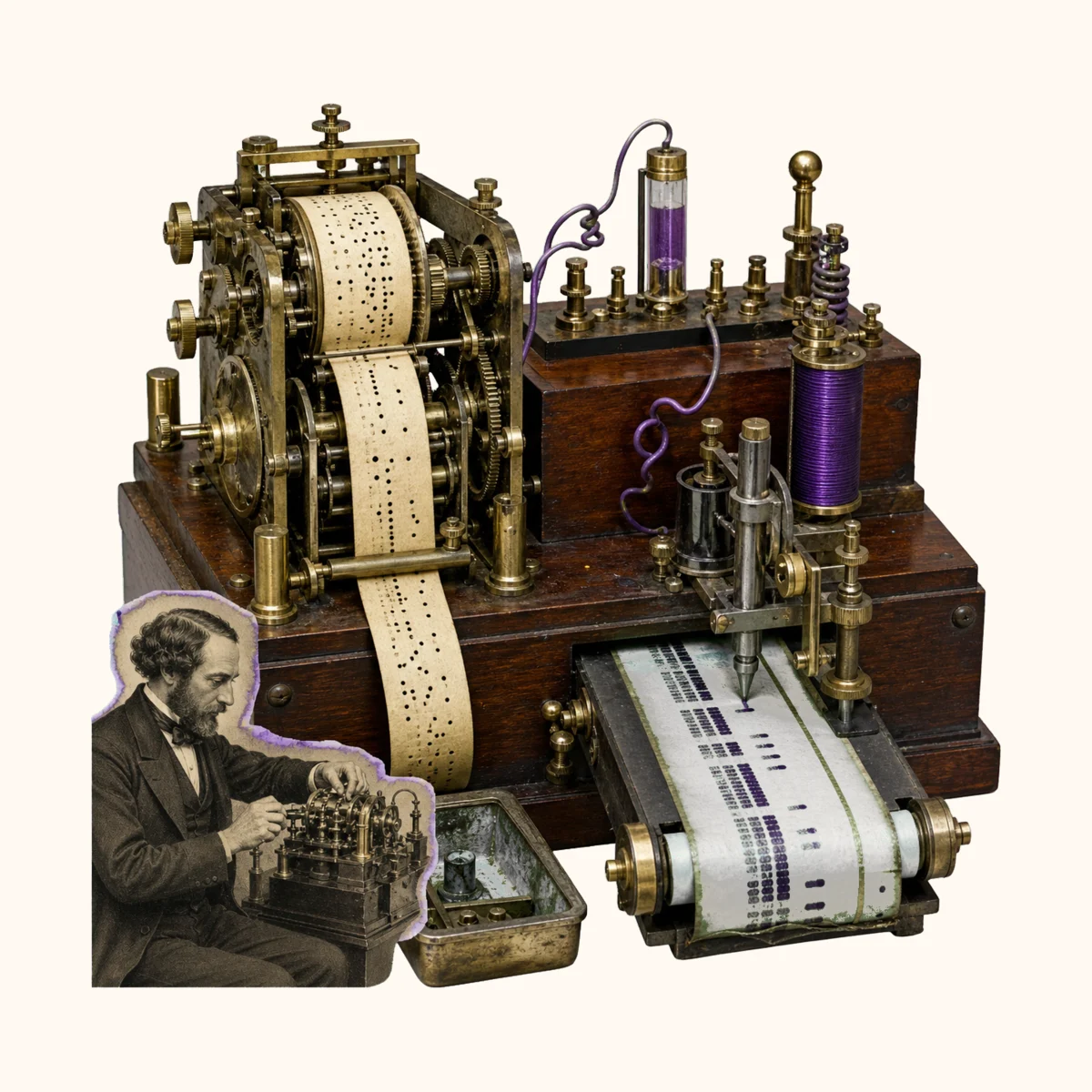
Alexander Bain's chemical telegraph did not receive a message by moving a needle or laying down ordinary ink. It made electricity leave visible marks on damp, chemically treated paper. An 1850 example preserved by the Science Museum Group shows how transmission and recording became a coordinated paper process.
First, a message was prepared as holes in a paper strip using a code similar to Morse. Clockwork pulled that strip through the transmitting instrument. When a spring mechanism encountered a perforation, it completed an electrical connection and sent a pulse along the line.
At the receiving end, another clockwork mechanism moved a roll of moistened, treated paper beneath a steel stylus connected to the wire. Each pulse caused the chemicals in the paper to change, leaving a mark. The arriving signal therefore became a coded trail on a wet ribbon without requiring an operator to watch a pointer and transcribe every movement as it happened.
The Electric Telegraph Company used the instrument for a time in place of a needle receiver. It did not permanently replace competing systems, but its operating sequence remains wonderfully physical: punch a message into dry paper, let clockwork turn absence into electrical contact, then ask electricity to stain a second strip that has been deliberately made wet enough to write on itself.